- Title
- Tiles
- Date Made
- second half of 16th century
- Medium
- Fritware, underglaze painted in red, blue, green and black
- Dimensions
- 8 x 19 in. (20.32 x 48.26 cm)
- Accession Number
- M.71.73.37a-b
- Curatorial Notes
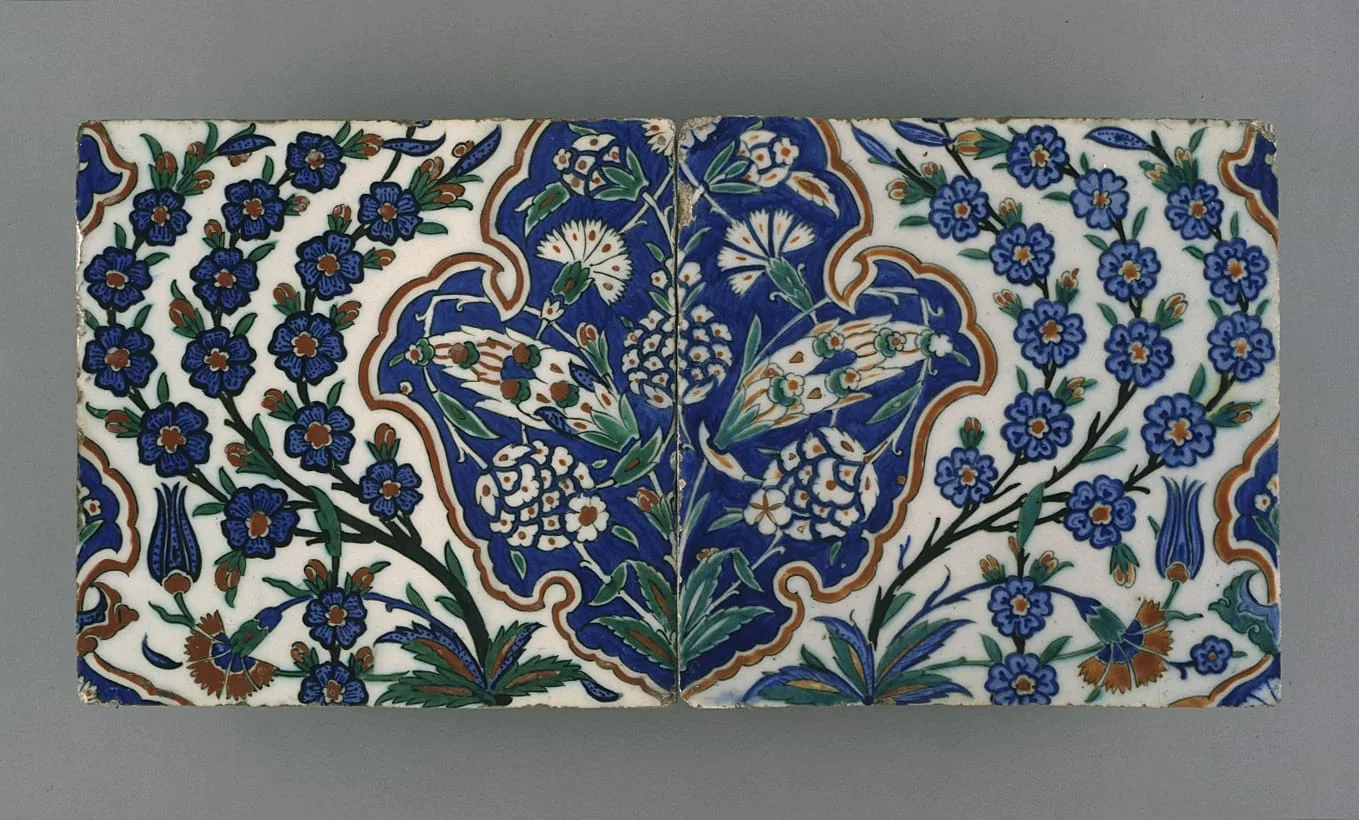
Ceramics made in Iznik, in western Turkey, represent one of the most renowned and influential arts of the Ottoman period. The Iznik kilns, about 85 miles southeast of the capital, Istanbul, produced both tableware and architectural revetment such as this. Tiles were first manufactured at Iznik around the early sixteenth century; however, production increased dramatically in the second half of the century as the court sponsored more and more new buildings.
Toward the mid-sixteenth century, the palette of Iznik wares expanded to include a brilliant red and a bright grass-green, as here. At about the same time that the Iznik palette reached its classic form, the focus of the ceramic industry shifted from tableware to tile work. This shift may have occurred as a result of the massive building projects undertaken by the court beginning in the 1550s during the reign of Süleyman the Magnificent (1520–66) and continuing under his immediate successors. These two tiles are associated with one such structure in Istanbul, the mosque and shrine of Abu Ayyub al-Ansari (Eyüp Sultan in Turkish), a companion of the Prophet Muhammad who died in an early attempt to conquer the city in the 670s. Multiple tiles of this type were brought together during the reconstruction of the mosque in 1798–1799, while others can be found in the mausoleum.
- Selected Bibliography
- Berg, Phil. Man Came This Way: Objects from the Phil Berg Collection. Los Angeles: Los Angeles County Museum of Art, 1971.