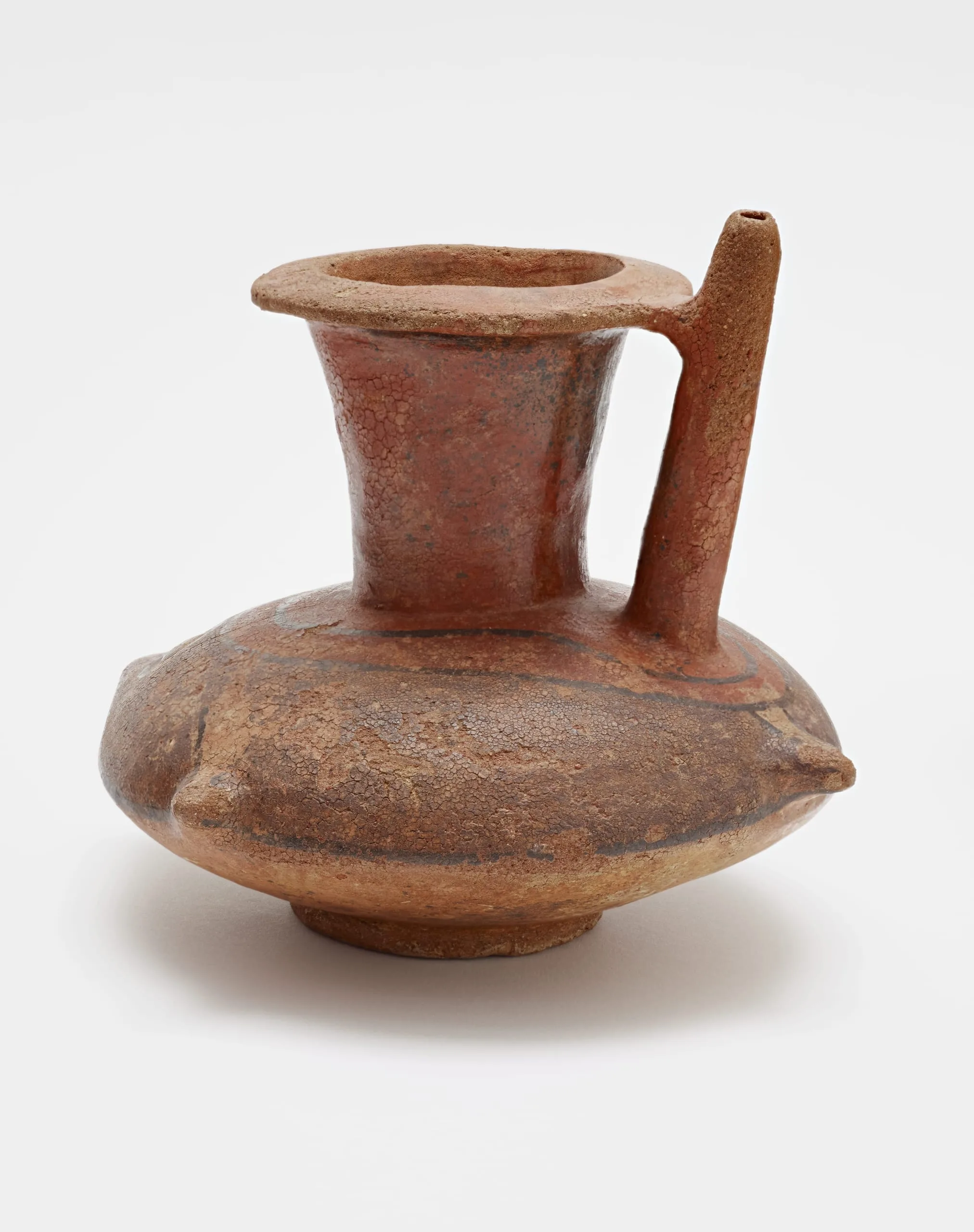
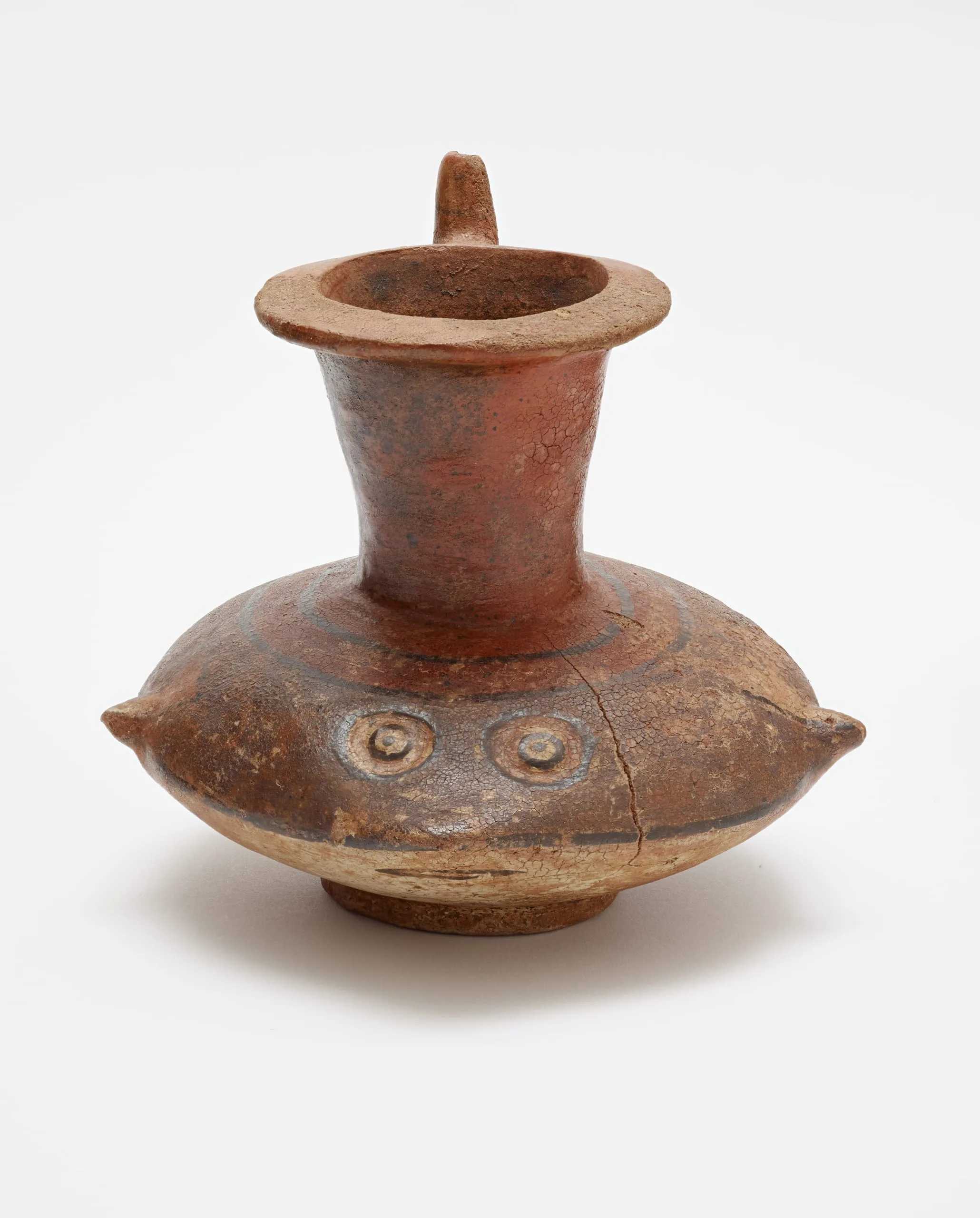
Stingrays are a common subject on ancient Panamanian ceramics, represented in both two- and three-dimensional forms. Here, the maker generated stingray characteristics with just a few minor adjustments to the base of a common double-spouted form: small nubbins hint at the diamond shape of the animal’s body, and the dark purple color on the top or back contrasts with the white belly, where the characteristically downturned mouth is rendered by both incising and black outlining (see also M.2016.348.29, L.2008.15.7, and L.2017.6.3).
In modern Guna (also Kuna) culture, images of stingrays reference the afterlife: when a fisherman dies, it is said that a manta ray transforms into a boat to take the fisherman to all the places he wanted to see when he was alive. Also, Guna people are wary of eating sea creatures considered to have a bad temperament, because biting or stinging fish like sharks or stingrays will pass their mood on to human beings. Understanding the symbolic richness and diversity of meaning for Indigenous Panamanians in their interactions with nonhuman entities is fundamental to our interpretation of ancient motifs. However, we must be cautious when using Guna cosmology to interpret ancient Panamanian ceramic designs. The Guna migrated to their current coastal home relatively recently. They originally lived in what is now northern Colombia and the Darién Province of Panama, moving to their San Blas Islands territories (Guna Yala) in the mid-1800s, and most of their mythology is based on animals, plants, and spirits of the forest.
2025
Selected Bibliography
Fortis, Paolo. Kuna Art and Shamanism: An Ethnographic Approach. University of Texas Press, 2012.