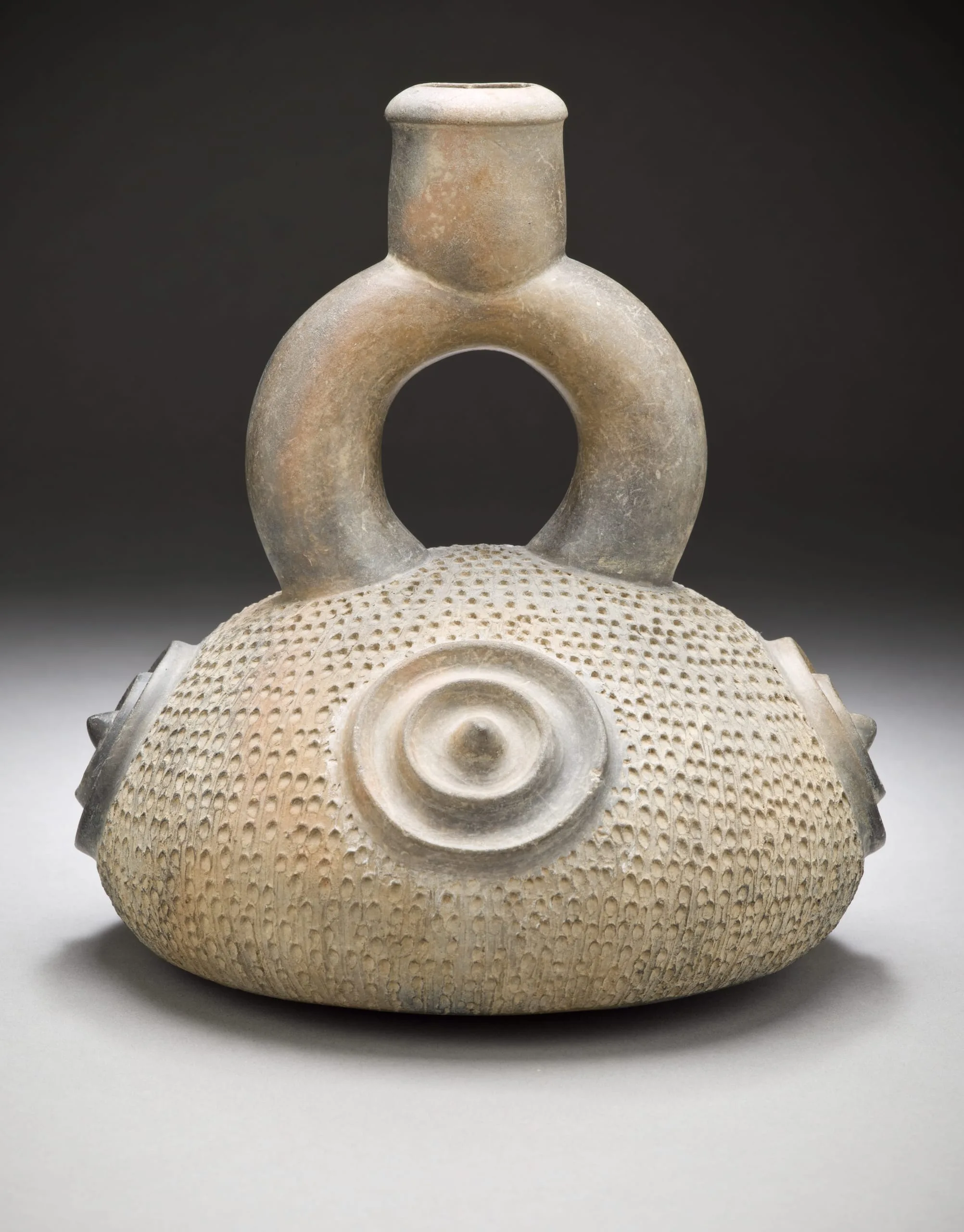
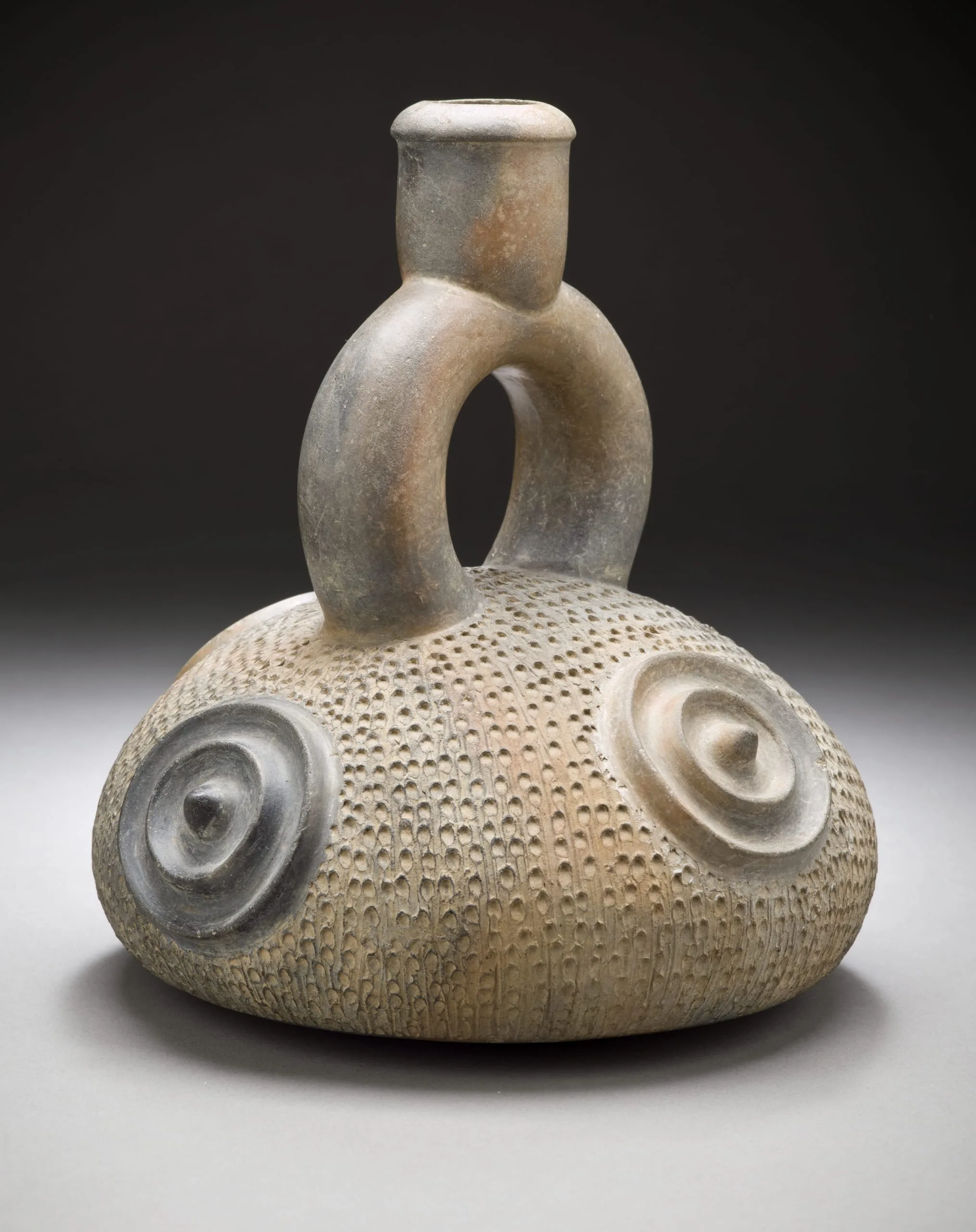
More than 2,000 years ago, a highly skilled ceramist hand-built this ornate stirrup-spout bottle (there was no potter’s wheel in pre-Hispanic South America). The squat, globular body is completely symmetrical, topped by an almost perfectly round handle with a wide spout. Most of the surface is matte and punctated, created by pushing a pointed tool in an upward direction. This decoration contrasts with four groups of smooth, polished, concentric circles appliquéd to the surface. The design’s meaning is unknown.
Two vessels with very similar stylistic characteristics—the same upward punctation contrasting with smooth areas, round handles, and wide spouts with beveled lips—were recovered in the 1940s from the Hacienda Chongoyape, hence the name for this style. It is sometimes considered a subset of the much broader Cupisnique ceramic and cultural complex. The vessels were found as offerings, possibly associated with a burial, together with a number of large gold artifacts, confirming that ceramics like these were considered objects of high value and status.
Selected Bibliography
Burtenshaw-Zumstein, Julia. “Cupisnique, Tembladera, Chongoyape, Chavín? A Typology of Ceramic Styles from Formative Period Northern Peru, 1800200 BC.” Doctoral thesis, University of East Anglia, 2014.
Lothrop, S. K. “Gold Ornaments of Chavín Style from Chongoyape, Peru.” American Antiquity 6, no. 3 (1941): 25062.