LACMA

ShopMembershipMyLACMATickets
LACMA
Los Angeles County Museum of Art
5905 Wilshire Blvd.
Los Angeles, CA 90036
info@lacma.org
(323) 857-6000
Sign up to receive emails
Subscribe
© Museum Associates 2026
  • About LACMA
  • Jobs
  • Building LACMA
  • Host An Event
  • Unframed
  • Press
  • FAQs
  • Log in to MyLACMA
  • Privacy Policy
© Museum Associates 2026
Collections

Tarporley Painter
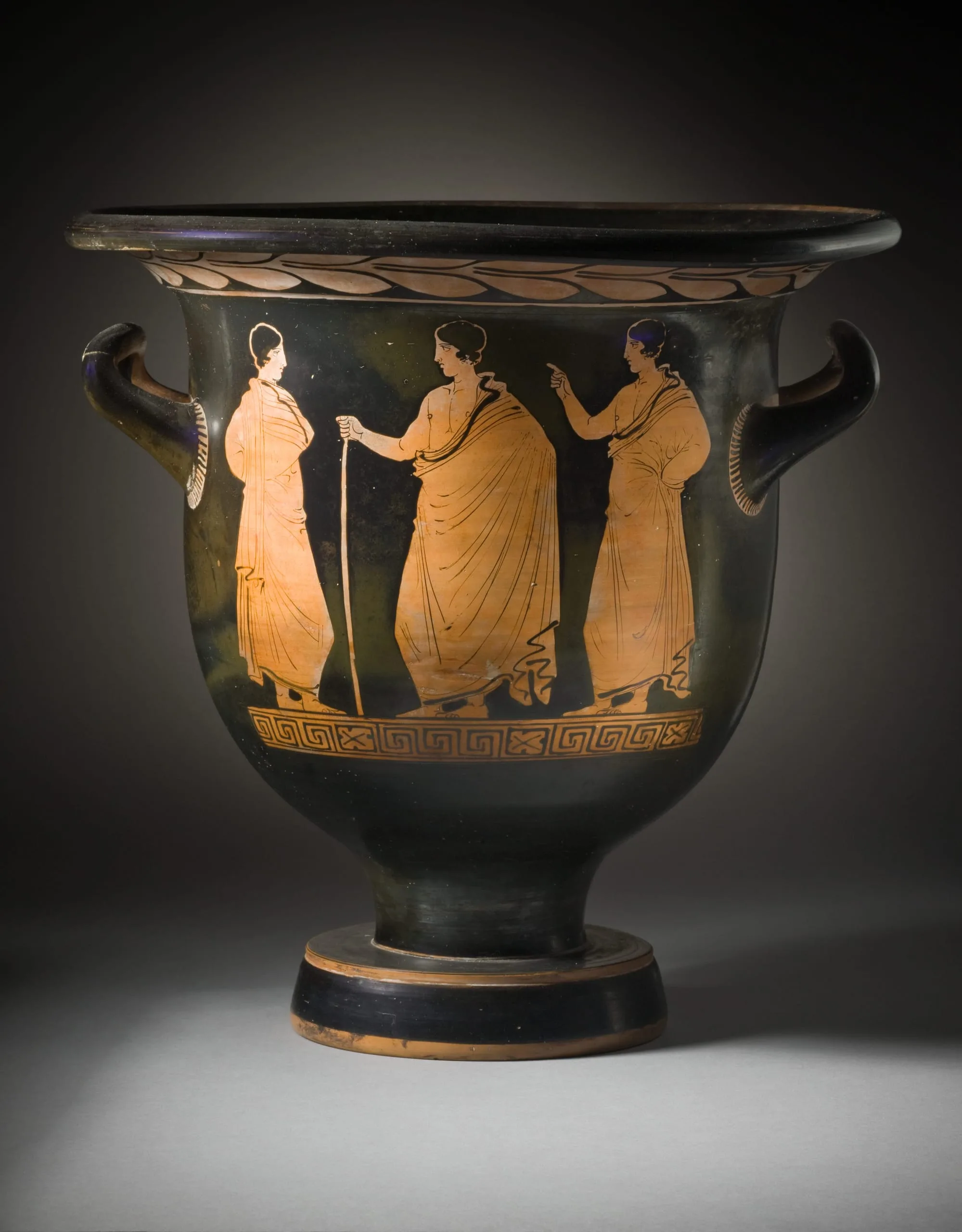
Bell-Krater with (A) a Maenad Crowning Young Dionysos, Watched by a Horned Youth (Pan?), and (B) Three Youthscirca 400 B.C.

On view:
Geffen Galleries, floor 1
Ancient Greek red-figure bell krater, wide-mouthed ceramic vessel with black glaze, decorated with three draped figures in terracotta and a meander band below

Tarporley Painter, Bell-Krater with (A) a Maenad Crowning Young Dionysos, Watched by a Horned Youth (Pan?), and (B) Three Youths, circa 400 B.C. (alternate view), Los Angeles County Museum of Art, William Randolph Hearst Collection, photo © Museum Associates/LACMA

Artist or Maker
Tarporley Painter
Title
Bell-Krater with (A) a Maenad Crowning Young Dionysos, Watched by a Horned Youth (Pan?), and (B) Three Youths
Place Made
South Italy
Date Made
circa 400 B.C.
Medium
Red-figure ceramic
Dimensions
Height: 14 3/4 in. (37.5 cm); Diameter: 14 5/8 in. (37.15 cm)
Credit Line
William Randolph Hearst Collection
Accession Number
50.8.29
Classification
Furnishings
Collecting Area
European Painting and Sculpture: Greek and Roman
Curatorial Notes

With its wide mouth and rounded body, this ceramic bell-krater from southern Italy (Apulia) was well-suited for mixing and serving diluted wine. Thematically, the scene on the front of the vessel echoes this purpose, depicting a maenad (female follower of Dionysos) crowning the young god of wine as a horned youth (typical male follower, similar to a satyr) looks on. Dionysos holds a stemless kantharos (cup) in his hand, further emphasizing the god’s connection to wine, as diluted wine could be ladled from the krater into a pitcher or a cup like the one depicted here. Each figure carries a thyrsos, a giant fennel stalk topped by a large pinecone, flowers, or ivy, an object typically associated with Dionysos and his followers that emphasizes the god’s association with nature and fertility.

The back side of the vessel depicts three young men, all clothed, conversing. These kinds of figures routinely appear on the reverse sides of many shapes of southern Italian vases. A band of laurel leaves runs continuously around the krater, while a band of three broken meanders alternated with dotted saltires (diagonal crosses) provides the groundline for the images. The krater is painted in the red-figure style, where slip (liquified clay) that turned black during firing was applied to the background and outlines of figures, while the figures themselves were left in the natural red-orange color of the clay.
Selected Bibliography
  • Levkoff, Mary L., ed. Hearst the collector. Exh. Cat. New York: Abrams and Los Angeles: Los Angeles County Museum of Art, 2008.
  • Clement, Paul A. "Geryon and Others in Los Angeles." Hesperia: The Journal of the American School of Classical Studies at Athens 24, no.1 (1955): 1-24.
  • Hope, Francis, and E.M.W. Tillyard. The Hope Vases: a Catalogue and a Discussion of the Hope Collection of Greek Vases. Cambridge: University Press, 1923.
  • Reinach, Salomon. Répertoire des Vases Peints Grecs et Étrusques. Paris: E. Leroux, 1922.