- Title
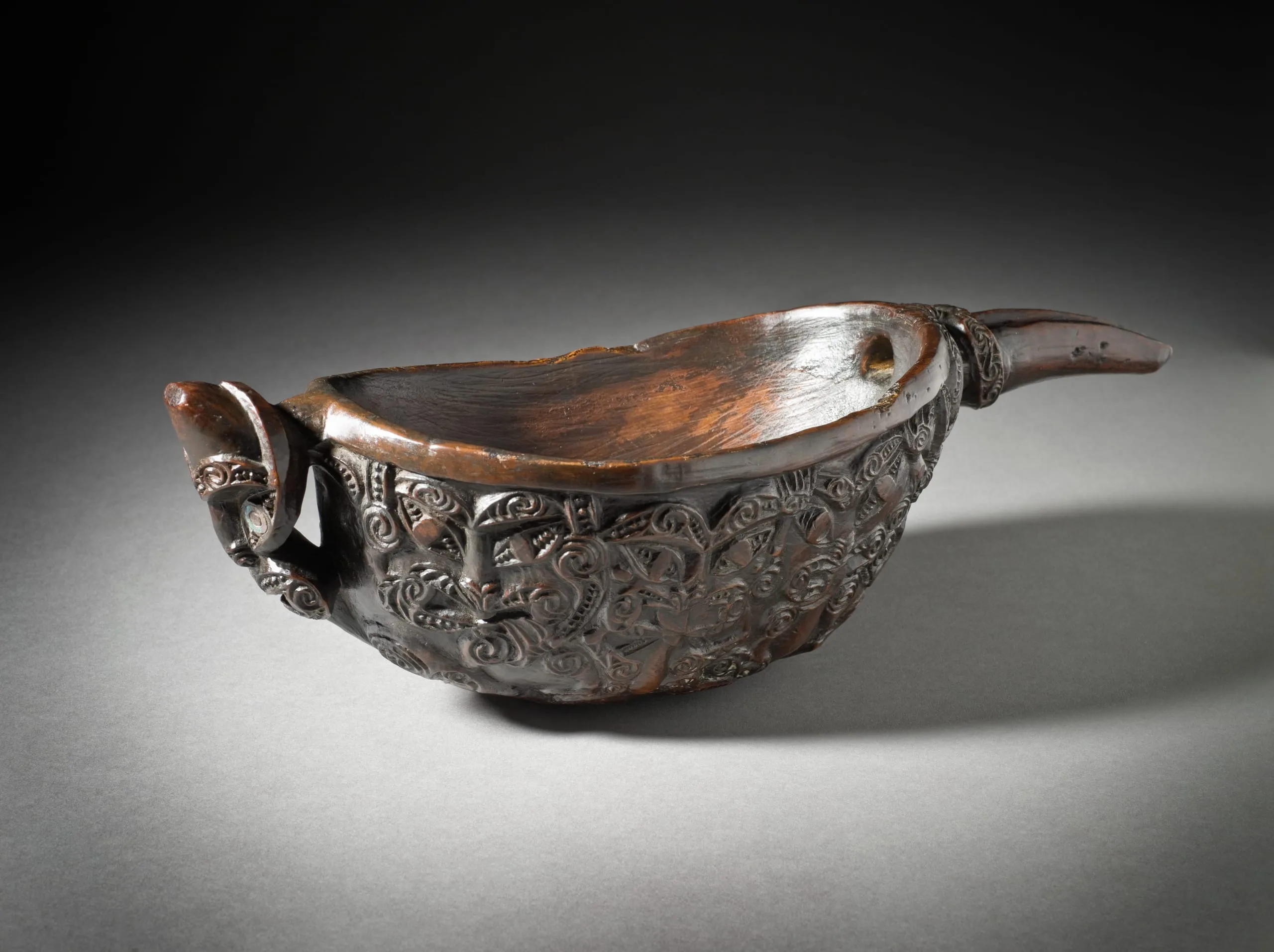
- Feeding Funnel (koropata)
- Culture
- Maori, Rongowhakaata or Te Aitanga a Mahaki tribes
- Date Made
- circa 1825
- Medium
- Wood and Haliotis shell
- Dimensions
- 4 1/4 x 14 1/2 x 5 1/2 in. (10.8 x 36.83 x 13.97 cm)
- Accession Number
- M.2008.66.24
- Collecting Area
- Art of the Pacific
- Curatorial Notes
Gallery Label
This unique carved Maori feeding funnel is not the typical conical shape of other funnels but rather a bowl shape with a troughlike spout. The entire surface is carved with asymmetrical designs. The feeding funnel’s function was to keep the moko, or liquid food that chiefs ate during facial tattooing, from touching their lips. The moko itself and the process of tattooing made it difficult to eat and chew during both the application and the healing process, so liquid food was necessary. The moko also was highly sacred, and it was believed that if food touched the lips or body during the application and healing process, the protective and mystical tapu (taboo) barrier was broken, and the mana (ancestral chiefly power) would be lost. The tattoo artist also was denied touching food and had to eat his food off of prepared sticks. The artists gained this tapu because of their close contact with the chiefs, the chiefly blood, and also through their ability to create and control mana in their craft.
The carved Maori feeding funnel is an interesting and unique cultural object in Maori chiefly society. The highly stratified status of chiefs and their associated mana was protected by rules of tapu, or the respect of that power. There was very little mobility among ranks; lower ranks could never gain the mana of the chiefs who were descended from divine lineage. The chiefly mana was said to be too great for those of lesser rank to come in contact with, and the chiefs were required to protect this mana through rituals such as tattooing and the use of this funnel.
- Selected Bibliography
- Wardwell, Allen. Island Ancestors: Oceanic Art from the Masco Collection. [Seattle]: University of Washington Press, 1994.
- Harding, Julian. "Pacific Treasures: the Masco Collection Goes to Los Angeles." Tribal Art no.50 (2008): 68-73.