LACMA

ShopMembershipMyLACMATickets
LACMA
Los Angeles County Museum of Art
5905 Wilshire Blvd.
Los Angeles, CA 90036
info@lacma.org
(323) 857-6000
Sign up to receive emails
Subscribe
© Museum Associates 2025

Museum Hours

Monday

11 am–6 pm

Tuesday

11 am–6 pm

Wednesday

Closed

Thursday

11 am–6 pm

Friday

11 am–8 pm

Saturday

10 am–7 pm

Sunday

10 am–7 pm


  • About LACMA
  • Jobs
  • Building LACMA
  • Host An Event
  • Unframed
  • Press
  • FAQs
  • Log in to MyLACMA
  • Privacy Policy
© Museum Associates 2025
Collections

Clubcirca 1840

Not on view
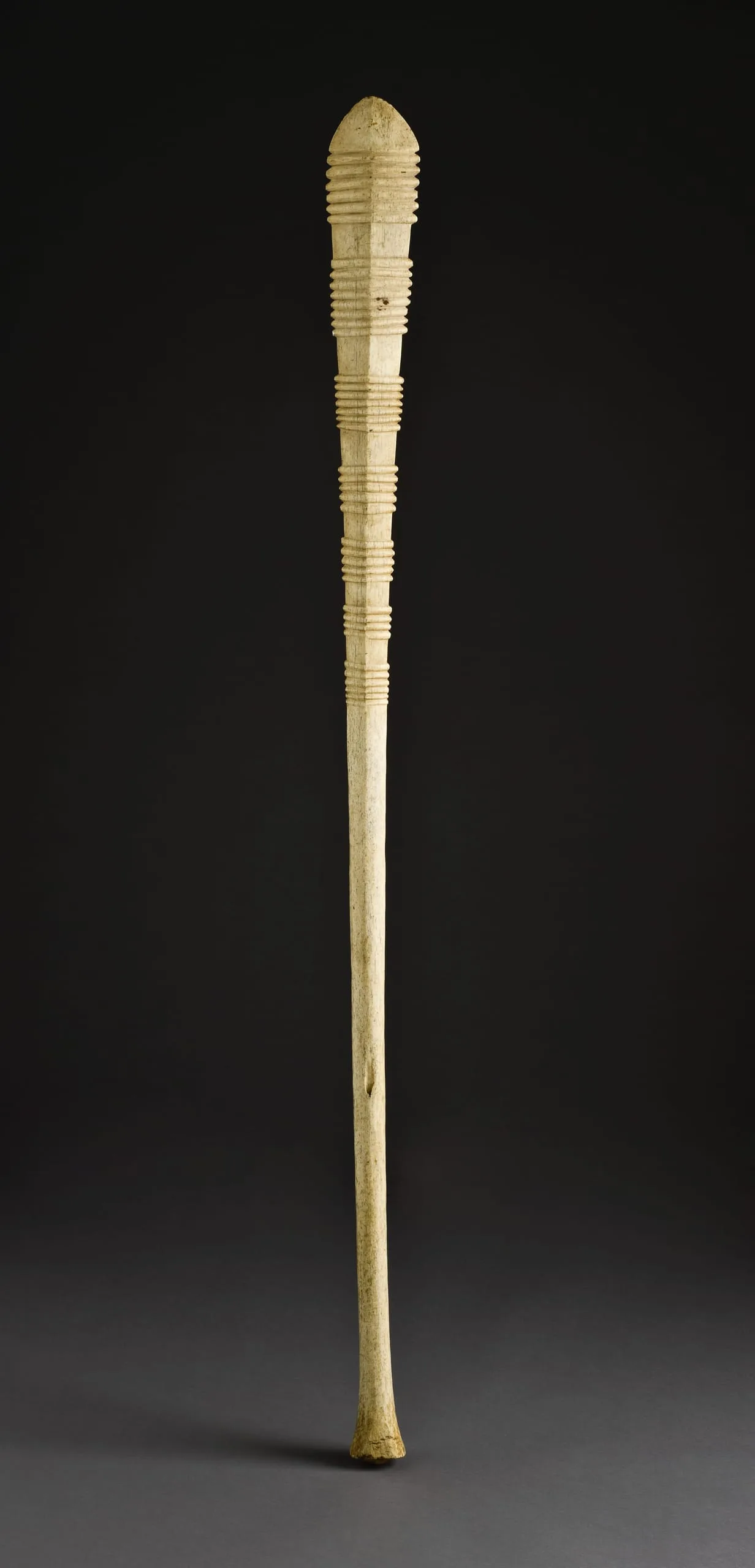
Carved bone or ivory rod with a bullet-shaped, ribbed top, tapering to a narrow shaft and a flared base, shown vertically against a dark background
Title
Club
Place Made
Tonga
Date Made
circa 1840
Medium
Whalebone
Dimensions
1 1/2 x 53 1/2 x 4 1/4 in. (3.81 x 135.89 x 10.8 cm)
Credit Line
Purchased with funds provided by the Eli and Edythe Broad Foundation with additional funding by Jane and Terry Semel, the David Bohnett Foundation, Camilla Chandler Frost, Gayle and Edward P. Roski, and The Ahmanson Foundation
Accession Number
M.2008.66.19
Classification
Arms and Armor
Collecting Area
Art of the Pacific
Curatorial Notes

Gallery Label
Tongans were known as capable warriors, and substantial attention was given to the creation of weapons. Though less prone to warfare among their own islands, they often served as mercenaries in Fiji and Samoa. Because of this close contact, Tongan-style clubs were found on Fiji and Samoa and became one of the objects made by Tongan craftsmen that were adapted to use outside of Tonga. This was particularly true in Fiji, where many Tongan craftsmen and warriors settled. The club’s use died out after the introduction of Christianity.

Though clubs were used in warfare as protective and aggressive weapons, it’s likely that this club was viewed primarily as a symbol of the chief’s power, status, and sacred abilities. Some clubs are smooth with intricate pearl shell inlay for ceremonial use; others have intricate geometric patterns for both ceremonial and utilitarian use. Both types are usually carved with sharp shark’s teeth. This particular club is unique in its surface decoration, the simplicity of its carvings, and its material, whalebone rather than wood. It has a simple horizontal series of ridges in a band rather than more intricate designs. The uncommon use of whalebone for this club indicates that it may have been crafted strictly for ceremonial use or as a display of power.


Selected Bibliography
  • Wardwell, Allen. Island Ancestors: Oceanic Art from the Masco Collection. [Seattle]: University of Washington Press, 1994.