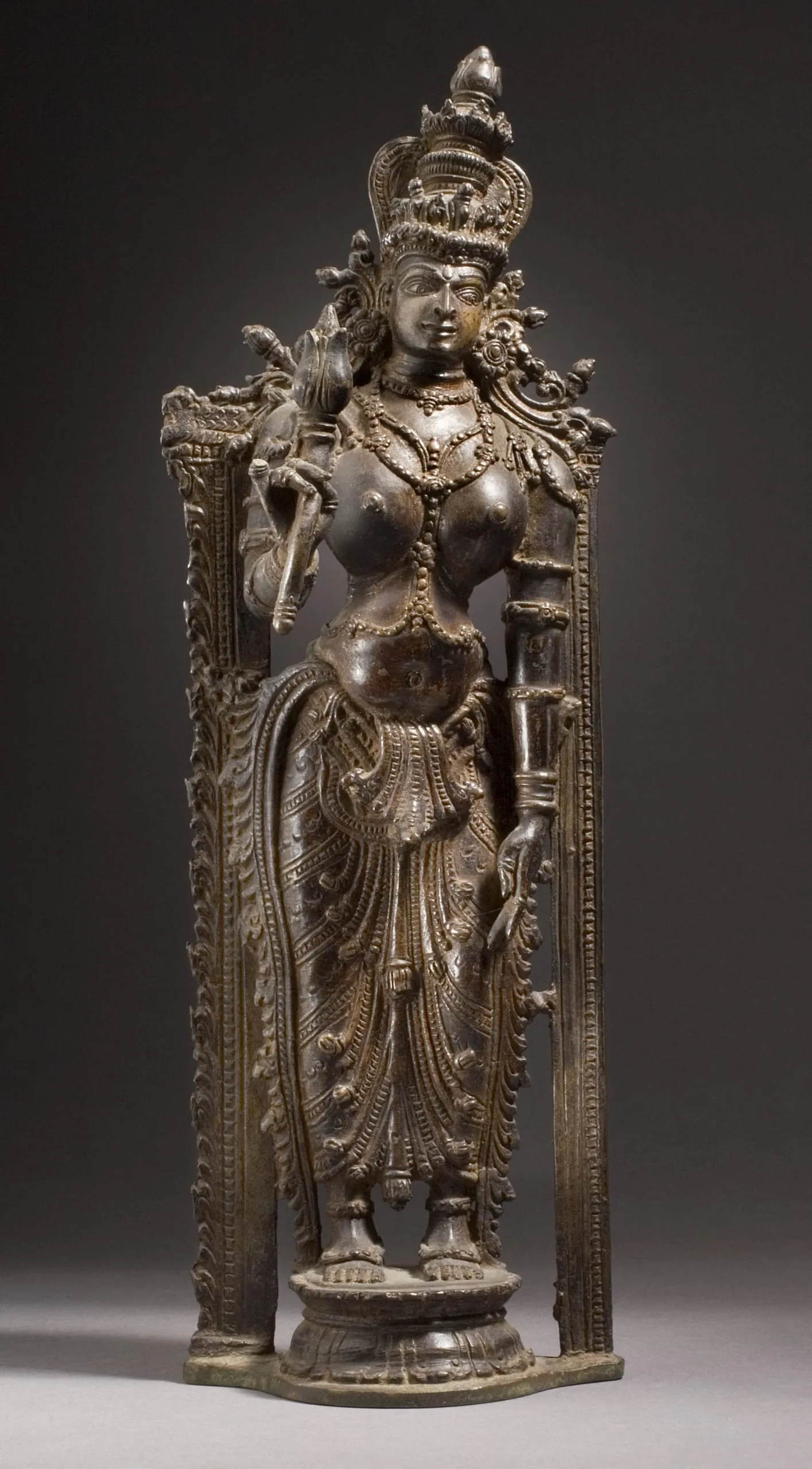
This exceptional copper alloy (bronze) sculpture from the modern Indian state of Kerala represents the Hindu goddess Shri Lakshmi, the consort of the god Vishnu. The two-armed goddess stands on a lotus pedestal within a mandorla that extends to her shoulder height. Lakshmi wears a tall crown with a lotus bud finial, splayed cascading locks adorned with floral terminals, and a small nimbus shaped like a pipal leaf or heart. She is profusely adorned with jewelry and wears a striped skirt with cascading pleats and a flaring sash. Her physiognomy includes large open eyes with carefully delineated eyelids and eyebrows, an aquiline nose, pointed chin, closed lips with a slight smile, and a devotional marking on her forehead. She carries an attribute with a lotus bud in her right hand. The image was once part of a triad, likely formed with Vishnu and another of his wives. This is indicated by several iconographic clues: the slight tilt of the goddess’ head and vertical axis towards the now-missing central figure of Vishnu, her eyes gazing to the left towards Vishnu, and the empty socket on the back of the sculpture into which the tang of a separately cast halo (prabhamandala) that united the three images. As postulated by Mary Beth Coffman Heston (Archives of Asian Art, 2004), the sculpted and painted figural types of Kerala demonstrate a hyperextension of the lower back and full breasts thrust forward that replicate the distinctive physique of Kerala’s Kathakali dance performers.