LACMA

ShopMembershipMyLACMATickets
LACMA
Los Angeles County Museum of Art
5905 Wilshire Blvd.
Los Angeles, CA 90036
info@lacma.org
(323) 857-6000
Sign up to receive emails
Subscribe
© Museum Associates 2025

Museum Hours

Monday

11 am–6 pm

Tuesday

11 am–6 pm

Wednesday

Closed

Thursday

11 am–6 pm

Friday

11 am–8 pm

Saturday

10 am–7 pm

Sunday

10 am–7 pm


  • About LACMA
  • Jobs
  • Building LACMA
  • Host An Event
  • Unframed
  • Press
  • FAQs
  • Log in to MyLACMA
  • Privacy Policy
© Museum Associates 2025
Collections

Unknown
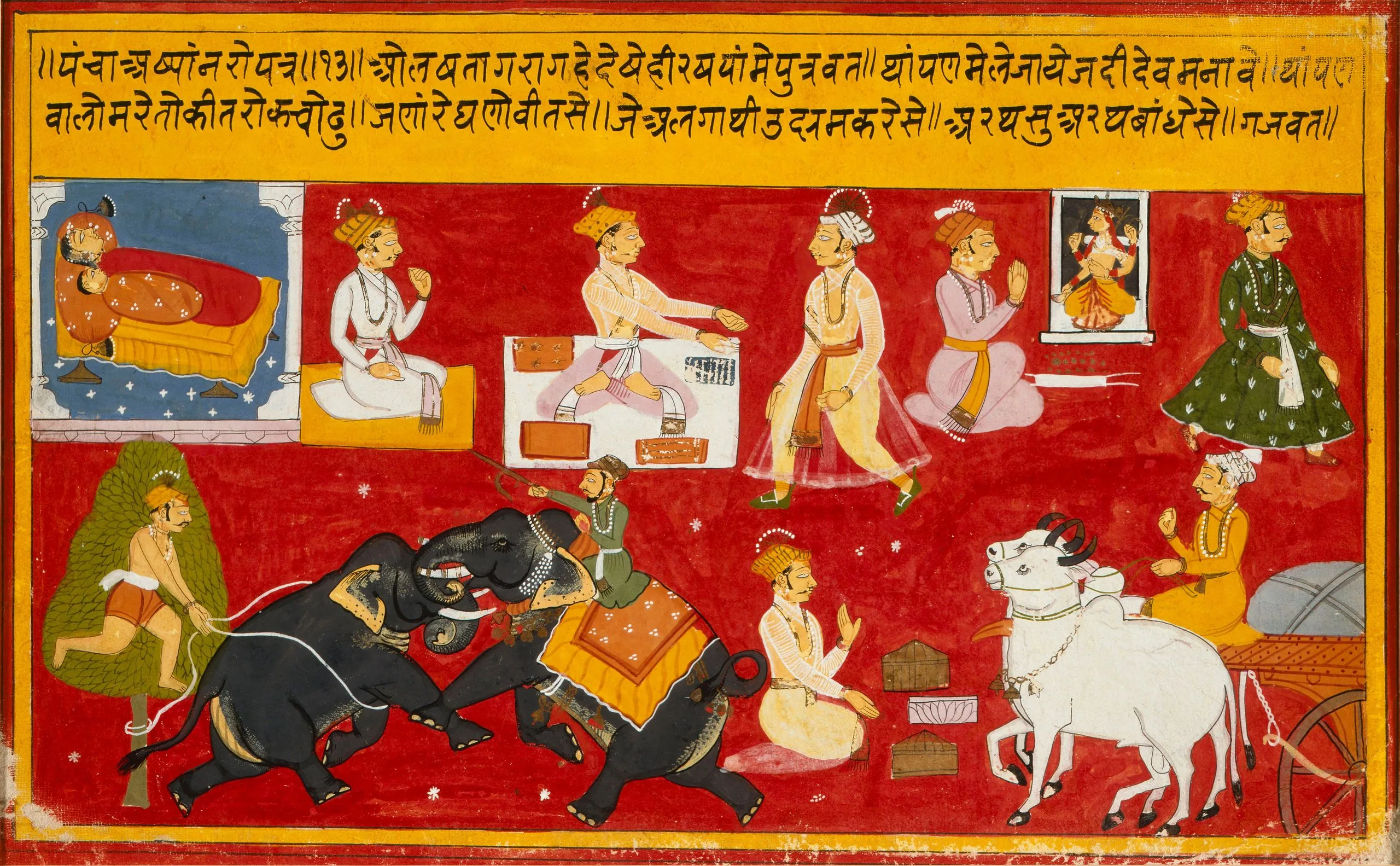
Folio from a Panchakhyana (Jain Recension of the Panchatantra)circa 1725

Not on view
South Asian manuscript painting with crimson ground, depicting multiple narrative scenes with pale-skinned figures, two black elephants, a white ox-cart, and Sanskrit text above
Artist or Maker
Unknown
Title
Folio from a Panchakhyana (Jain Recension of the Panchatantra)
Culture
South Asia
Place Made
India, Rajasthan, Mewar
Date Made
circa 1725
Medium
Opaque watercolor, gold, and ink on paper
Dimensions
Image: 9 1/4 x 15 1/4 in. (23.5 x 38.74 cm); Framed: 19 1/2 x 23 7/16 in. (49.53 x 59.53 cm)
Credit Line
Gift of the Joseph B. and Ann S. Koepfli Trust in honor of Dr. Pratapaditya Pal
Accession Number
M.2011.156.2
Classification
Drawings
Collecting Area
South and Southeast Asian Art
Curatorial Notes
This painting is folio no. 13 from a dispersed series of the Panchakhyana (a Jain recension of the Panchatantra). The Panchatantra (Five Treatises) is an ancient compendium of interwoven allegorical and moralistic fables, many involving anthropomorphized animals with human virtues and vices. The original Sanskrit text is indecisively ascribed to Vishnu Sharma and likely dates from 300-200 BCE, but the animal tales are presumably incorporated from a much earlier oral folklore tradition. The Panchatantra tales form one of the bases of Aesop’s Fables and numerous other renditions of the animal stories in myriad languages worldwide. The Panchakhyana, the Jain recension of the Panchatantra edited by the Jain monk Purnabhadra in 1199 CE, was particularly popular in western and central India. Here, although the descriptive text in the header has yet to be translated, the story appears to illustrate in what is likely continuous narration a merchant engaged in various commercial activities, a sleeping mother and child, an offering being made to an image of the goddess Durga, and an elephant battle. See also M.90.160.2.