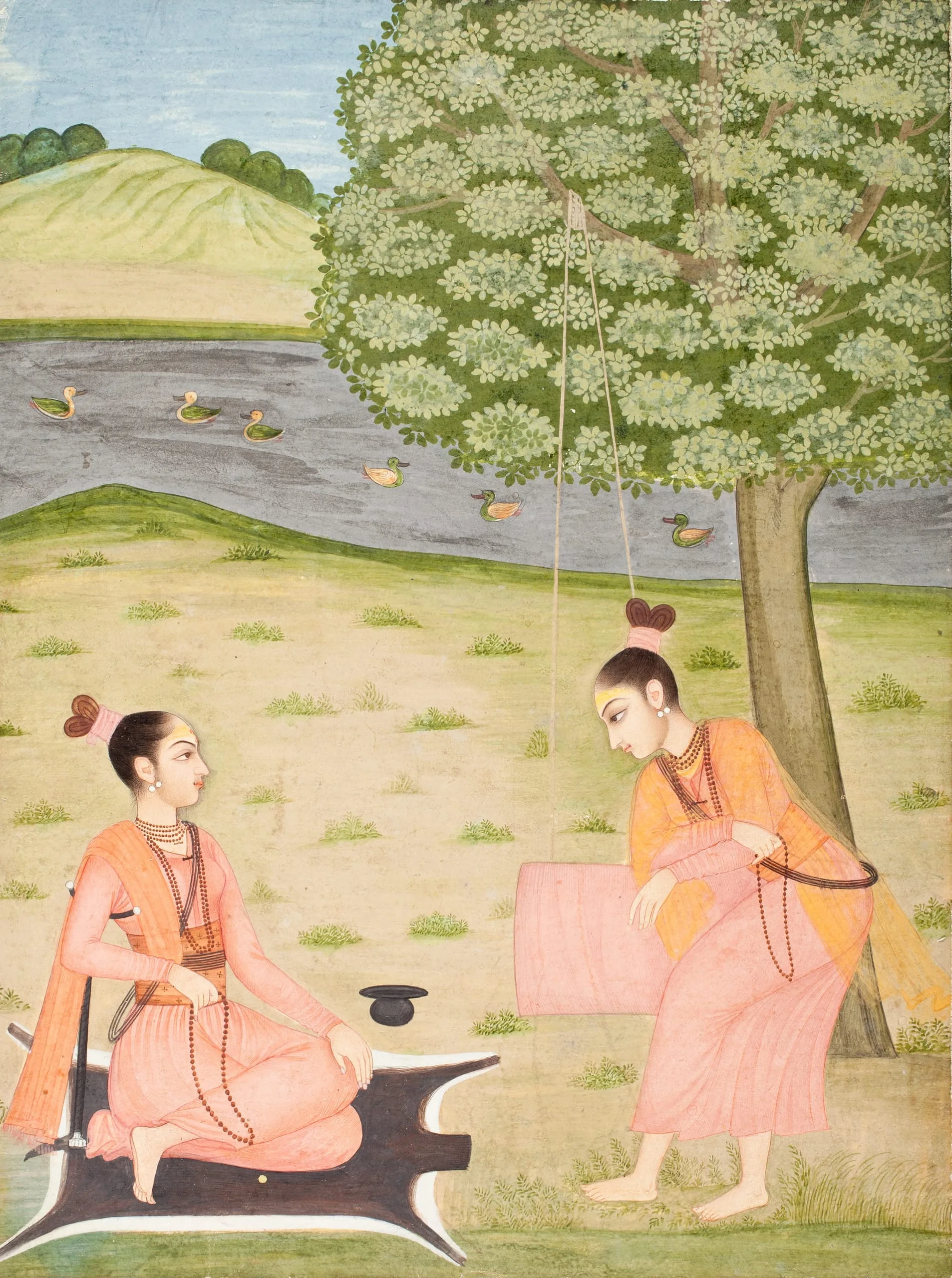
Female ascetics (yoginis) are adept in yogic and tantric practices, which have been performed in South Asia for millennia. Hindu yoginis are often theologically affiliated with Parvati, Durga, or other goddesses in the Shaiva sect associated with the god Shiva. Many Hindu yoginis are practitioners of Nath Yoga, which was founded around the 11th century and particularly prevalent in northern and western India and in the Deccan. Painted and sculpted images of ascetics (yogis and yoginis) were common as both primary and ancillary subjects, especially in representations of courtly supplicants seeking their guidance or blessings (see M.72.88.2, M.76.149.1, M.81.271.10, M.87.20.2 recto, M.90.141.3 recto, and AC1997.30.1).
Here, two yoginis are portrayed in a field beside a river. Each has her hair pulled up in a top knot and wears pinkish and orange garments, bead necklaces, pearl earrings, and a sacred thread across her shoulders. Both have Shaiva sectarian markings across their foreheads and carry a bead rosary. One yogini sits on an animal skin rug with her arm supported by an ascetic’s crutch. A metal basin used for ablutions is beside her. Her companion unusually stands with her arm resting on a rope swing hanging from a tree.
According to a rubber stamp impression on the verso, the painting was formerly in the collection of Dr W.B. Manley (1885-1972), who served in the Indian Police in the Bombay Presidency from 1905-1924 and as an officer in the Bengal Lancers from 1917-1919.