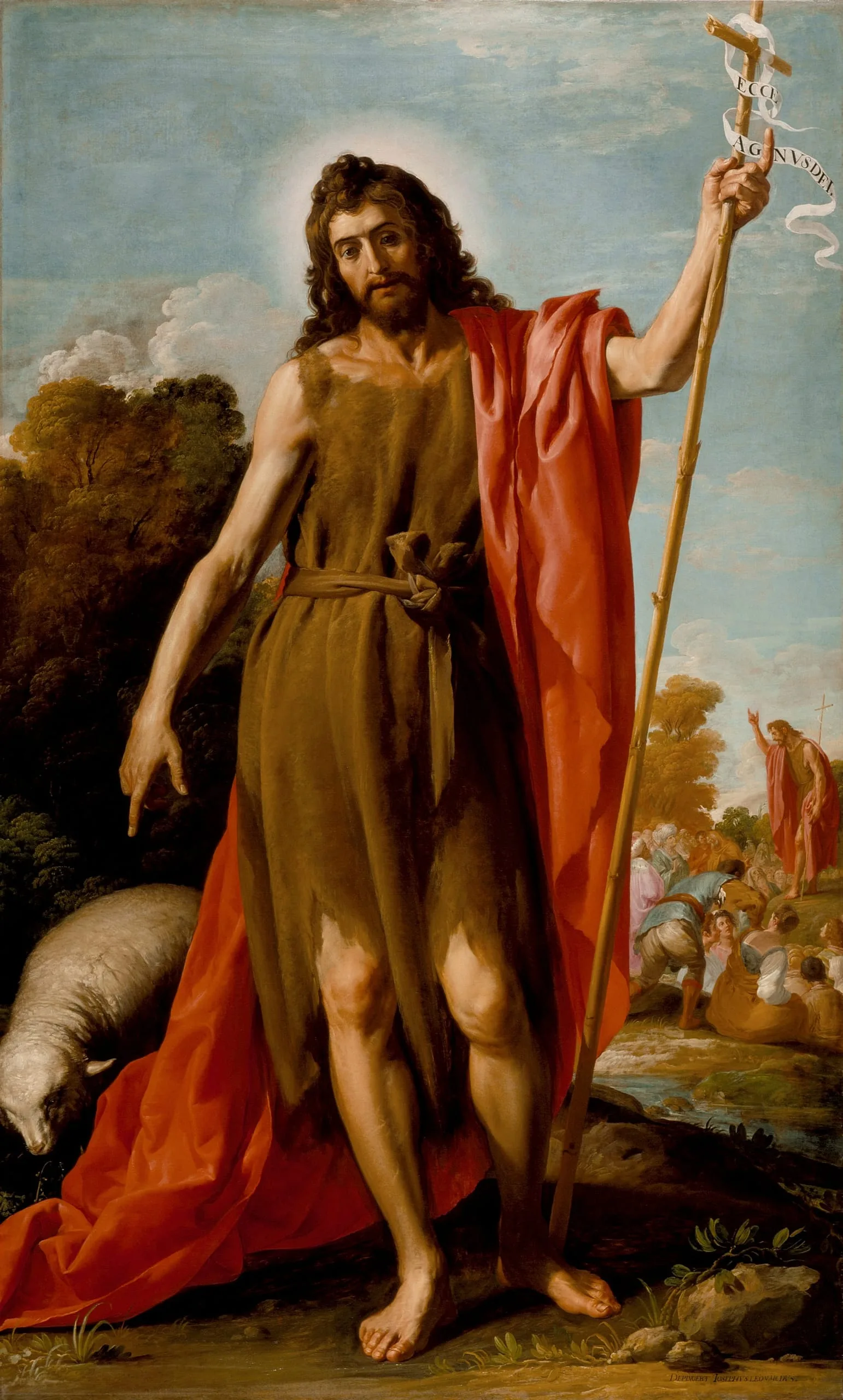
In this work, the seventeenth-century Spanish painter Jusepe (José) Leonardo depicts Saint John the Baptist in both symbolic isolation and in active ministry. The saint is shown full length in the foreground, wearing his traditional camel-hair garment and an orange drapery. He holds a reed cross in his left hand, entangled at top with a banner inscribed Ecce Agnus Dei (“Behold the Lamb of God”). With his right hand, he gestures toward a lamb at his side, a clear reference to Christ’s sacrificial destiny. John appears again in the background, addressing a gathering in the wilderness of Judaea. Several figures are on horseback, and others wear turbans, a form of exoticized dress commonly used in European painting to suggest distant lands. A winding stream, trees, and a cloud-filled sky provide the natural setting for the scene. The canvas is signed in the lower right corner: DEPINGEBAT IOSEPHUS LEONARDUS (“Joseph Leonard painted [this]”).
Leonardo was born in Calatayud in 1601 and trained in Madrid under Pedro de las Cuevas, whose studio produced several leading painters of the seventeenth century. In 1634, as a court painter to King Philip IV, he participated in the decoration of the Hall of Realms (Salón de Reinos) in the Buen Retiro Palace, alongside Diego Velázquez, Francisco de Zurbarán, and other prominent court artists. The following year he contributed to a series of portraits of Spain’s monarchs for the palace’s Banquet Hall. His style combines the rich colors of Venetian painting and the dramatic realism associated with Jusepe de Ribera. Although his career was curtailed by illness, ending with his death in Zaragoza in 1652, his surviving works reflect both the ambitions of court painting and the devotional sensibilities of the Spanish Counter-Reformation. A similar painting of Saint John the Baptist by Leonardo is preserved in the National Gallery of Canada.
The painting has a distinguished provenance. It corresponds to the long-lost canvas that entered the collection of King Louis-Philippe at the Louvre in 1838 and remained on view there until 1848. It was purchased by LACMA with funds provided by William Randolph Hearst in 1947.