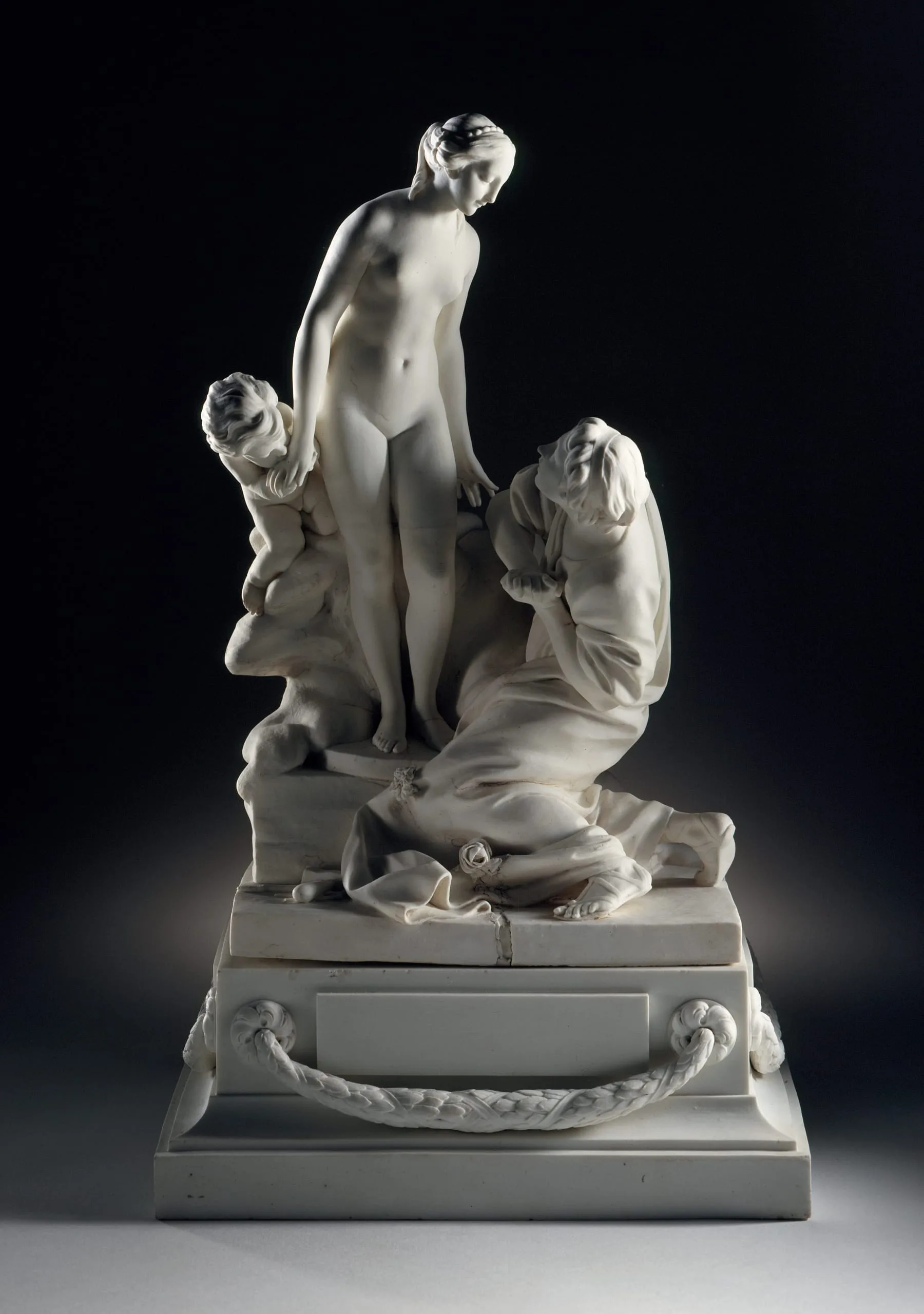
This porcelain group depicting Pygmalion and Galatea, widely acknowledged as one of the finest ever produced at Sèvres, is based on a marble by Étienne-Maurice Falconet with the addition of an extra cupid at the back. Falconet’s marble group was exhibited at the Salon of 1763. The sculptor made several copies of Pygmalion and Galatea; surviving examples are held at the Louvre in Paris and the Walters Art Gallery in Baltimore. Recorded in Ovid’s Metamorphoses, the myth of Pygmalion and Galatea remained popular in eighteenth-century Europe and was often used as a metaphor for artists’ abilities to animate inert material. Pygmalion, a Cypriot sculptor, fell in love with his own carving of an alabaster figure of a woman. At a feast dedicated to Aphrodite, he begged the goddess to grant him a woman in the image of the figure, and upon returning home, he discovered that the statue had come to life. The couple married and had a daughter, Paphos.
Plaster and clay prototypes are preserved in the Archives de la Manufacture de Sèvres as models for the two sizes in which Sèvres produced this sculpture. Because Sèvres was experimenting with materials and firing technique, the work shows a prominent firing crack at the center of the base. As with other pieces from this period, Sèvres placed flowers along the seam to conceal or distract from the flaw. The base is marked with a “B” for the modeler Jean-Charles-Nicolas Brachard.
Cynthia Kok
2025