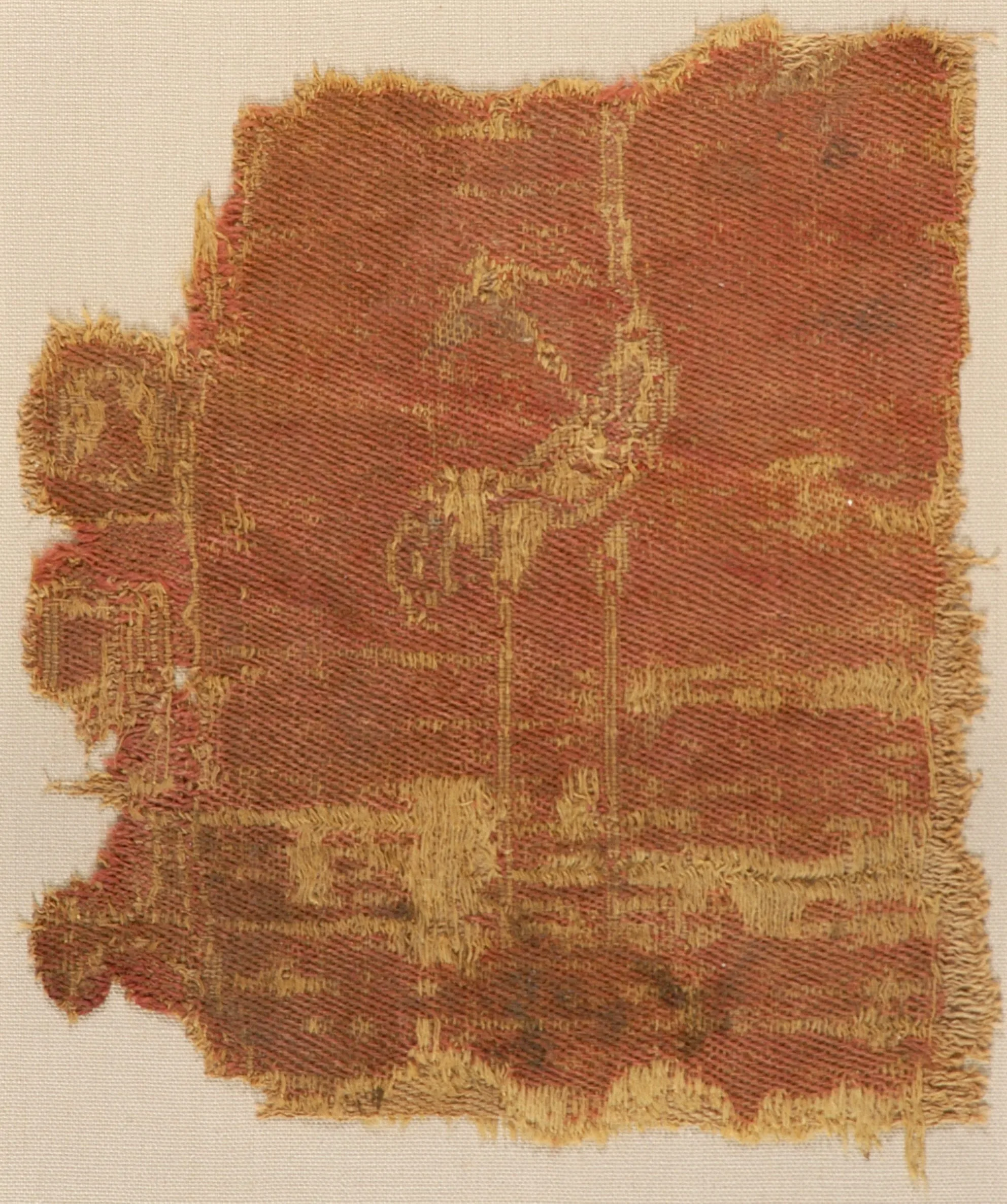
- Title
- Textile Fragment
- Date Made
- 7th-8th century
- Medium
- Wool and cotton weft-faced compound twill (samite)
- Dimensions
- 8 1/2 x 7 in. (21.59 x 17.78 cm); Mount: 13 x 10 1/2 in. (33.02 x 26.67 cm)
- Accession Number
- M.2002.1.686
- Curatorial Notes
Animals were an especially popular motif in late Sasanian (224−651) and early Islamic textiles, and included actual creatures, such as pheasants (see M.2007.32.2) and rams, as well as mythical beasts, such as the senmurv (for a related example in metalwork, see M.76.174.8). With its long neck and legs, the bird depicted here is possibly a crane or heron, which would have been repeated across the surface of the complete textile. The fabric’s compound structure and wool and cotton materials contribute to its strength, suggesting it was used for hardier-wear situations, such as a cushion cover or wall hanging. Like many textiles from this period, however, it only survives as a fragment because it was likely constantly reused over a long period of time and may have been cut down further once it entered the art market.
2025