- Title
- Two Bottles
- Date Made
- early 18th century
- Medium
- Cobalt blue glass mold-blown with gilding
- Dimensions
- a) 2 5/16 x 1 5/16 x 1 5/16 in. (5.87 x 3.33 x 3.33 cm); b) 2 3/8 x 1 5/16 x 1 5/16 in. (6.03 x 3.33 x 3.33 cm)
- Accession Number
- M.2002.1.488a-b
- Curatorial Notes
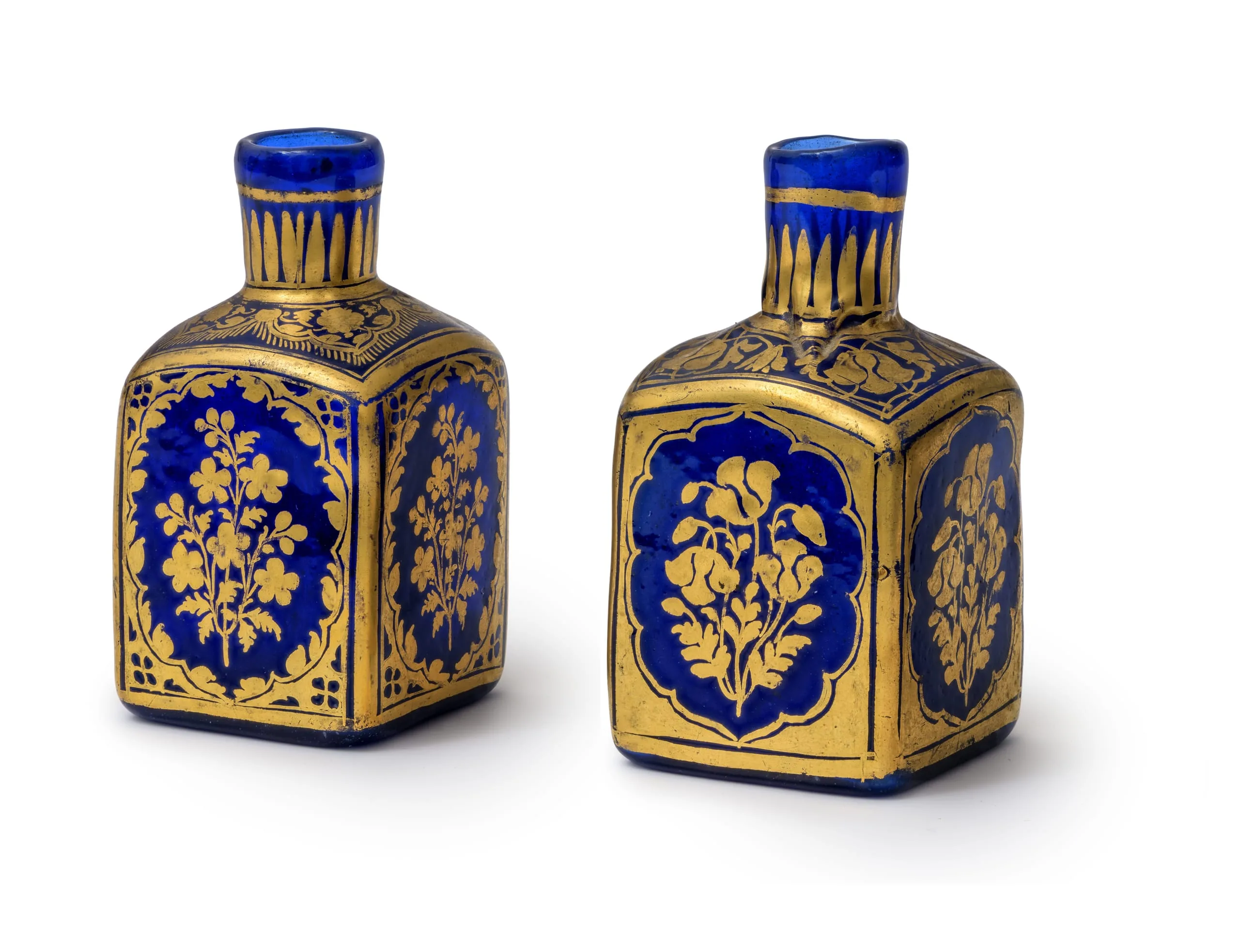
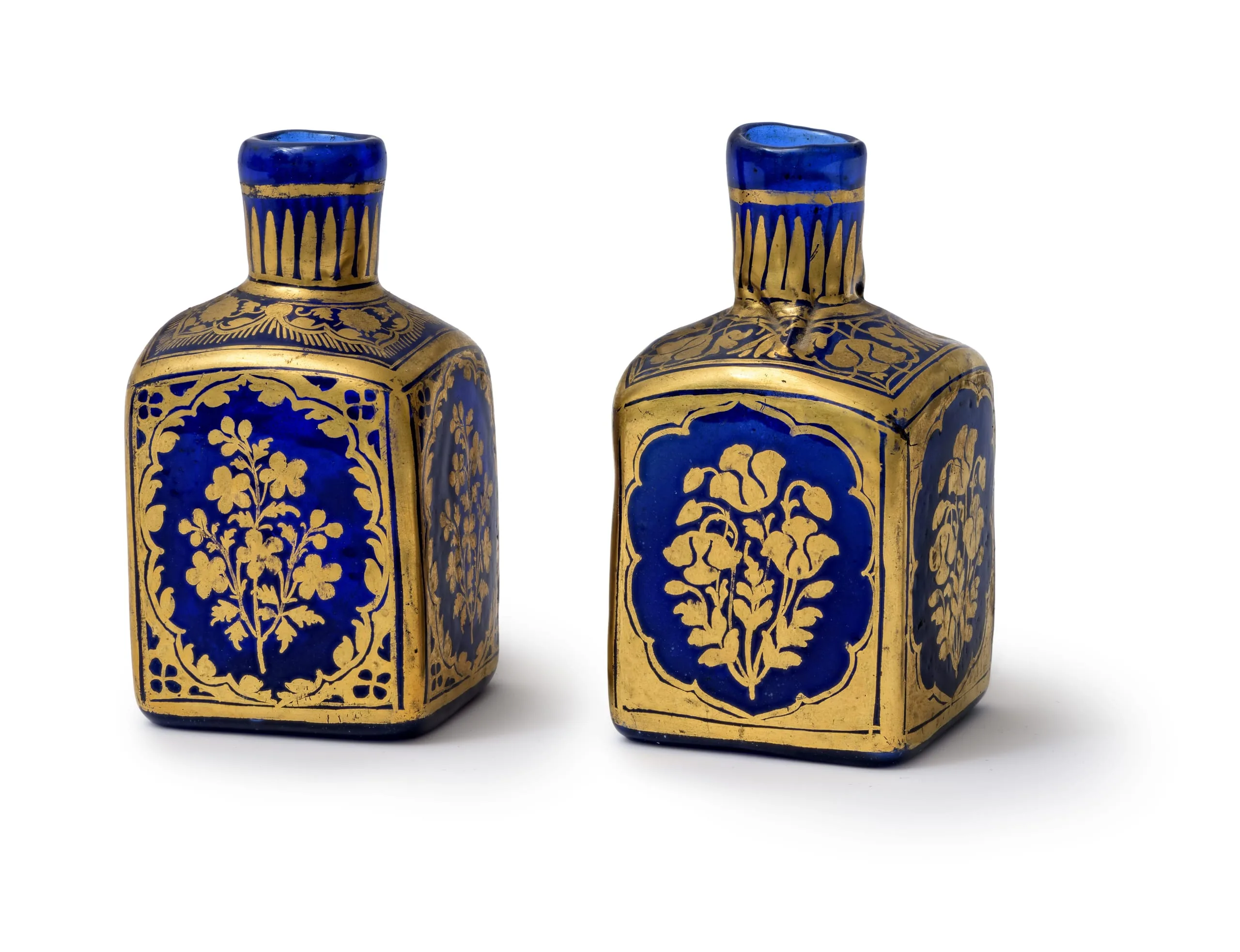
Likely used for fragrances, these diminutive rectangular mold-blown bottles are made of cobalt blue glass with gilded decoration. Although virtually identical in size and displaying the same general decorative program, they vary in their specific choice of motifs and some detailing. Bottle A has a band of upright laplets on the neck. The shoulder has a scrolling vine with large open blossoms of carnations (?) in each corner and an outer pendent fringe. The four sides of the body are framed in a plain gold border. Each side has a twelve-lobed cartouche enclosing a stylized flowering plant. Splayed floral motifs adorn the spandrels. Bottle B has a band of upright laplets on the neck. The shoulder has a scrolling poppy vine. The four sides of the body are framed in a plain gold border. Each side has a twelve-lobed cartouche enclosing a stylized poppy plant.
Cobalt blue glass is made by introducing a cobalt compound, typically cobalt oxide, into the molten glass mixture. The resultant deep blue glass was ground and used as a distinctive blue pigment, known as smalt, since ancient times in the West and South Asia. Smalt was used to make the blue underglaze on Chinese ceramics as early as the 11th century. European cobalt blue glassware is traditionally regarded as originating in Bohemia in the 16th century. The heyday of cobalt blue glassware made in India was during the 18th century in the Mughal dominions, especially in Gujarat, and in the Deccan. See also M.84.124.2a-c.
- Selected Bibliography
- Desjardins, Tara. Mughal Glass: a History of Glassmaking in India. New Delhi: Roli Books, 2024.