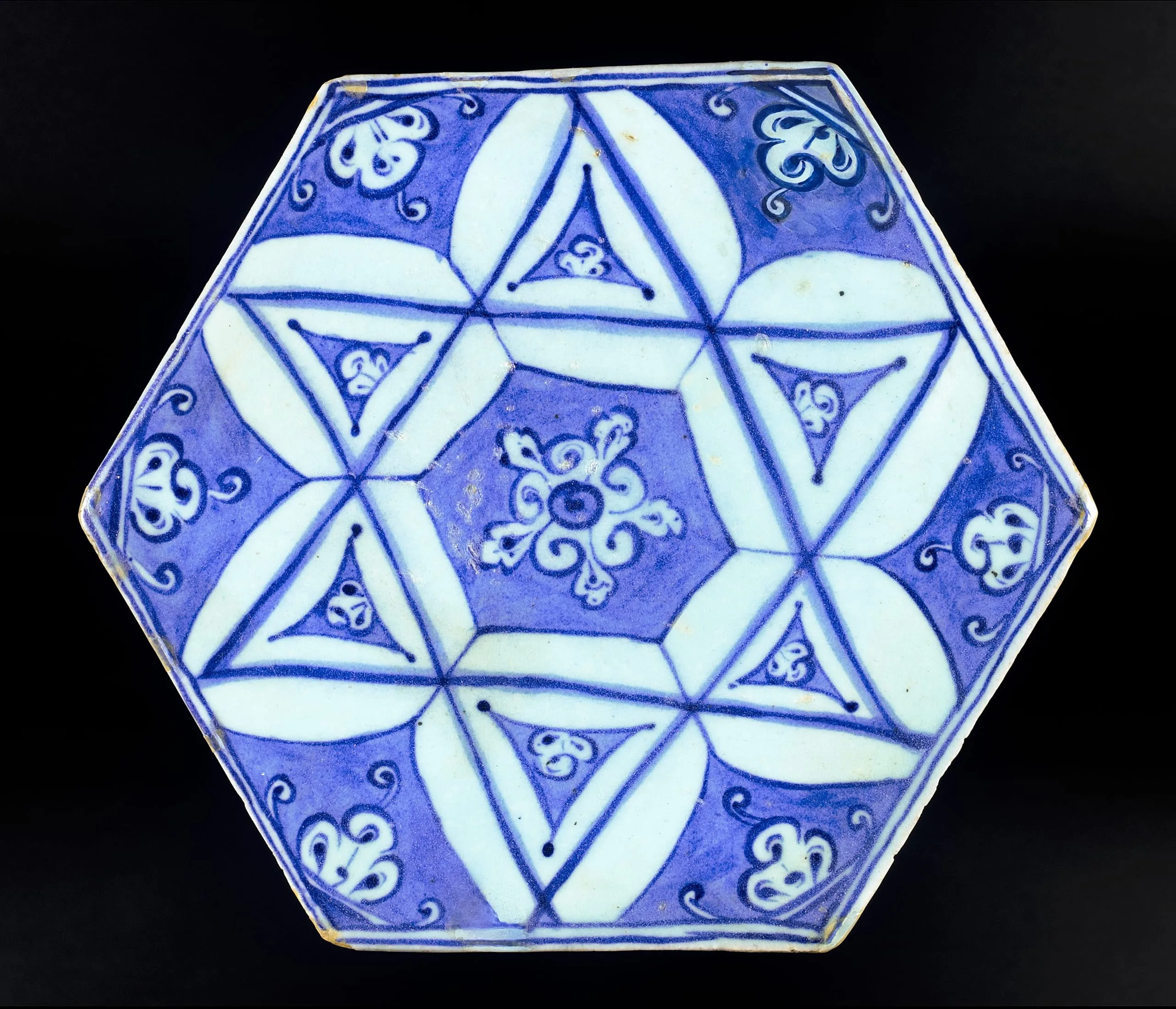
Ceramics made in Iznik represent one of the most renowned and influential arts of the Ottoman period. The Iznik kilns, about 85 miles southeast of the capital, Istanbul, produced both tableware and architectural revetment such as this. Tiles were first manufactured at Iznik in the early sixteenth century; however, the use of ceramic tiles as architectural revetment began in fifteenth-century Turkey at Bursa, which was the Ottoman capital until 1453 and the conquest of Constantinople (later known as Istanbul). Indeed, the type of hexagonal tile, as here, occurs among the revetment from monuments in Bursa, including the design based on a six-pointed star. Arranged to form larger panels, such hexagonal tiles were produced at Iznik in blue and white, although their use in state-sponsored buildings seems to have been limited until the great building boom of the second half of the century, by which time Ottoman ceramic artists had developed a more extensive palette (see M.2000.31). Architectural revetment and tableware often shared not only color schemes but designs as well. This tile, for example, is closely related to a contemporaneous blue-and-white jar (M.85.237.80), especially in terms of the use of floral motifs reserved in white against blue.