Image
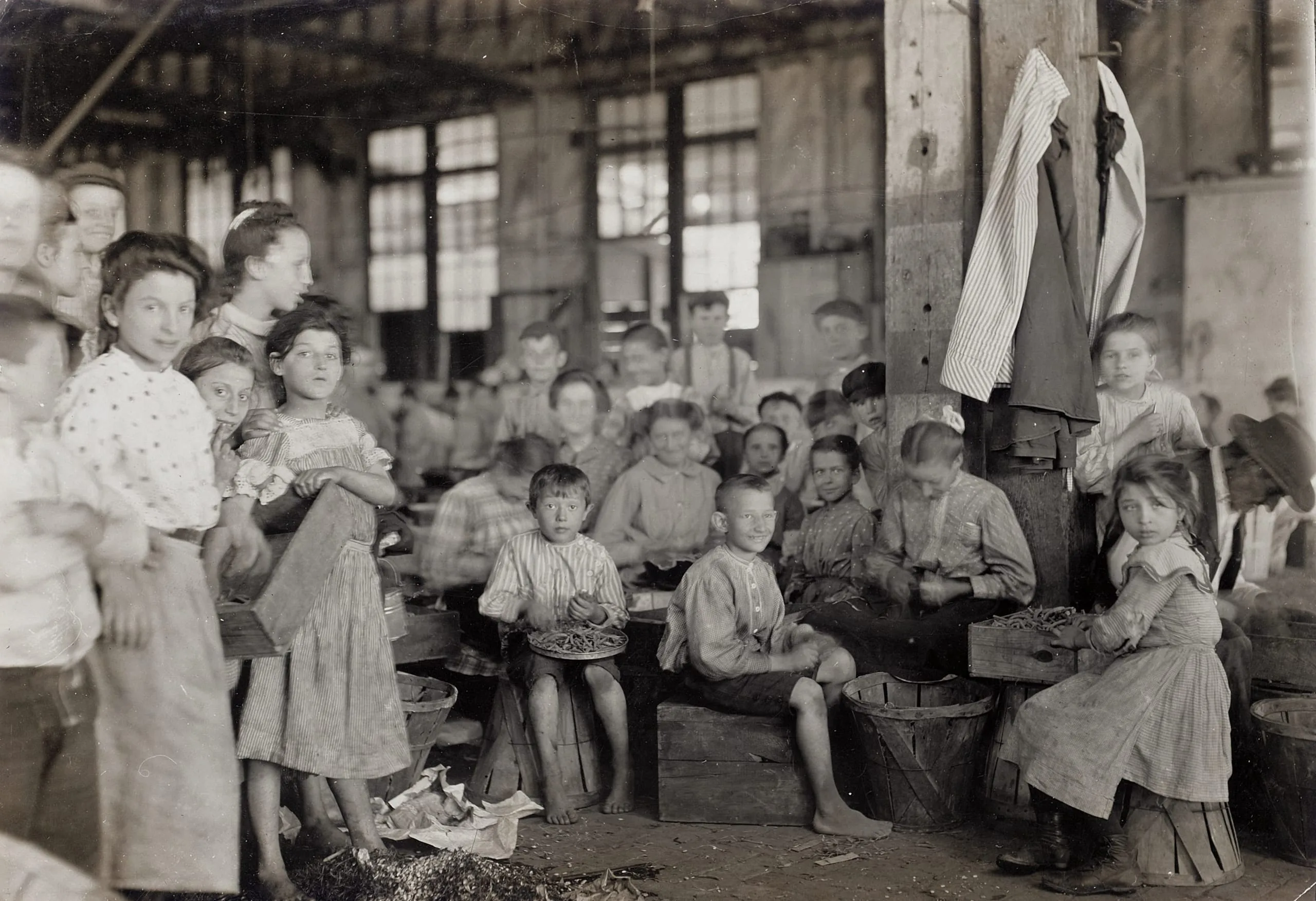
The bare feet, dirty floor, and large manufacturing space lend poignancy to this photograph of child laborers, some of whom look resigned while others have bravely cheerful faces. Although this is a group portrait, individual personalities shine through in the direct gaze of the boy standing on the left, in the childish eagerness of the boy poking his head out behind him, and in the wariness of the girl protectively holding her box. Lewis Hine's photographs of child laborers for the National Child Labor Committee (NCLC) are one of the most important examples of the use of photography for social reform. Hine's commitment to the cause of child workers is evident in his efforts to capture the human qualities of the children in their industrial environment.
Technique
Lewis Hine used the cumbersome professional equipment of the day—a modified box-type 5 x 7 inch camera, rapid rectilinear lens, shutter with a plunger, gelatin dry plates (and, later, sheet film), magnesium flash powder, and a wooden tripod—to print contact or enlarged images on gelatin silver paper. (For more on gelatin dry plates and gelatin silver prints, see Untitled [Group].) He would ignite the flash powder in the pan and then quickly open the camera shutter before his subjects blinked from the bright light.
Context
Lewis Hine built his practice on a belief in photography's ability to inspire social reform. Hine spent twelve years documenting child labor for his employer, the National Child Labor Committee (NCLC). Through these efforts and other projects, Hine furthered the use of photography as an effective device for social change. Hine and his predecessors—including Thomas Annan in Glasgow in the 1860s and 1870s, John Thomson in London in the 1870s, and Jacob Riis in New York in the 1880s and 1890s—focused on the poverty and social injustice that accompanied urban growth.
Hine began his career as a teacher at New York's Ethical Culture School. Photography provided an ideal way for Hine to take action and express his reformist views. Following a project on Ellis Island immigrants in 1904, he began to produce freelance sociological photography for the NCLC and other reform organizations. He stopped teaching in 1908, when he was hired full time by the NCLC to document child labor.
Between 1908 and 1918, Hine crisscrossed the country for the NCLC, photographing the living and working conditions of children in glassworks, coal mines, cotton mills, tenement workshops, sugar beet fields, cranberry bogs, and street trades in numerous states. His images provided evidence of abuses and violations of existing child labor laws and were used to help pass reform legislation. Hine gathered information about the children he photographed to help build an irrefutable case and to prove that the photographs were beyond suspicion of falsification.
Hine created more than five thousand photographs of child labor for the NCLC. He designed pamphlets, posters, and exhibitions, gave slide lectures, and prepared slides that could be rented along with typewritten manuscripts. By 1914, thirty-five states prohibited child labor for those under age fourteen and a mandatory-length workday for children under age sixteen; thirty-six states had factory inspectors and stronger mechanisms for enforcing child labor laws. A national child labor law was not passed until the Fair Labor Standards Act in 1938.