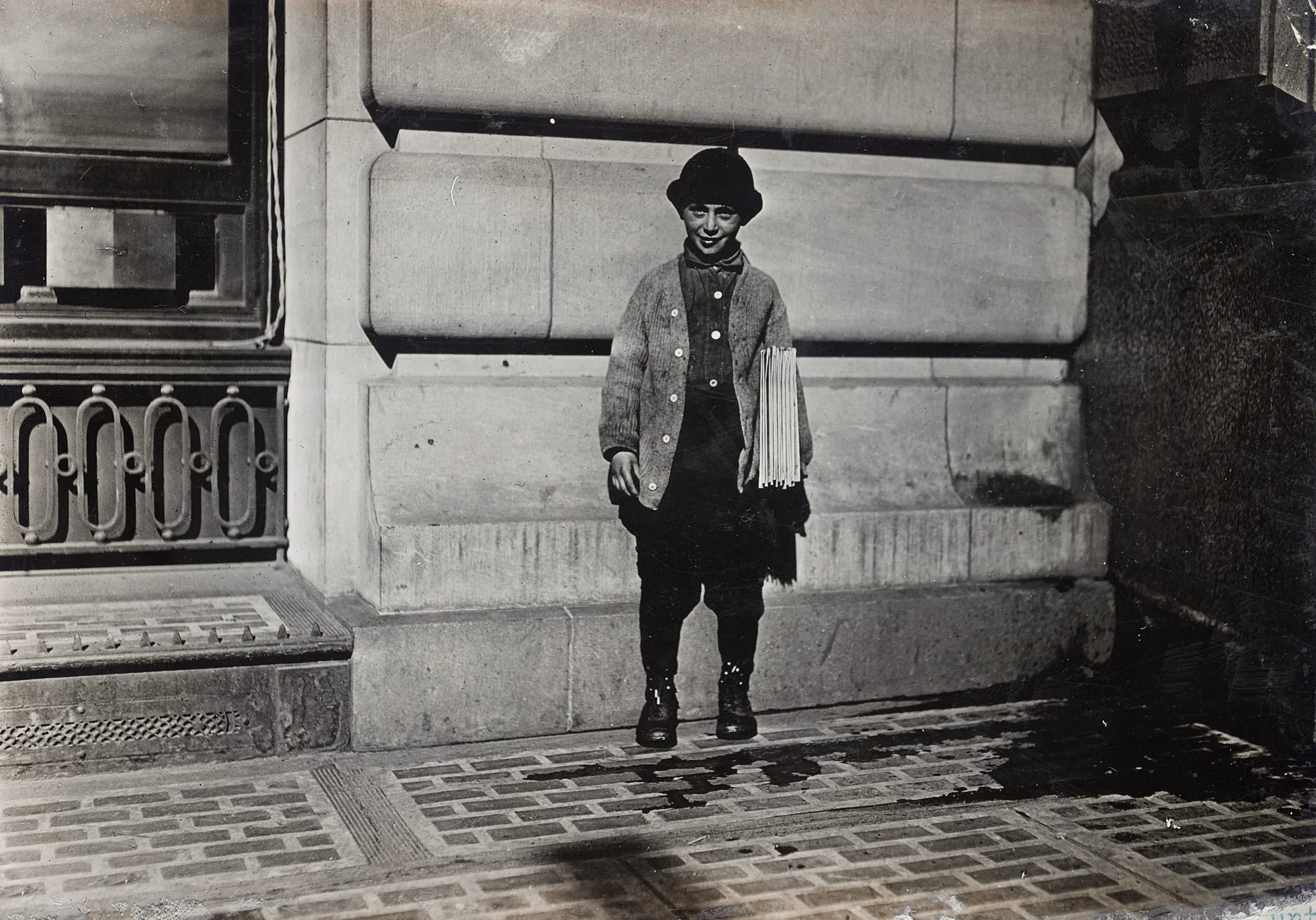
Among the most influential artist-activists in photographic history, Lewis Hine deployed the camera as an instrument of social change. Commissioned by social welfare agencies, he traveled the country to record the harsh conditions under which immigrants and children lived and labored. From 1908 to 1913, he worked as an investigative photographer for the National Child Labor Committee, documenting children working in mills, factories, canneries, mines, and agricultural fields across America. His compelling images ultimately helped to establish child labor laws in the United States.
Here, a “newsie” shyly poses for the camera. Newspaper sellers fit into the category that Hine identified as the street trades, a subject that engendered some of his most lyrical photographs. While these child laborers, ranging in age from six to fourteen, worked early and long hours for little money, Hine’s depictions of them are not as overtly critical as his documentation of other exploitive industries. Picturing them in pairs or packs, or in this case individually, Hine captured the camaraderie that helped newsboys survive the streets of Manhattan and Brooklyn, and their capacity for hustle that enlivened the cityscape, an image cemented in public consciousness through repeated appearances in classic movies.
Hine coined the term “photo-story,” precursor of the photo-essay, to describe his work as an investigative photographer, in which he combined image and text. A keen observer, he captioned his images with detailed information about the subject’s context. “The average person believes implicitly that the photograph cannot falsify,” Hine explained. “Of course, you and I know that this unbounded faith in the integrity of the photograph is often rudely shaken, for, while photographs may not lie, liars may photograph.” Hine left a resounding impact on the worlds of journalism and art, pioneering a new form of storytelling that today we call photojournalism.
Eve Schillo
2024