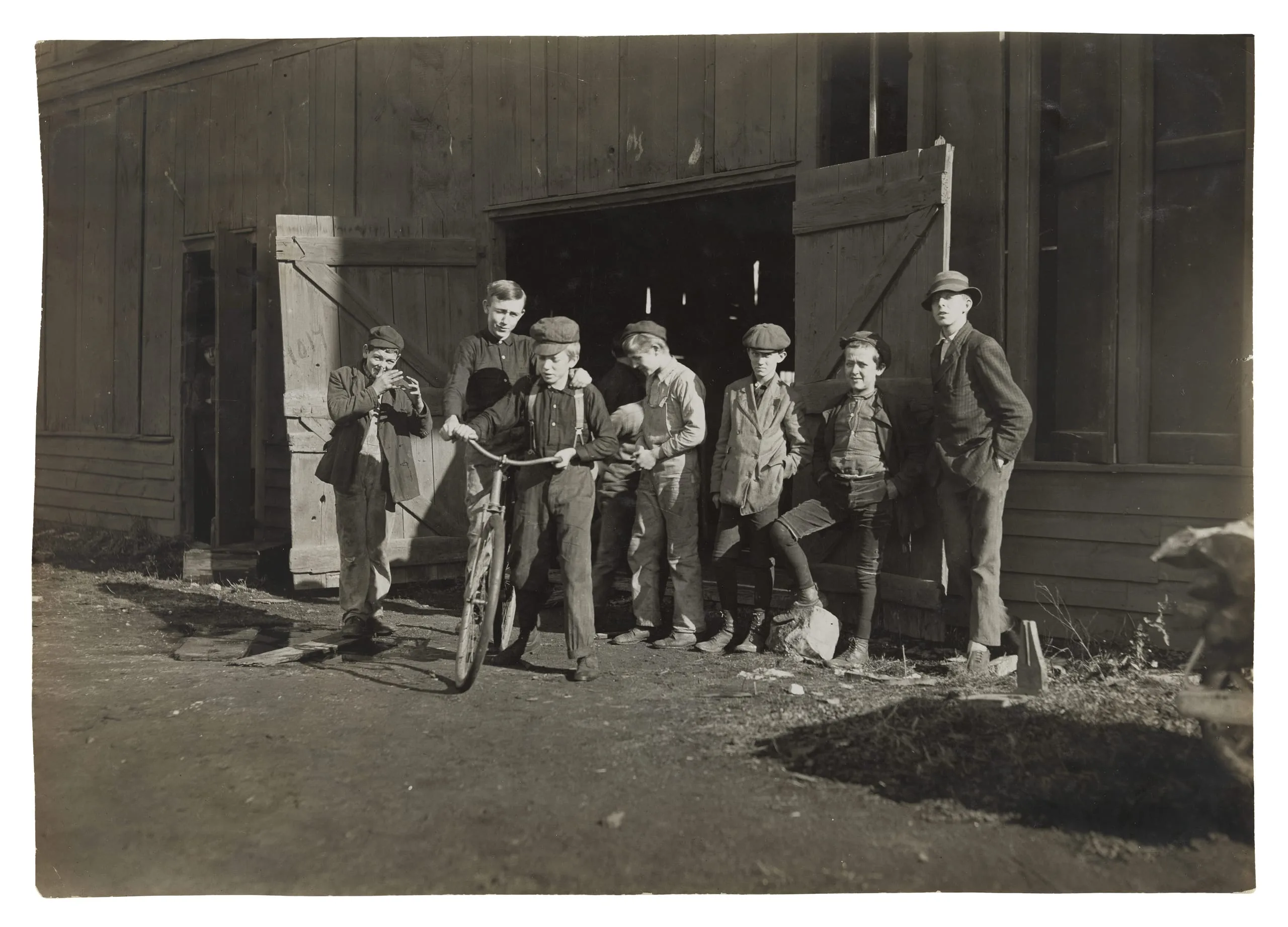
Among the most influential artist-activists in photographic history, Lewis Hine deployed the camera as an instrument of social change. Commissioned by social welfare agencies, he traveled the country to record the harsh conditions under which immigrants and children lived and labored. From 1908 to 1913, he worked as an investigative photographer for the National Child Labor Committee, documenting children working in mills, factories, canneries, mines, and agricultural fields across America. His compelling images ultimately helped to establish child labor laws in the United States.
Hine coined the term “photo-story,” precursor of the photo-essay, to describe his work as an investigative photographer, in which he combined image and text. A keen observer, he captioned his images with detailed information about the subject’s context. “The average person believes implicitly that the photograph cannot falsify,” Hine explained. “Of course, you and I know that this unbounded faith in the integrity of the photograph is often rudely shaken, for, while photographs may not lie, liars may photograph.” Here, he depicts a group of boys at the noon hour outside a bottle factory in New Jersey. Our modern selves identify this as the lunch break, although these children may well have been working through the night and just ending their shift, as indicated in his notes on young workers from another glass factory in the South: “Glass blower and mold boy. Boy has 4 1/2 hours of this at a stretch; then an hour’s rest and 4 1/2 more: cramped position. Day shift one week: night shift next. Grafton. W. Va.”
All of Hines’s photographs reside in the Library of Congress and are searchable online by industry, location, and date. If you have ancestors who worked in agriculture, a mill, factory, or mine, you may be able to find an image of them here.
Eve Schillo
2024