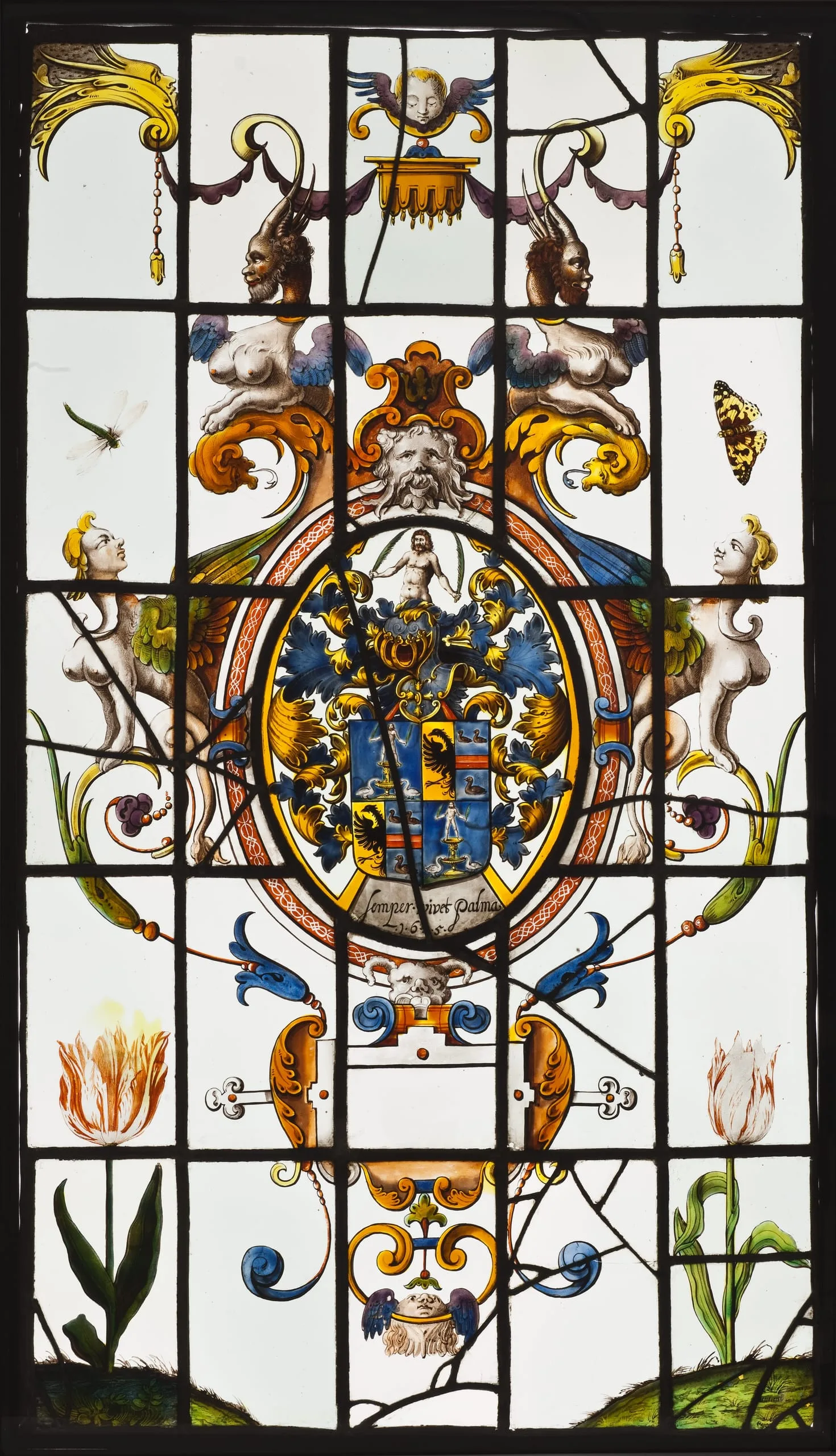
This stained-glass panel belongs to a series of six produced in 1620, likely for a professional organization (see also 45.21.57, .58, .59). Several of the central cartouches were left blank to be filled in with a corporate or family crest at a later date as the organization’s membership changed. While the rectangular panel was left blank, the roundel was decorated with a coat of arms likely from the De la Palma family and inscribed “Semper vivet palma 16?5,” or “Victory lives on forever” and presumably with the date 1625 like the other panels in the series. Marcus de la Palma was councilor and burgomaster of Middelburg, and his son Pieter de la Palma was treasurer of Walcheren and a steward in the local government.
Its style of ornamentation, featuring figures with human female torsos, wings, and hybrid animal bodies—referred to as grotesque—derives from ancient Roman fresco decoration. Especially popular in Europe in the sixteenth and early seventeenth centuries, grotesque decoration could be found on everything from silver pitchers to the backs of chairs. The panels were likely produced in a workshop with multiple painters, accounting for variation in shading and line in the ornamental frame.
The panel is framed by two different red-striped varietals of tulip, a flower originally imported from Turkey. A dragonfly and a yellow-and-black moth fly in the negative spaces above each grotesque figure. The distinctively naturalistic and jewel-like style of the flowers and insects, along with the inclusion of grotesque decoration, indicate that the panels were likely produced in Middelburg, a major port for the Dutch East India Company. The influx of living specimens, seeds, and flower bulbs arriving from the Asian continent to the harbor allowed the city to host a thriving horticultural network that included botanical artists, gardens, and collector’s cabinets.
Cynthia Kok
April 2025, adapted from Diva Zumaya, The World Made Wondrous (2023)