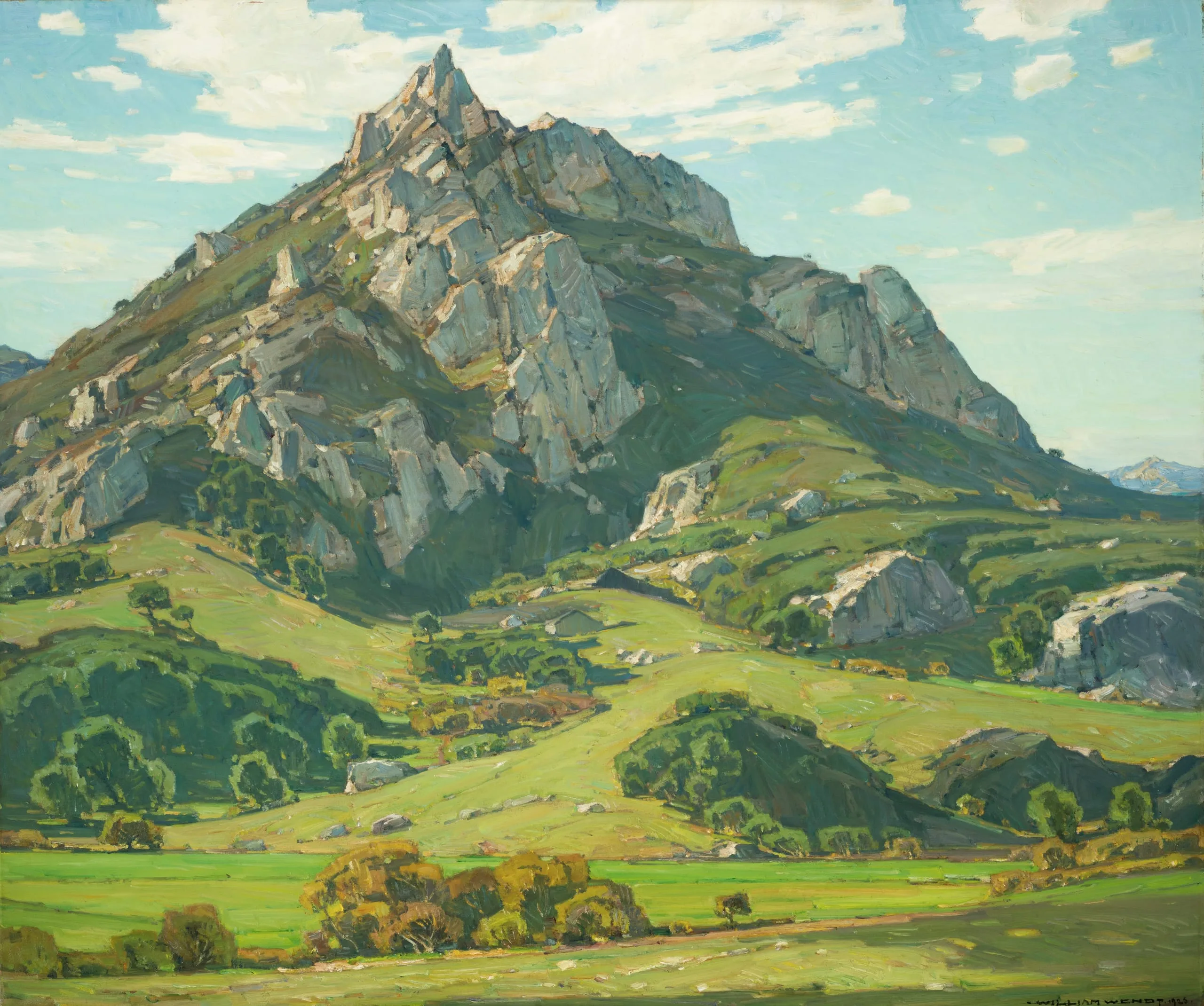
This painting regularly has been referred to as Wendt’s masterpiece since first being called that in the book published in conjunction with the Stendahl Art Galleries’ 1926 exhibition of Wendt’s work. In many respects it is entirely characteristic of Wendt’s mature paintings: in its subject being the California foothills, its restrained palette, its noon light, its broad, long, regular brushstrokes, and its simplification of forms.
Wendt’s approach to composition was to find a motif and let it dictate the structure of the composition. His paintings generally give the impression of an intimate encounter with a modest portion of a landscape and are not formally composed. Where Nature’s God Hath Wrought, in contrast, is an extremely bold and powerful composition, at once dramatic and unified. Wendt always sought the spirit of the landscape and its deeper meaning; the title of this painting is his strongest statement of that philosophy. Many have remarked on the inspirational quality of the mountain’s upward thrust. According to critic Arthur Millier, the view is of Morro Bay, north of San Luis Obispo in central California, where Wendt occasionally worked in the 1920s. As Millier noted, the bay’s distinctive soaring hill formations afforded Wendt a "supreme opportunity to express his profound feeling for the structural balance."
The last digit of the date Wendt inscribed on the canvas is ambiguous. In recent literature the date given has been 1923, but exhibition and literature references suggest that the artist painted Where Nature’s God Hath Wrought in 1925 or shortly before. The first record of the painting is its inclusion in the Los Angeles Museum’s First Pan-American Exhibition of Oil Paintings of 1925-26. It is doubtful that Wendt would have contributed a painting several years old to such a significant exhibition. Furthermore, the fact that the canvas is unusually large for Wendt might be explained by its function as a major showpiece.
The painting shared, with the modernist Parthenope by JOHN CARROLL (LACMA; q.v.), the Balch Prize in the Pan-American Exhibition, achieving for the artist considerable local distinction. It was the one exception to the awards jury’s preference for progressive styles. This may be explained, in part, by a deference to Wendt’s preeminence among Los Angeles artists. At the same time, however, the painting’s breadth and simplified, somewhat geometric forms would have appealed to the taste of the jurors.