- Title
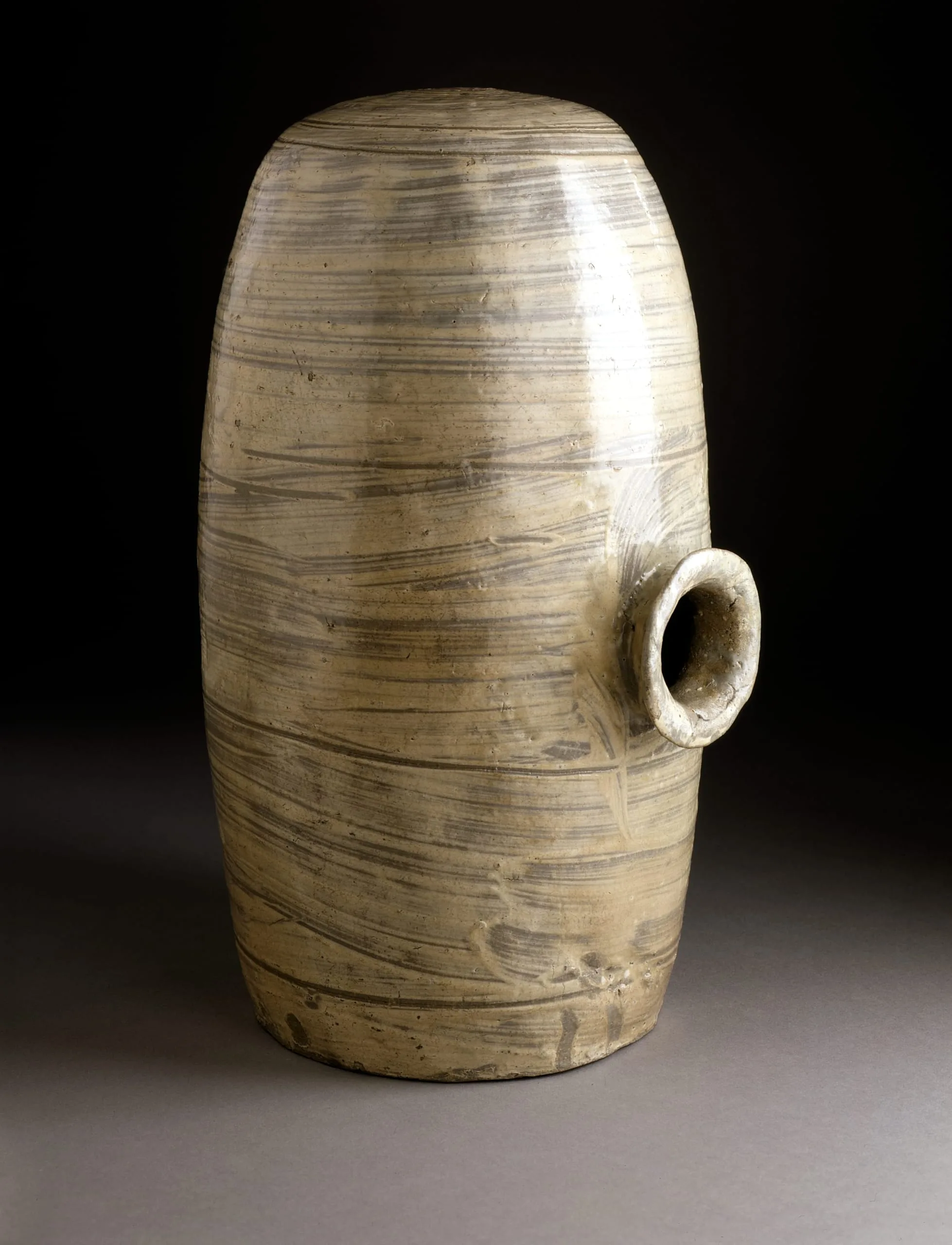
- Cylindrical Bottle with Brushstroke Marks
- Date Made
- Joseon dynasty (1392-1910), 15th-early 16th century
- Medium
- Buncheong ware; Wheel-thrown stoneware with slip and pale green glaze
- Dimensions
- Height: 12 1/2 in. (31.75 cm); Diameter: 7 1/2 in. (19.05 cm)
- Accession Number
- M.2000.15.94
- Curatorial Notes
The beauty of this Joseon flask lies in its brushed decoration, or gwiyal, expressing a sense of immediate energy. With a spout protruding from its midsection, this cylindrical vessel has an unusual shape. Called a rice-bale bottle or drum-shaped ware known as janggun, the form was produced as early as the Three Kingdoms period (57 BCE–668 CE). Its use is indicated by its shape. The flat, unglazed end keeps the empty cylinder upright. To fill it with liquid, the vessel is laid horizontally on a stand with the spout facing upward.
LACMA’s bottle is a type of buncheong ware, a term referring to the grayish green ceramic glaze that on the surface was a stark change from the designs, patterns, and glaze of the well-known Goryeo celadons of the previous dynasty (9181392). The new aesthetic marked the beginning of the Joseon dynasty in 1392, employing the same government kilns, techniques, and materials, with the exception of a clay and slip that contained less iron oxide and produced a paler color than the traditional Goryeo celadons. Utilized initially by the royal court and nobility, buncheong ware became more popular and was mass-produced during the first third of the dynasty until the Imjin Wars in the sixteenth century.
Virginia Moon
- Selected Bibliography
- Korean Art Collection of the Los Angeles County Museum of Art, U.S.A. Daejeon, Republic of Korea: National Research Institute of Cultural Heritage, 2012.