LACMA

ShopMembershipMyLACMATickets
LACMA
Los Angeles County Museum of Art
5905 Wilshire Blvd.
Los Angeles, CA 90036
info@lacma.org
(323) 857-6000
Sign up to receive emails
Subscribe
© Museum Associates 2026
  • About LACMA
  • Jobs
  • Building LACMA
  • Host An Event
  • Unframed
  • Press
  • FAQs
  • Log in to MyLACMA
  • Privacy Policy
© Museum Associates 2026
Collections

Unknown
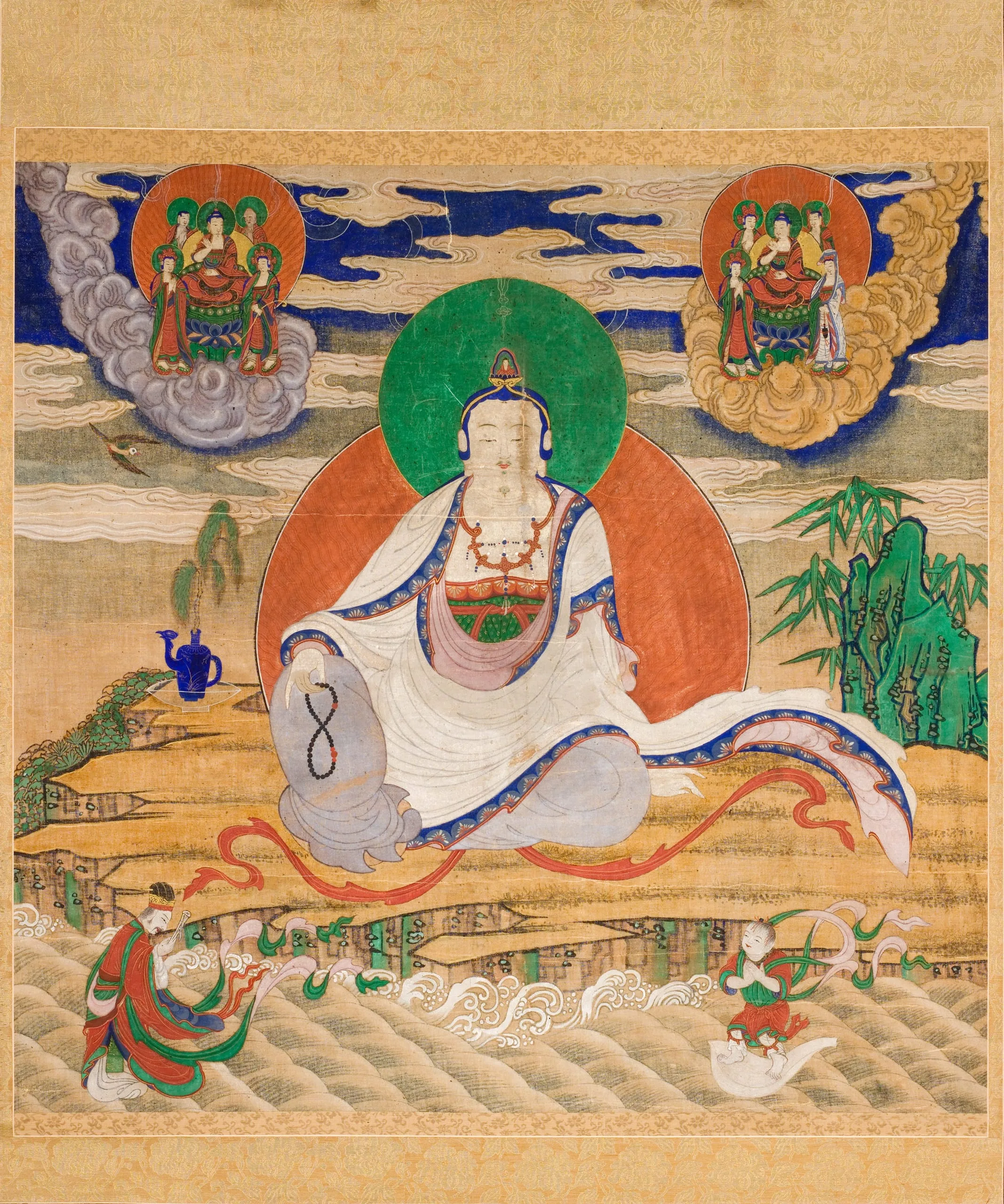
Avalokitesvara Bodhisattva Joseon dynasty (1392-1910), late19th-early 20th century

Not on view
Hanging scroll painting of a large white-robed divine figure with orange and green halos seated on stylized waves, with attendants below and celestial groups on clouds above
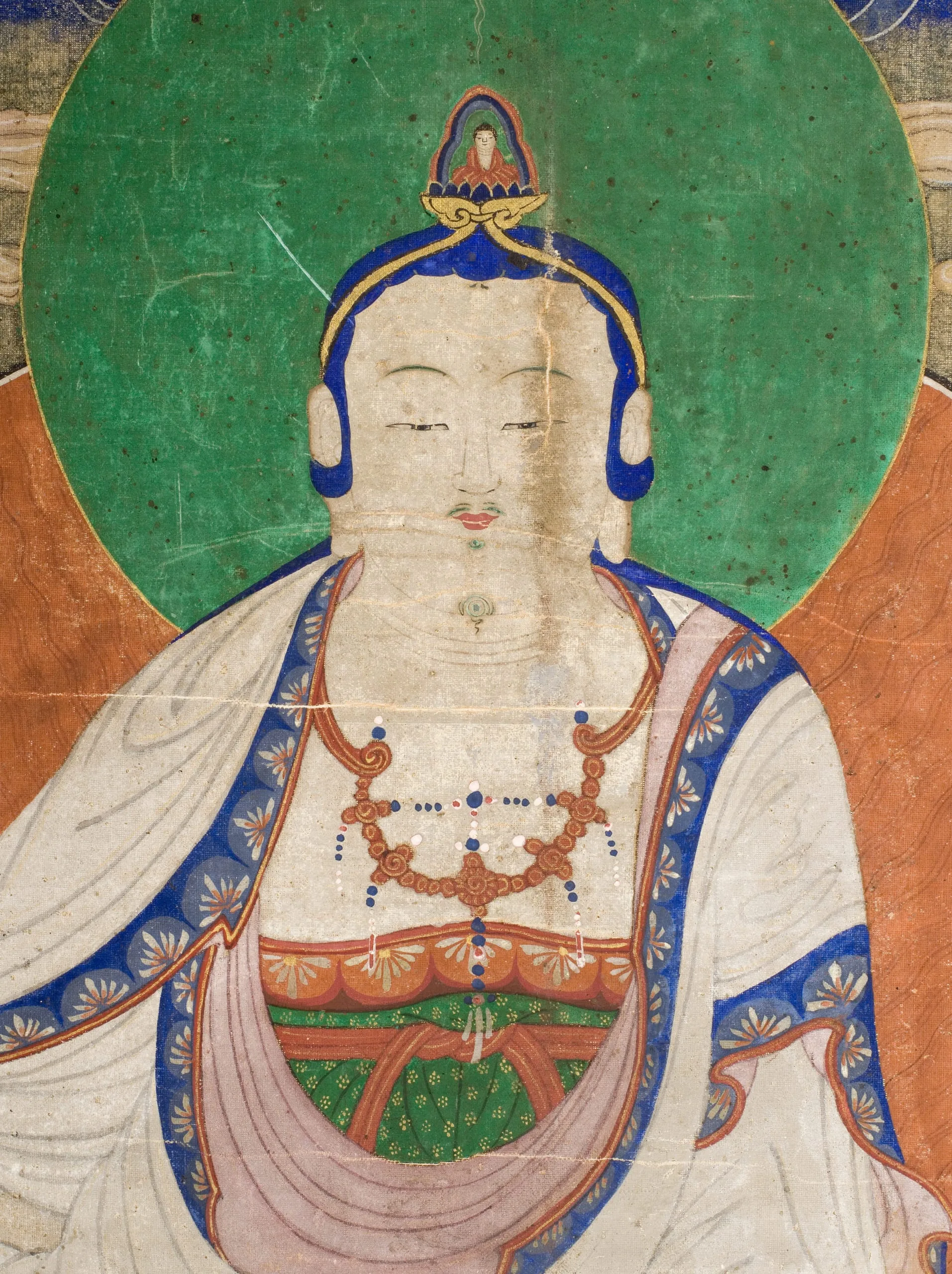
Painted hanging scroll depicting a bodhisattva figure in frontal view, with eyes downcast, blue hair ornaments, and a small seated figure atop the crown. White robes with blue floral-patterned borders, terracotta necklace with blue and white beads, and a large green circular halo. Paint shows visible age cracking and surface wear.
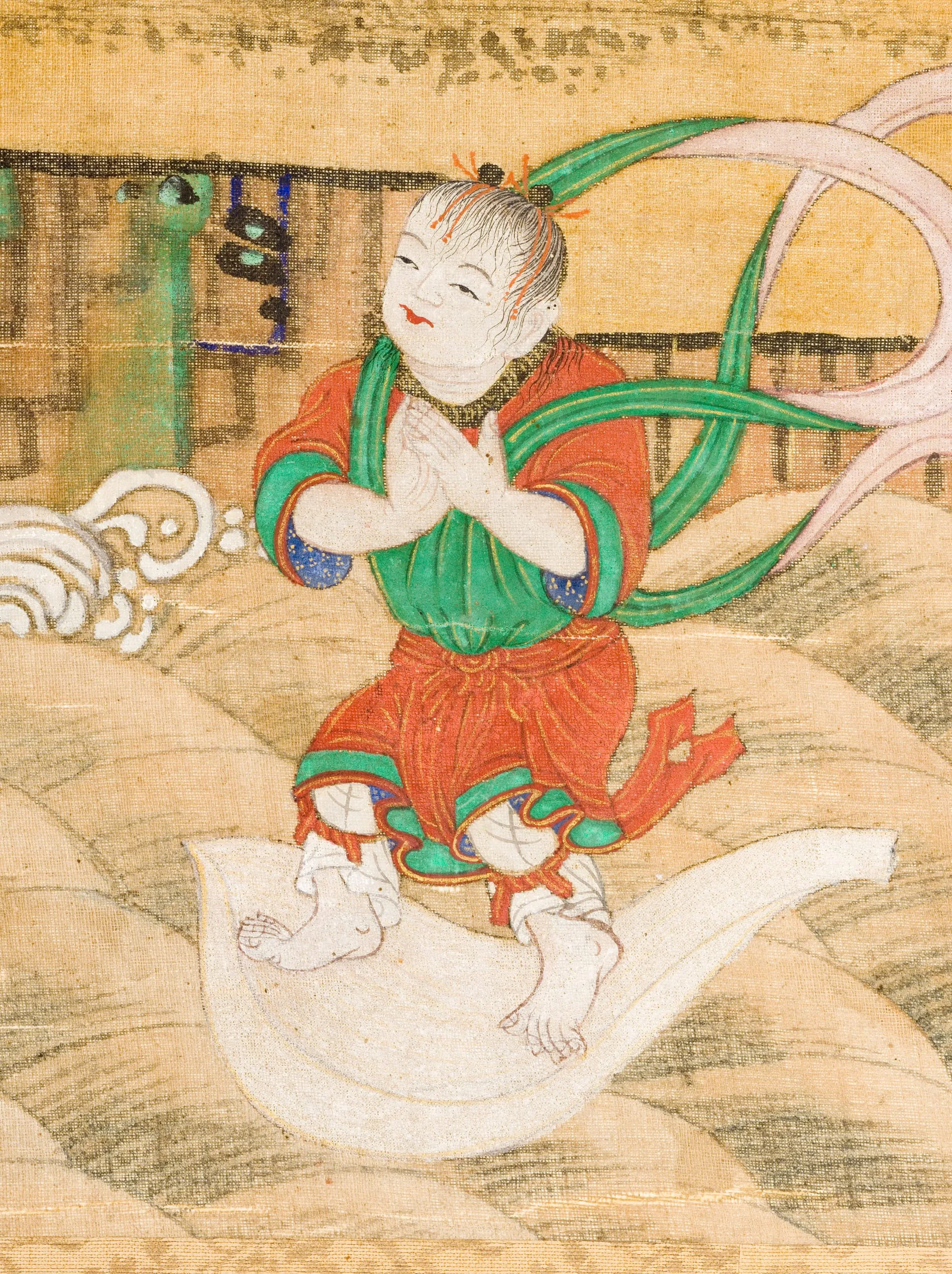
Ink and color painting on silk, detail showing a young child figure in red and green robes with hands pressed together, standing atop stylized white waves, with flowing green and pink ribbons; vertical columns of non-Latin script visible at upper left.
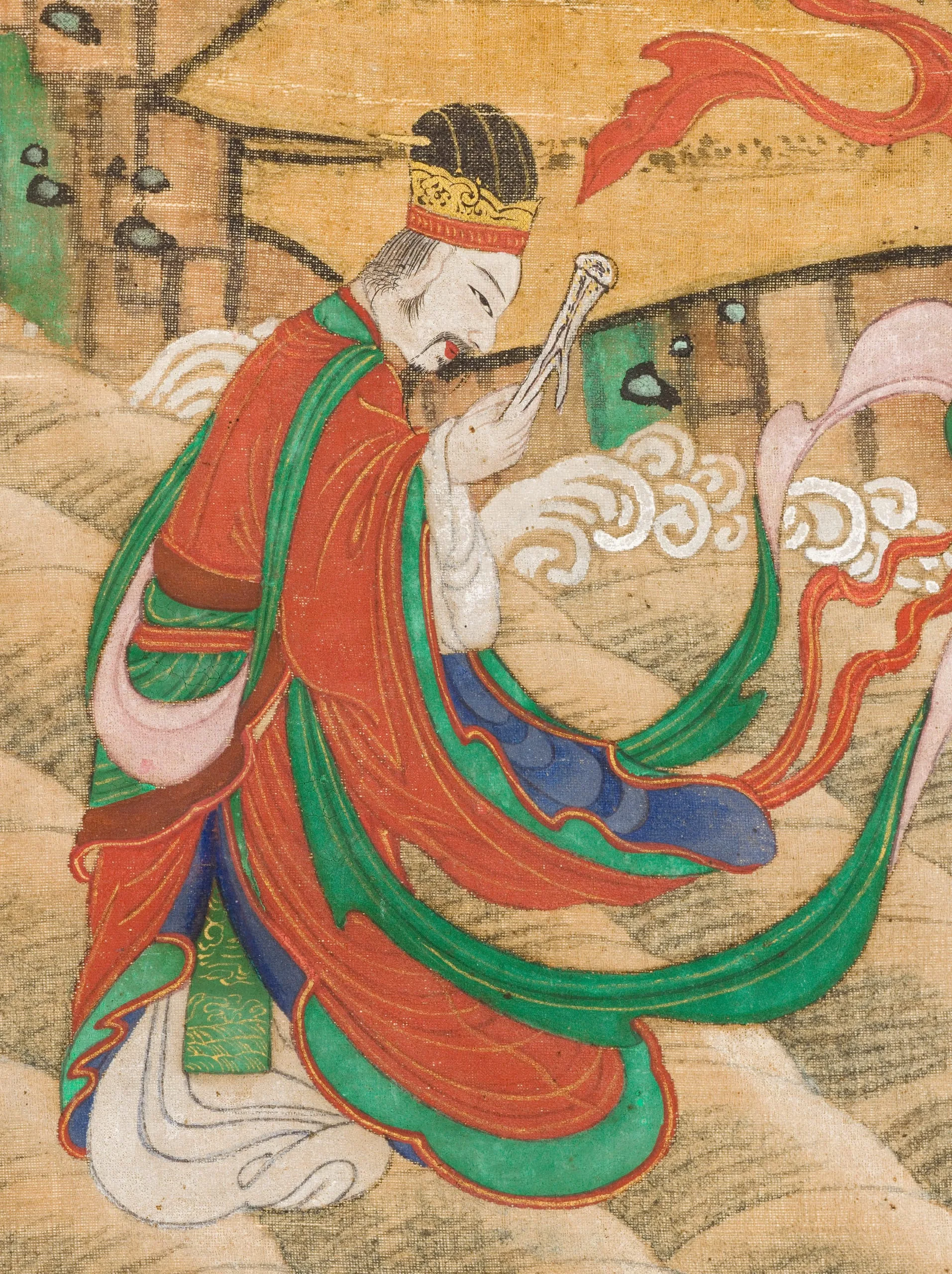
Ink and color painting on silk, a bearded male figure wearing a gold crown and billowing red and green robes, kneeling on rocky terrain while holding a small object to his lips, surrounded by swirling white clouds and red ribbons.
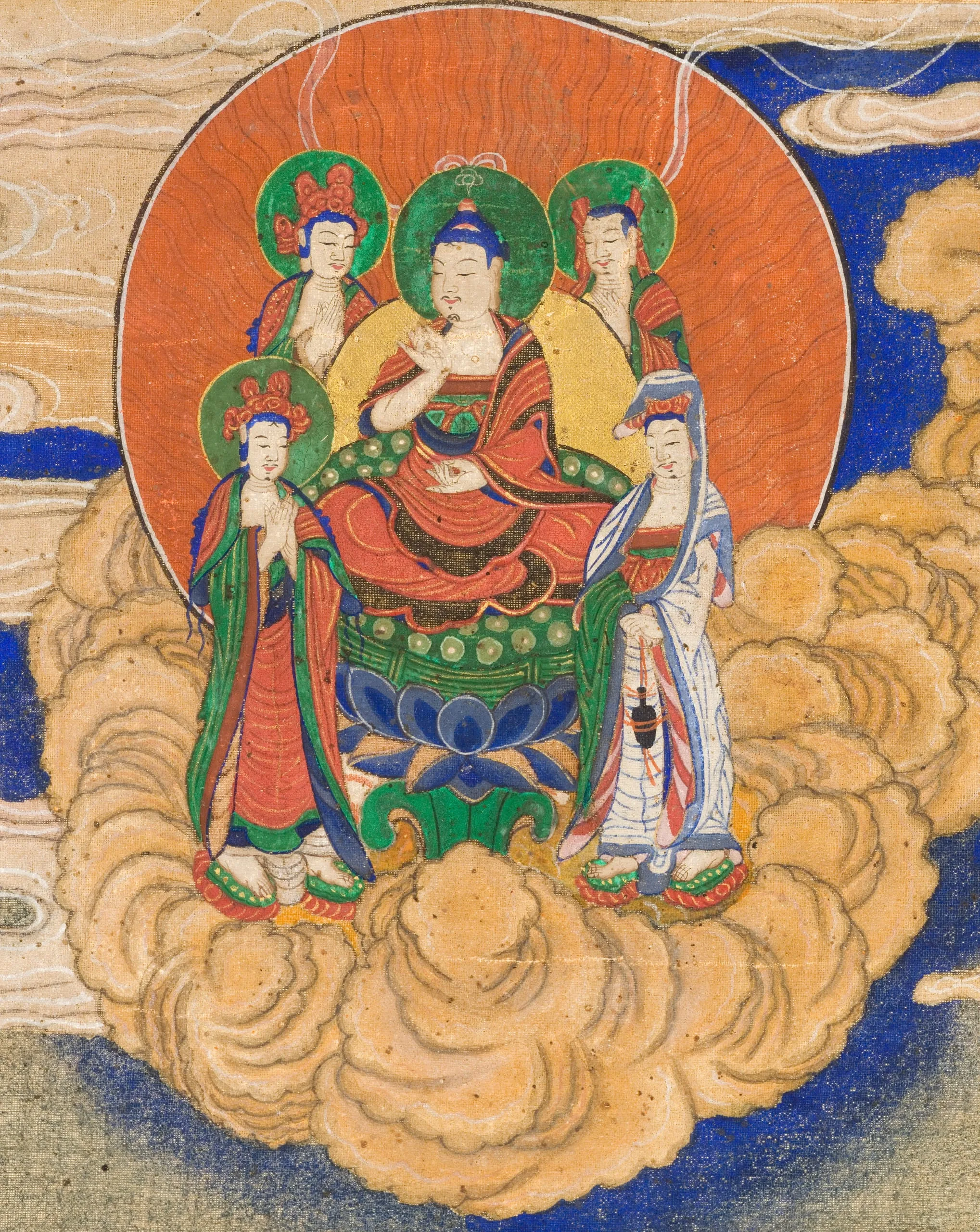
Painted silk or textile panel depicting a central enthroned deity in red robes seated on a lotus throne, surrounded by four attendant figures with green halos, all set against a large orange mandorla and billowing golden clouds on a blue ground.
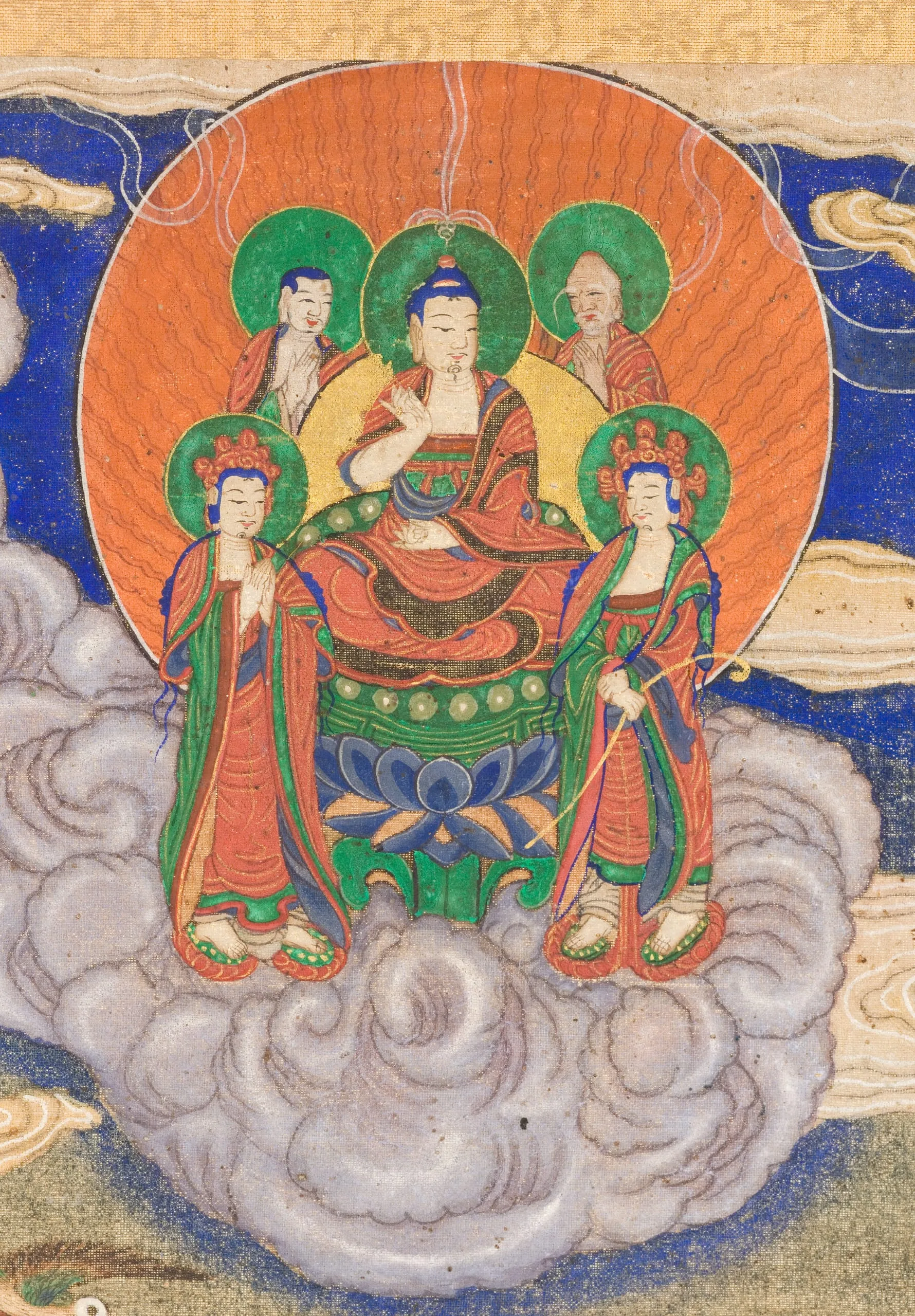
Hanging scroll painting, a central seated figure with green halo on a lotus throne within a large orange mandorla, flanked by four attendant figures with green halos, rendered in mineral pigments of red, green, blue, and gold, all set against swirling white clouds and a deep blue background.
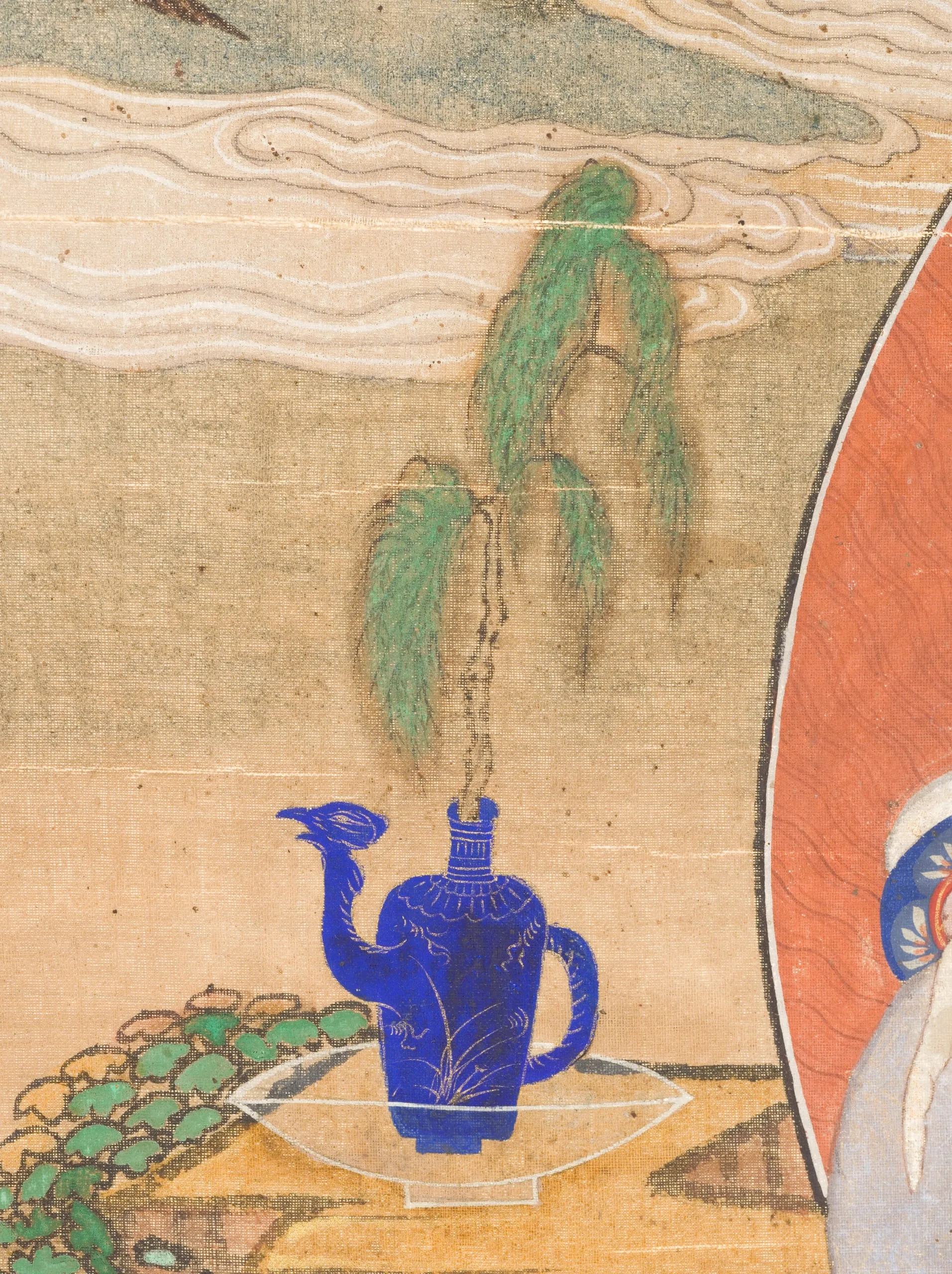
Detail of a Buddhist thangka painting on cloth; a cobalt blue ewer with a bird-head spout holds a green willow branch, set on a lotus-shaped tray against a beige ground with swirling white clouds.
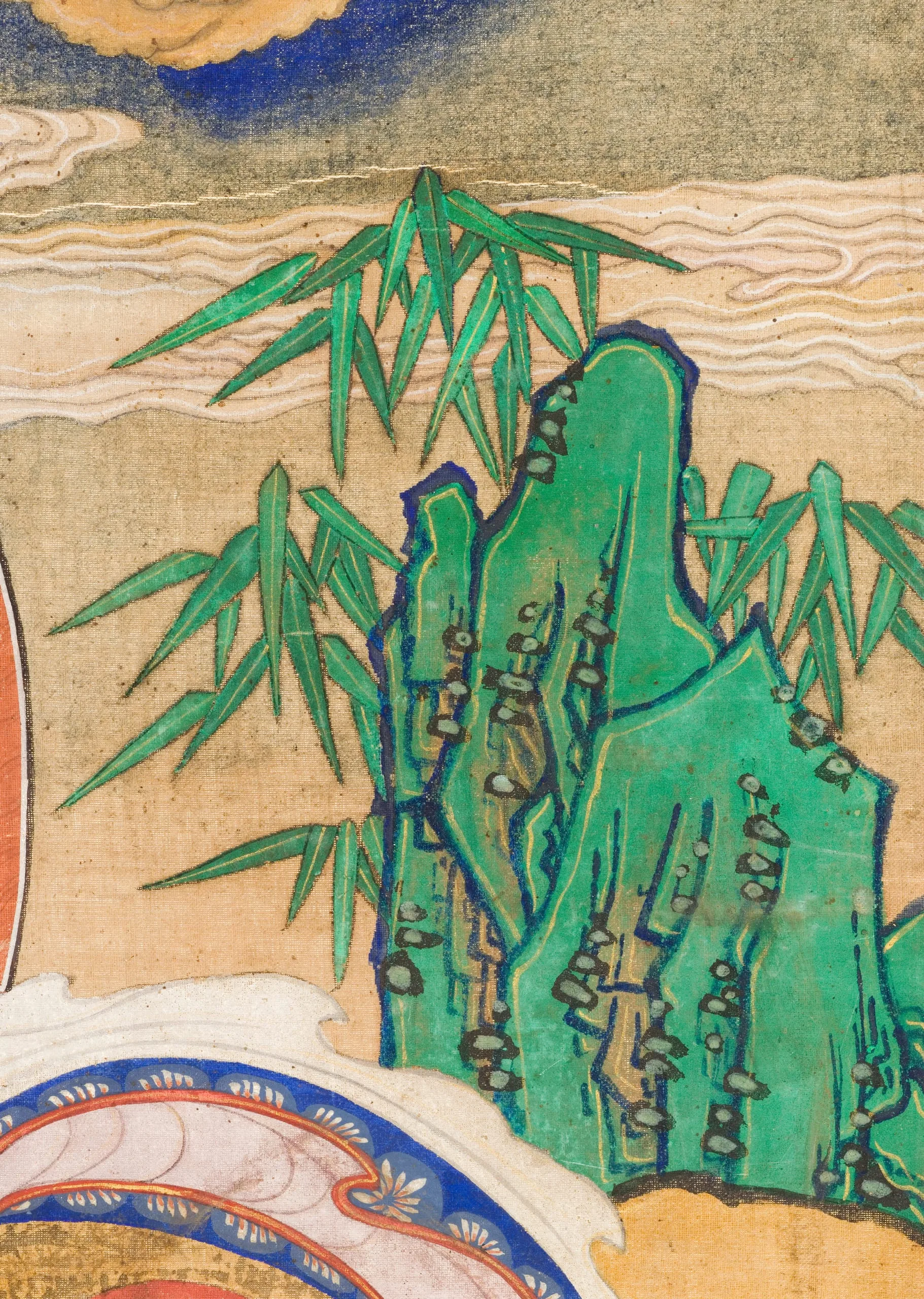
Detail of a thangka painting showing green rock formations and bamboo sprays against a tan ground with stylized white clouds and blue sky above; flat mineral pigments with dark outline work.

Unknown, Avalokitesvara Bodhisattva, Joseon dynasty (1392-1910), late19th-early 20th century, Los Angeles County Museum of Art, Purchased with Museum Funds, photo © Museum Associates/LACMA

Artist or Maker
Unknown
Title
Avalokitesvara Bodhisattva
Place Made
Korea
Date Made
Joseon dynasty (1392-1910), late19th-early 20th century
Medium
Hanging scroll, ink, color, and gold on cotton
Dimensions
Image: 34 3/4 x 34 in. (88.27 x 86.36 cm); Mount: 66 1/4 x 40 in. (168.28 x 101.6 cm); Roller: 42 1/2 in. (107.95 cm)
Credit Line
Purchased with Museum Funds
Accession Number
M.2000.15.4
Classification
Paintings
Collecting Area
Chinese and Korean Art
Curatorial Notes

The most popular of the many bodhisattvas worshipped in East Asia was Avalokiteshvara (Ch. Guanyin; K. Gwanseum; J. Kannon), Bodhisattva of Compassion and the Buddhist savior par excellence. An entire section of the seminal Lotus Sutra is devoted to Avalokiteshvara, where thirty-three of the deity’s manifestations are described. Here, the bodhisattva is seated in the royal-ease position on a flat rocky outcropping next to the eastern sea. This suggests that the scene depicts Mount Potalaka, Avalokiteshvara’s paradise and traditional abode. At the lower left, the Dragon King who rules the oceans emerges from the waves; at the lower right, the child Sudhana floats on a single lotus petal. Sudhana’s search for enlightenment is described in the final chapter of the Flower Garland Sutra. A noteworthy detail of this Korean painting is the presence of a vase holding a branch of the willow tree on the rocky ledge next to Gwanseum; this symbol alludes to the bodhisattva’s specific ability to cure illness. In the upper left corner, floating on clouds, is a group of figures centered on the historical Buddha Shakyamuni accompanied by the bodhisattvas of wisdom (Manjushri) and benevolence (Samantabhadra), along with the Buddha’s favorite disciples, the young monk Ananda and the elderly monk Kashyapa. In the upper right corner, also floating on clouds, is a group of figures centered on Amitabha, Buddha of the Western Paradise (of whom the Bodhisattva Avalokiteshvara is an emanation), accompanied by the bodhisattvas Avalokiteshvara and Mahasthamaprapta, along with two unidentified bodhisattvas.

Stephen Little

2022

Selected Bibliography
  • Kim, Hongnam. The Story of a Painting: A Korean Buddhist Treasure from The Mary and Jackson Burke Foundation. New York: The Asian Socity Galleries, 1991.
  • Woo, Hyunsoo, ed. Treasures from Korea: Arts and Culture of the Joseon Dynasty, 1392-1910. Philadelphia: Philadelphia Museum of Art, 2014.
  • Korean Art Collection of the Los Angeles County Museum of Art, U.S.A. Daejeon, Republic of Korea: National Research Institute of Cultural Heritage, 2012.
  • Muchnic, Suzanne. LACMA So Far: Portrait of a Museum in the Making. San Marino, California: Huntington Library, Art Collections, and Botanical Gardens, 2015.