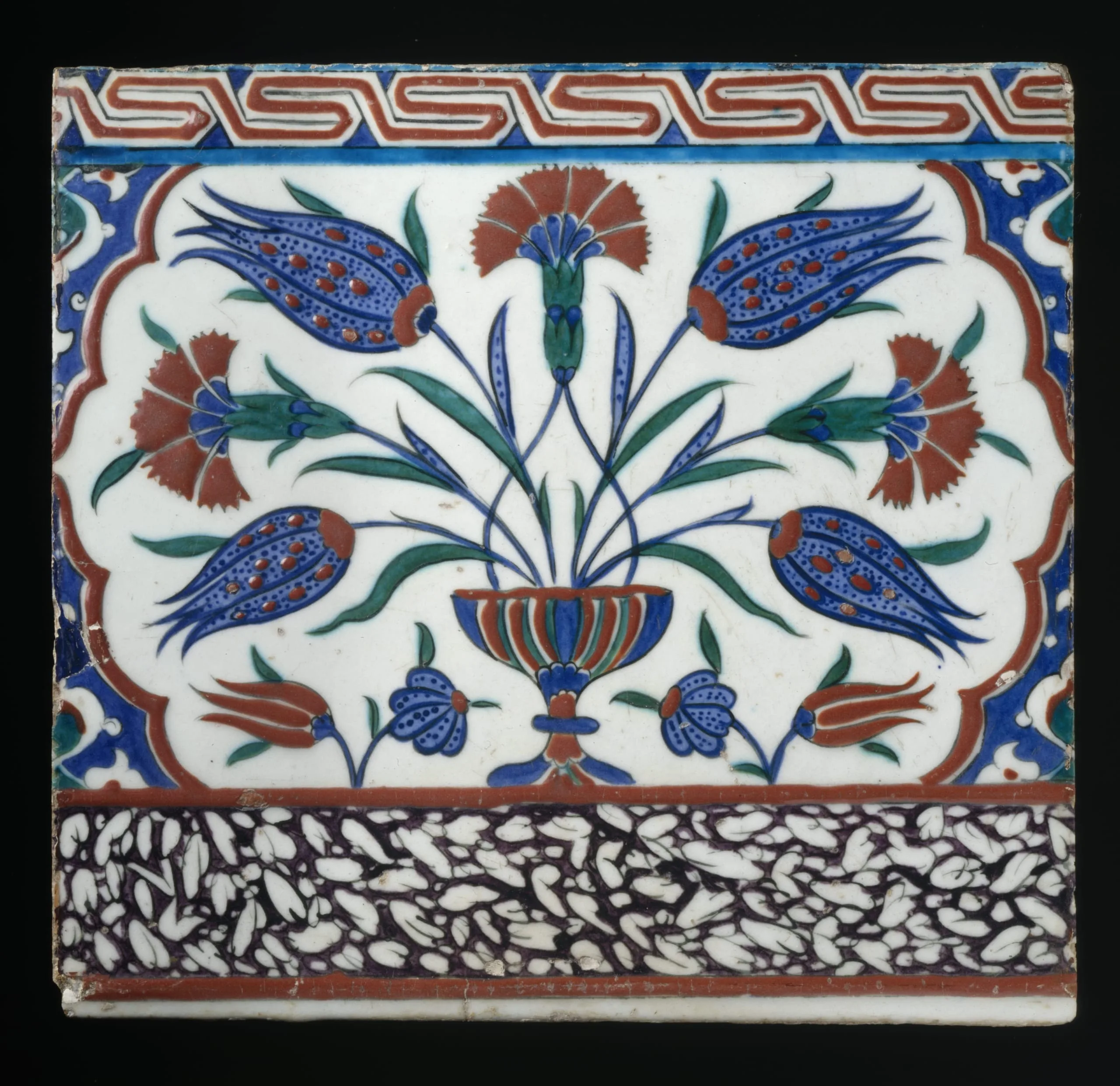
Ceramics made in Iznik, in western Turkey, represent one of the most renowned and influential arts of the Ottoman period. The Iznik kilns, about 85 miles southeast of the capital, Istanbul, produced both tableware and architectural revetment such as this. Tiles were first manufactured at Iznik around the early sixteenth century; however, production increased dramatically in the second half of the century as the court sponsored more and more new buildings.
Toward the mid-sixteenth century, the palette of Iznik wares expanded to include a brilliant red and a bright grass-green, as here. This magnificent and rare surviving tile, with sumptuous flowers and a lower border painted to imitate breccia marble, probably comes from the royal living quarters of Murad III (r. 1574−95) at the Topkapı Palace, Istanbul, completed in 1588, where it probably formed part of a repetitive decorative band along the lower section of a wall. This part of the palace suffered a devastating fire in 1665. On that account, many of the remaining tiles were removed, and some found their way to Western museums (also see AC1995.124.1).
Objects of this type, both tile revetment and vessels, demonstrate the great variety of ornament used by Iznik potters, including the ubiquitous tulip; lush, plump peonies and carnations; spiky and scrolling leaves; and bold epigraphic ornament. They also help to illustrate the different stylistic phases of Iznik wares, which in turn reflect the evolution of Ottoman taste in the sixteenth and seventeenth centuries in a variety of mediums.