- Title
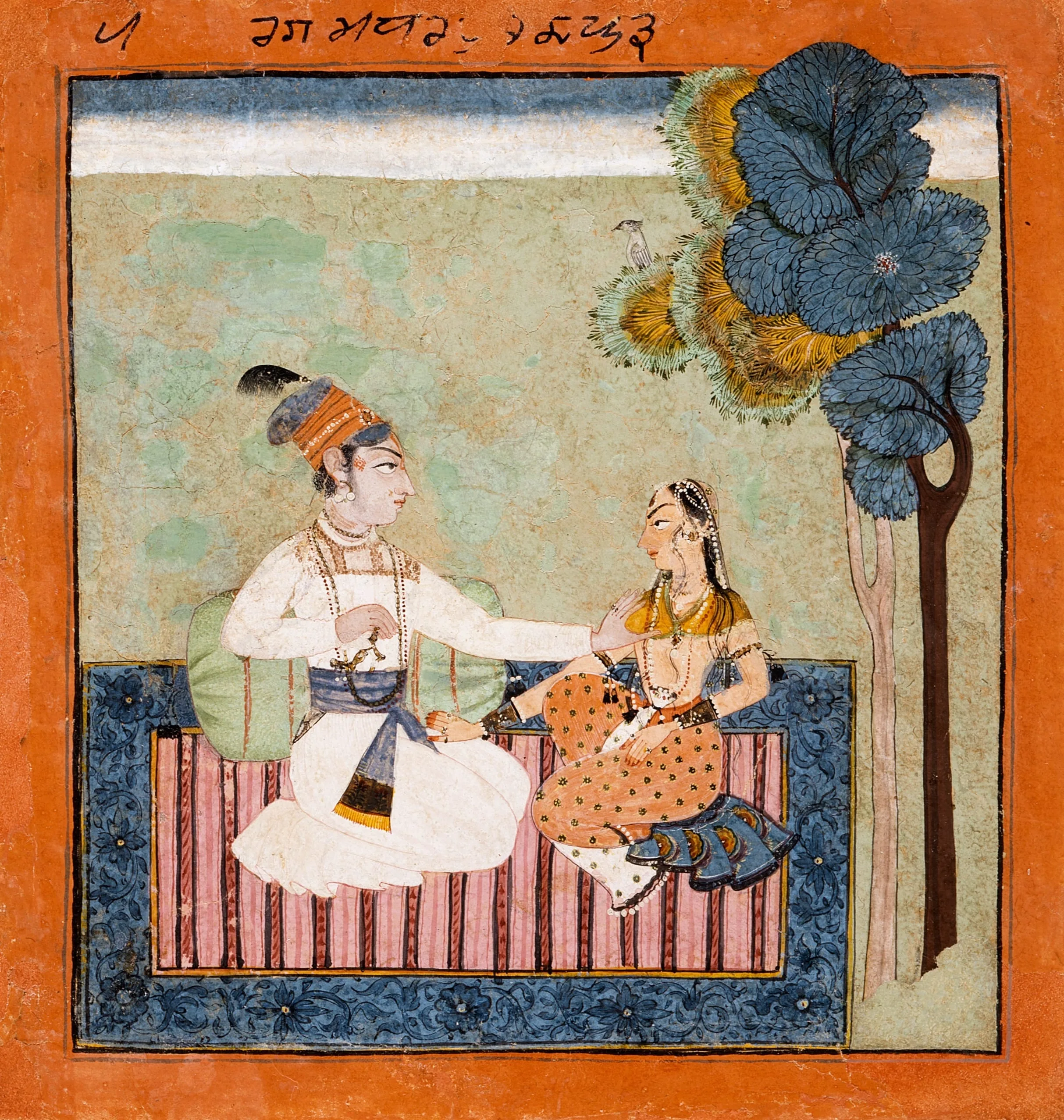
- Madhu Ragaputra, Third Son of Bhairava Raga, Folio from a Ragamala (Garland of Melodies)
- Date Made
- circa 1715
- Medium
- Opaque watercolor, gold, silver, and ink on paper
- Dimensions
- Image: 7 1/4 x 7 in. (18.42 x 17.78 cm); Sheet: 8 3/4 x 8 1/4 in. (22.23 x 20.96 cm)
- Accession Number
- AC1999.127.8
- Curatorial Notes
The Takri inscription of the border above this painting states it to be Madhu Ragaputra, a son of Bhairava Raga. According to Kshemakarna’s system of classification, the protagonist is described as a handsome and fair man, knowledgeable, skilled in the arts, and frequently dressed in red (verse 20). Here, however, as in most representations of the melody in the Himachal Pradesh or Pahari tradition, the hero is shown in white and fondling his beloved’s breast. They are seated outdoors on a carpet in the shade of an overhanging tree. Alternatively, the couple are depicted as drinking, with or without a female attendant.
This Chamba painting of c. 1715 exhibits strong stylistic influence from contemporaneous Basohli works. Figural and facial types are similar, and coloration schemes of deep intense hues and monochromatic backgrounds are analogous. In contrast, in slightly later Chamba painting figures are generally somewhat less stylized, drapery and fauna conventions differ, the palette is generally more subdued, and small sections of beetle thorax casing are never used for decoration as in the Basohli tradition. The Ragamala set of which this painting was once a part originally belonged to the Chamba royal family. It is now in the Bhuri Singh Museum of Chamba, except for some twelve dispersed pages.
- Selected Bibliography
- Pal, Pratapaditya; Markel, Stephen; Leoshko, Janice. Pleasure Gardens of the Mind: Indian Paintings from the Jane Greenough Green Collection. Los Angeles County Museum of Art; Mapin Publishing Pvt. Ltd.: Los Angeles, 1993.