LACMA

ShopMembershipMyLACMATickets
LACMA
Los Angeles County Museum of Art
5905 Wilshire Blvd.
Los Angeles, CA 90036
info@lacma.org
(323) 857-6000
Sign up to receive emails
Subscribe
© Museum Associates 2026
  • About LACMA
  • Jobs
  • Building LACMA
  • Host An Event
  • Unframed
  • Press
  • FAQs
  • Log in to MyLACMA
  • Privacy Policy
© Museum Associates 2026
Collections

Bagta
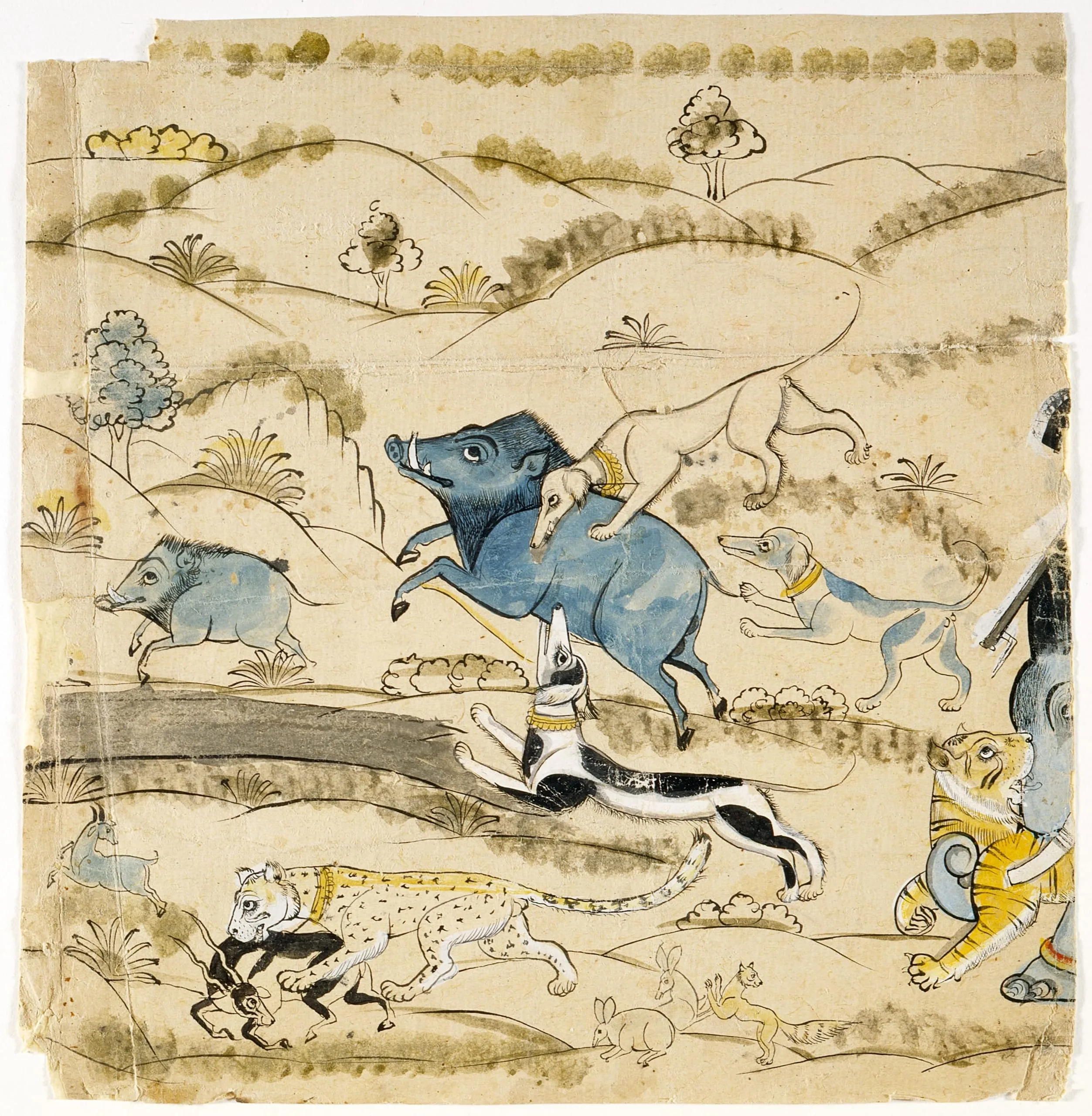
Hunting Scene (fragment)circa 1775-1800

Not on view
Ink and watercolor drawing on aged cream paper depicting a hunting scene with a rearing blue boar attacked by dogs, alongside a cheetah, rabbits, an elephant, and a tiger in a hilly landscape

Bagta, Hunting Scene (fragment), circa 1775-1800, Los Angeles County Museum of Art, Gift of Jane Greenough Green in memory of Edward Pelton Green, Photo © Museum Associates/ LACMA

Artist or Maker
Bagta
India, active circa 1761-1814
Title
Hunting Scene (fragment)
Place Made
India, Rajasthan, Mewar
Date Made
circa 1775-1800
Period
active 1765-1810
Medium
Ink and color washes on paper
Dimensions
10 5/8 x 10 1/8 in. (26.99 x 25.72 cm)
Credit Line
Gift of Jane Greenough Green in memory of Edward Pelton Green
Accession Number
AC1999.127.46
Classification
Paintings
Collecting Area
South and Southeast Asian Art
Curatorial Notes

Three saluki dogs—a type of greyhound originally brought to South Asia from the Near East and bred for hunting—are shown here attacking a boar in the annual spring hunt. Hunting fierce predators, particularly wild boars, tigers, lions, bears, and crocodiles, was a popular pastime that provided entertainment for the court and proved the bravery and prowess of the Rajput nobles. More importantly, the spring hunt was dedicated to the warrior goddess, Durga, and success was perceived as a good omen for the coming year. On the right side of this unfinished fragment, a hunter on elephant back aims his rifle at a tiger being attacked by the elephant. In the lower left corner, a trained cheetah, distinguished by its collar, attacks a gazelle. In the foreground, a fox standing on its hind legs battles a hare.

Bagta was a leading artist at the Mewar capital of Udaipur in circa 1761–1768 before becoming the resident court artist at Devgarh in 1769–1814. He was a prolific artist specializing in royal portraits and hunting scenes. For additional LACMA works attributed to Bagta, see M.79.69, M.87.278.3, and M.87.278.4.