LACMA

ShopMembershipMyLACMATickets
LACMA
Los Angeles County Museum of Art
5905 Wilshire Blvd.
Los Angeles, CA 90036
info@lacma.org
(323) 857-6000
Sign up to receive emails
Subscribe
© Museum Associates 2025

Museum Hours

Monday

11 am–6 pm

Tuesday

11 am–6 pm

Wednesday

Closed

Thursday

11 am–6 pm

Friday

11 am–8 pm

Saturday

10 am–7 pm

Sunday

10 am–7 pm


  • About LACMA
  • Jobs
  • Building LACMA
  • Host An Event
  • Unframed
  • Press
  • FAQs
  • Log in to MyLACMA
  • Privacy Policy
© Museum Associates 2025
Collections

Unknown
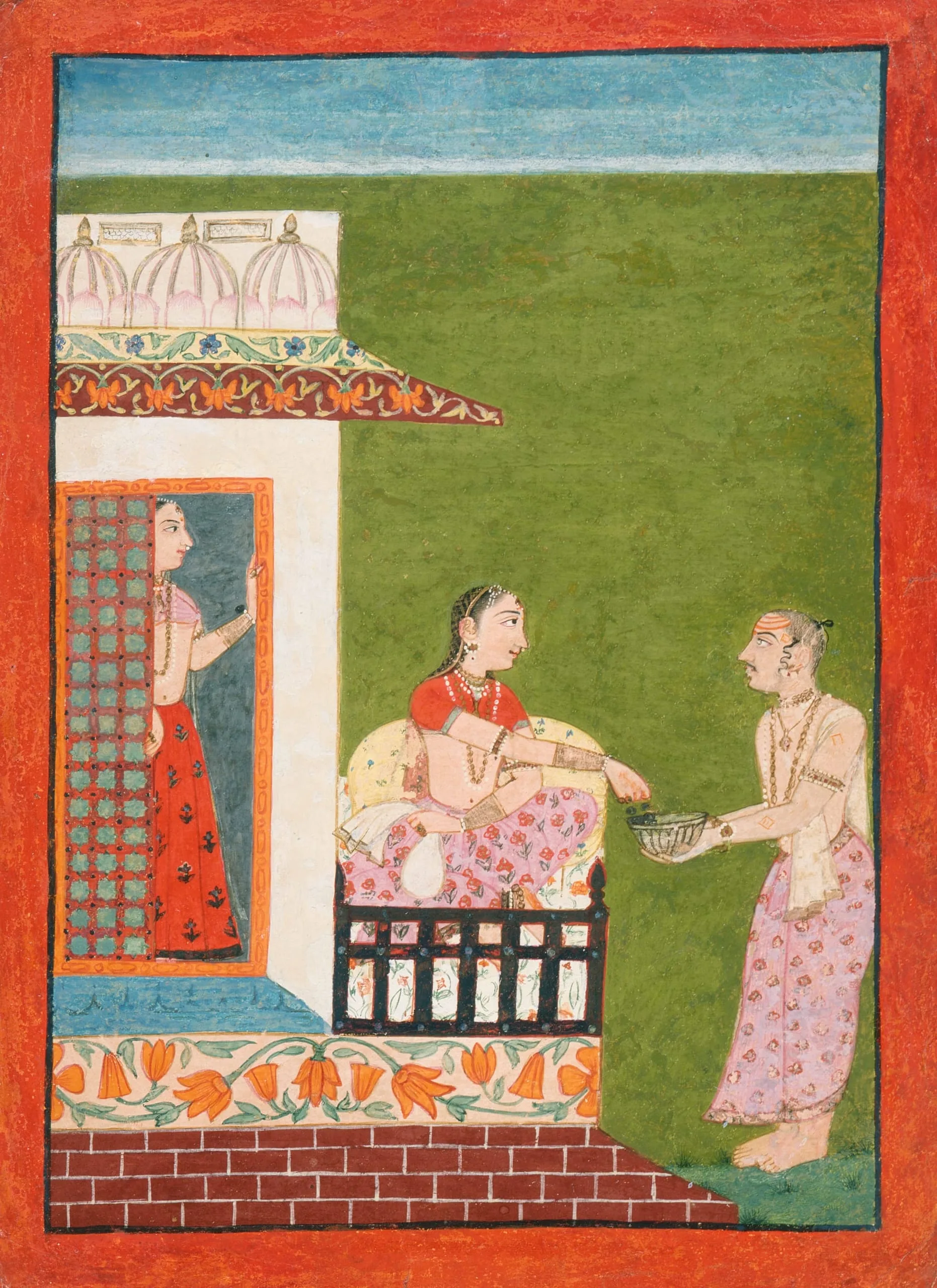
Punyaki Ragini, Fourth Wife of Bhairava Raga, Folio from a Ragamala (Garland of Melodies)circa 1700

Not on view
Indian miniature painting, three figures on a terrace — a seated woman receiving a tray from a standing man while a second woman watches from a doorway
Artist or Maker
Unknown
Title
Punyaki Ragini, Fourth Wife of Bhairava Raga, Folio from a Ragamala (Garland of Melodies)
Place Made
India, Himachal Pradesh, Bilaspur
Date Made
circa 1700
Period
18th century
Medium
Opaque watercolor and gold on paper
Dimensions
Image: 9 1/4 x 6 1/2 in. (23.5 x 16.51 cm); Sheet: 10 1/2 x 7 3/4 in. (26.67 x 19.69 cm)
Credit Line
Gift of Jane Greenough Green in memory of Edward Pelton Green
Accession Number
AC1999.127.7
Classification
Drawings
Collecting Area
South and Southeast Asian Art
Curatorial Notes

The reverse of this painting is inscribed in Takri as Punaki (Punyaki) Ragini and in Devanagari as Puravi Ragini. The apparent disparity in names is resolved through an analysis of the painting's iconography, which corroborates the former identification. Both inscriptions, however, label it correctly as the wife of Bhairava Raga, no. 4 (in the raga's family). Punyaki Ragini is a wife of Bhairava Raga according to the Kshemakarna System of classification, in which the melody is compared to the sound of rushing water (verse 107). The term "punya" means the earning of religious merit through charity. Consequently, as Indian religious ceremonies often involve the pouring of consecrated water over a holy man's hands, representations of Punyaki Ragini frequently show the woman of the house or palace pouring water over an ascetic’s hands (a ritual symbolic of giving).

Here, rather than pouring water over the mendicant’s hands, the woman is shown dropping coins into his alms bowl. Nevertheless, the underlying rationale is the same, as it is still a charitable act being portrayed. Indeed, other iconographic variations are known, including the offering to the mendicant of a piece of jewelry or even a sheaf of barley. The painting features the common Bilaspur stylistic characteristics of a long spiraling lock of hair in place of a sideburn for the ascetic, slightly stunted figures, a substantial depiction of brickwork, and a distinctive sultry palette.
Selected Bibliography
  • Pal, Pratapaditya; Markel, Stephen; Leoshko, Janice. Pleasure Gardens of the Mind: Indian Paintings from the Jane Greenough Green Collection. Los Angeles County Museum of Art; Mapin Publishing Pvt. Ltd.: Los Angeles, 1993.