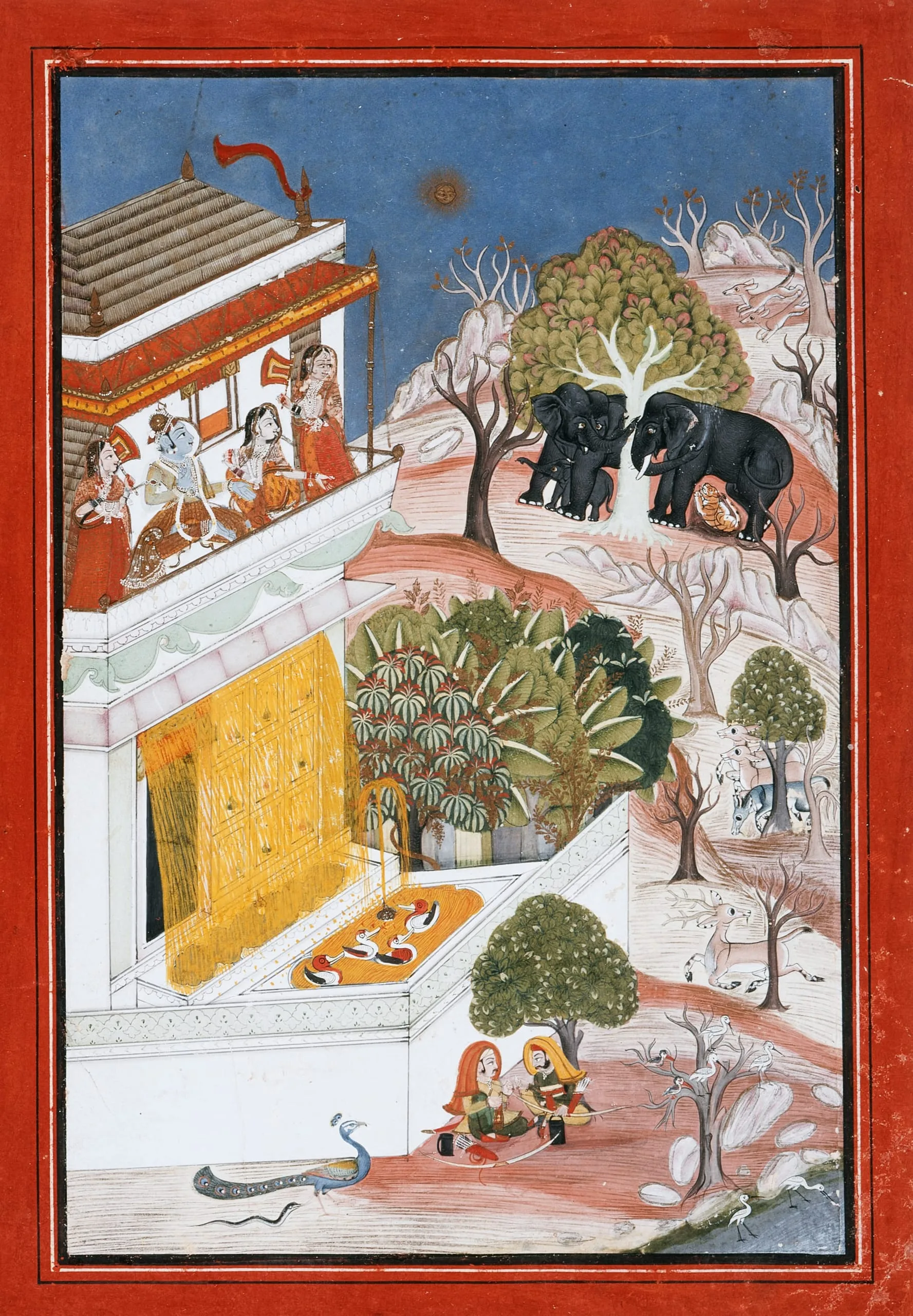
The Barahmasa (The Twelve Months) is a collection of poems adapted from India’s vast oral traditions that describe the months of the year and their correlating climates and emotional states. The most popular text for painters to illustrate was the Kavipriya (Poet’s Delight) composed in 1601 in Braj-Bhasa by the poet Keshavdas (1555–1617) of the Orchha court. Chapter 10 of the Kavipriya describes the life and activities of people and animals in each of the twelve lunar months.
This painting illustrates the month of Jyeshtha (May-June), as described in the Kavipriya:
The sun is so bright and scorching that the five elements - air, water, sky, earth and fire, have become one, i.e. hot as fire. The roads are deserted and the [water] tanks are parched dry, seeing which elephants do not go out. Even the cobra and lions sleep inside in this weather (and dare not go out because of the heat). Thus, even the powerful creatures have become weak in this season and the whole world is at unrest. Poet Keshavdas says that the elders are of the opinion that one should not go out in the season.
(Translation by V. P. Dwivedi.)
Radha and Krishna are seated on a balcony being fanned by two maidservants under a blazing sun. They are watching a family of elephants savoring the shade under a tree, with a tiger resting in the shade underneath one of the elephants. Nearby, antelope shelter under trees. In the foreground, two archers take relief under a tree’s shade.