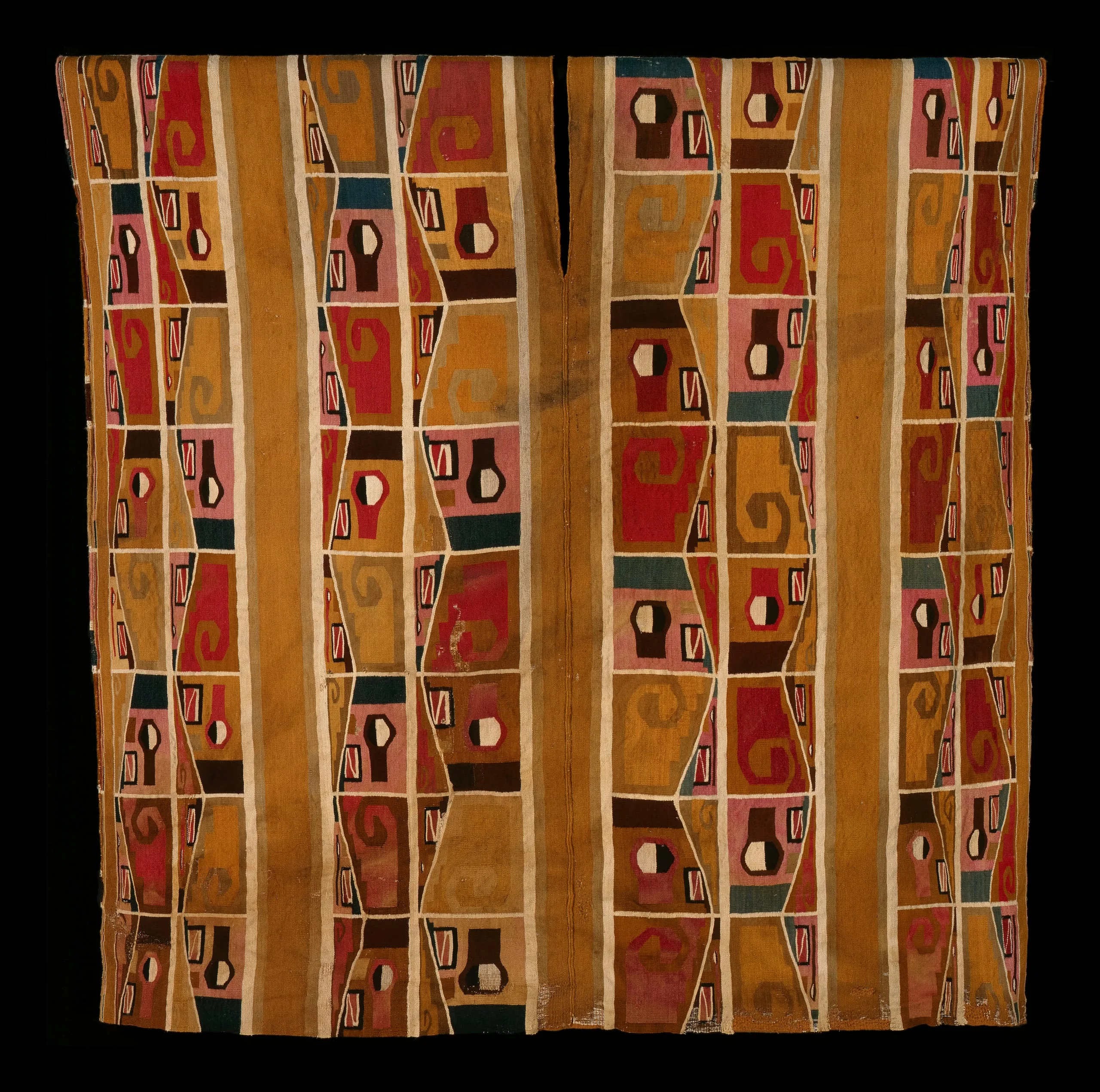
Although this tunic was woven centuries ago, its grid pattern and serial imagery are strikingly contemporary. Wari weavers used abstraction, stylization, and complex color patterning to reduce natural forms to powerful visual signs. The design format of the high-status tunic was minimal and quite rigid; columns of pattern alternated with columns of solid color, and motifs were developed within the confines of bands or grids.
One of the abstract patterns of the Wari textile “code,” the fanged human-feline, is recognizable here as a face in profile with a black and white circular “eye” enclosed in a keyhole shape. An N-shape nested in a square next to the eye acts as visual shorthand for the cat’s jaws and crossed fangs. The faces are alternately upright and upside-down, and the trapezoid shape above the eye (a stylization of a four-cornered hat; see M.79.81.2) forms a stepped diagonal pattern across the width of the tunic.
The profile face’s companion pattern is a stepped diagonal fused with a curlicue, known as a “stepped fret.” These motifs are intentionally distorted through elongation and compression; both expand and contract in a regular rhythm, growing narrower as they approach the sides of the tunic—where the face and the fret become so slender that only a few threads suffice to weave the pattern completely.
Nicole LaBouff via Kaye Spilker
2009