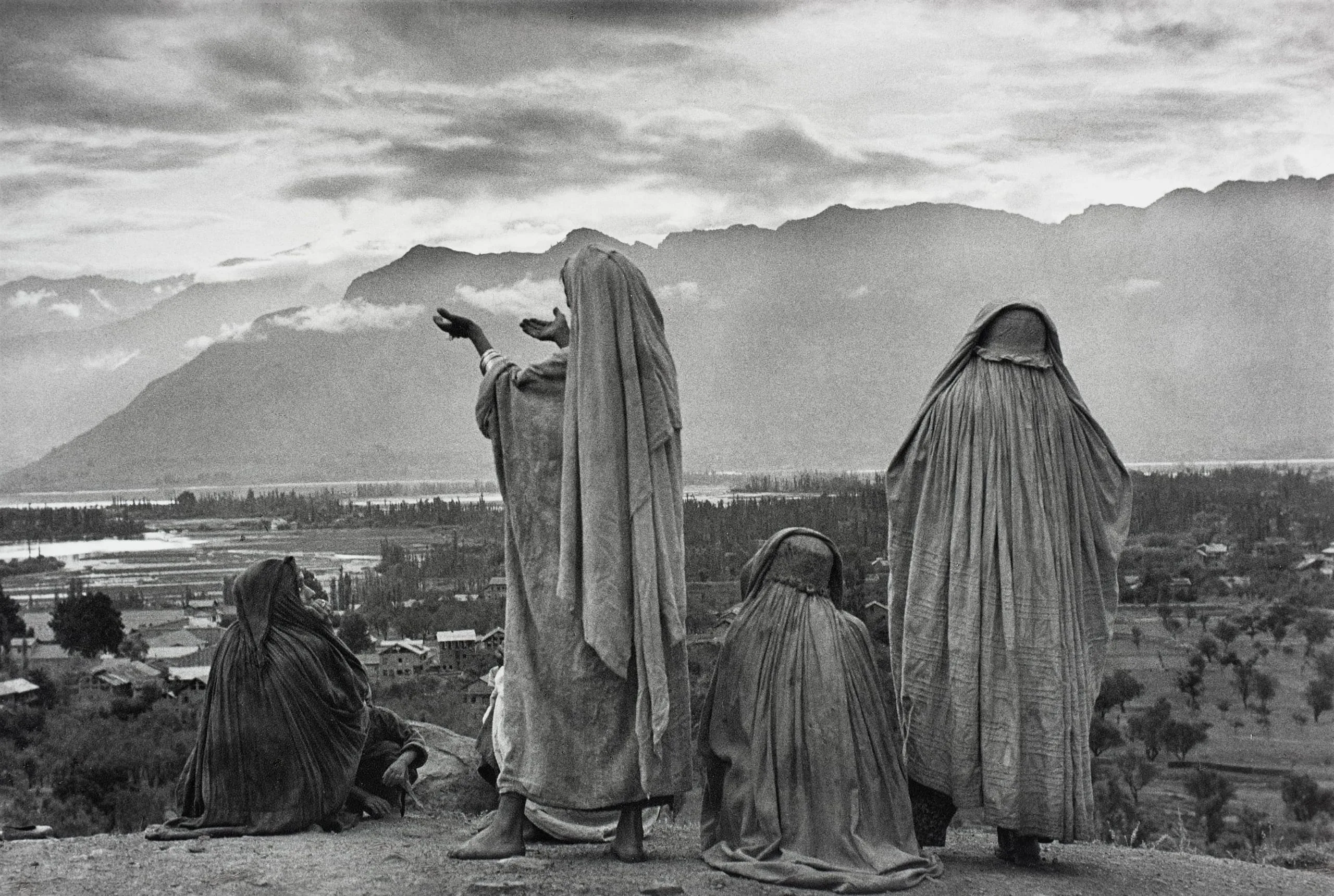
Henri Cartier-Bresson was a twentieth-century French street photographer known for his founding role in the formation of Magnum, a photography collective/agency begun in 1947 with Robert Capa, David Seymour (“Chim”), and George Rodger. Magnum was owned exclusively by its members, who were free to choose their own assignments and retained copyright to their images. Cartier-Bresson opted to cover India and China due to his particular interest in the extraordinary political and social changes precipitated by the postwar collapse of colonial rule. He arrived in India in 1947, just after the country gained independence from Great Britain, and would make five additional trips through 1986. His inaugural trip was marked by the assassination of Mahatma Gandhi, whose funeral Cartier-Bresson photographed.
Outside of that major political event, Cartier-Bresson’s photographs of India were guided by an interest in everyday people, in the markets, along the riverbanks, and throughout the mountainous regions. Srinagar, Kashmir, captioned “Muslim women praying at dawn in Srinagar,” shows four women, backs turned to the camera, looking out onto the valley. Cartier-Bresson often used the term “the decisive moment” to describe that fraction of a second when the precise organization of forms and the significance of an event converge in the camera. Here that moment is marked by the central figure’s hands, which are raised in prayer, framing and glorifying the cloud cover and the mountainous ridge in the distance. These Himalayan mountains were the source of Srinagar’s major industry—they are the home of the wild goats from which Kashmir shawls are made. Women typically sorted and spun the fine goat-hair fibers into yarns that were woven by men. Extremely labor-intensive to make, the shawls were too costly to be worn by the makers themselves. Although draped in fabric headcoverings and praying above a city well known for its Kashmir shawl industry, the women depicted are not wearing this luxury textile.