LACMA

ShopMembershipMyLACMATickets
LACMA
Los Angeles County Museum of Art
5905 Wilshire Blvd.
Los Angeles, CA 90036
info@lacma.org
(323) 857-6000
Sign up to receive emails
Subscribe
© Museum Associates 2025

Museum Hours

Monday

11 am–6 pm

Tuesday

11 am–6 pm

Wednesday

Closed

Thursday

11 am–6 pm

Friday

11 am–8 pm

Saturday

10 am–7 pm

Sunday

10 am–7 pm


  • About LACMA
  • Jobs
  • Building LACMA
  • Host An Event
  • Unframed
  • Press
  • FAQs
  • Log in to MyLACMA
  • Privacy Policy
© Museum Associates 2025
Collections

Unknown
Betel Box (pandan)circa 1750-1800

Not on view
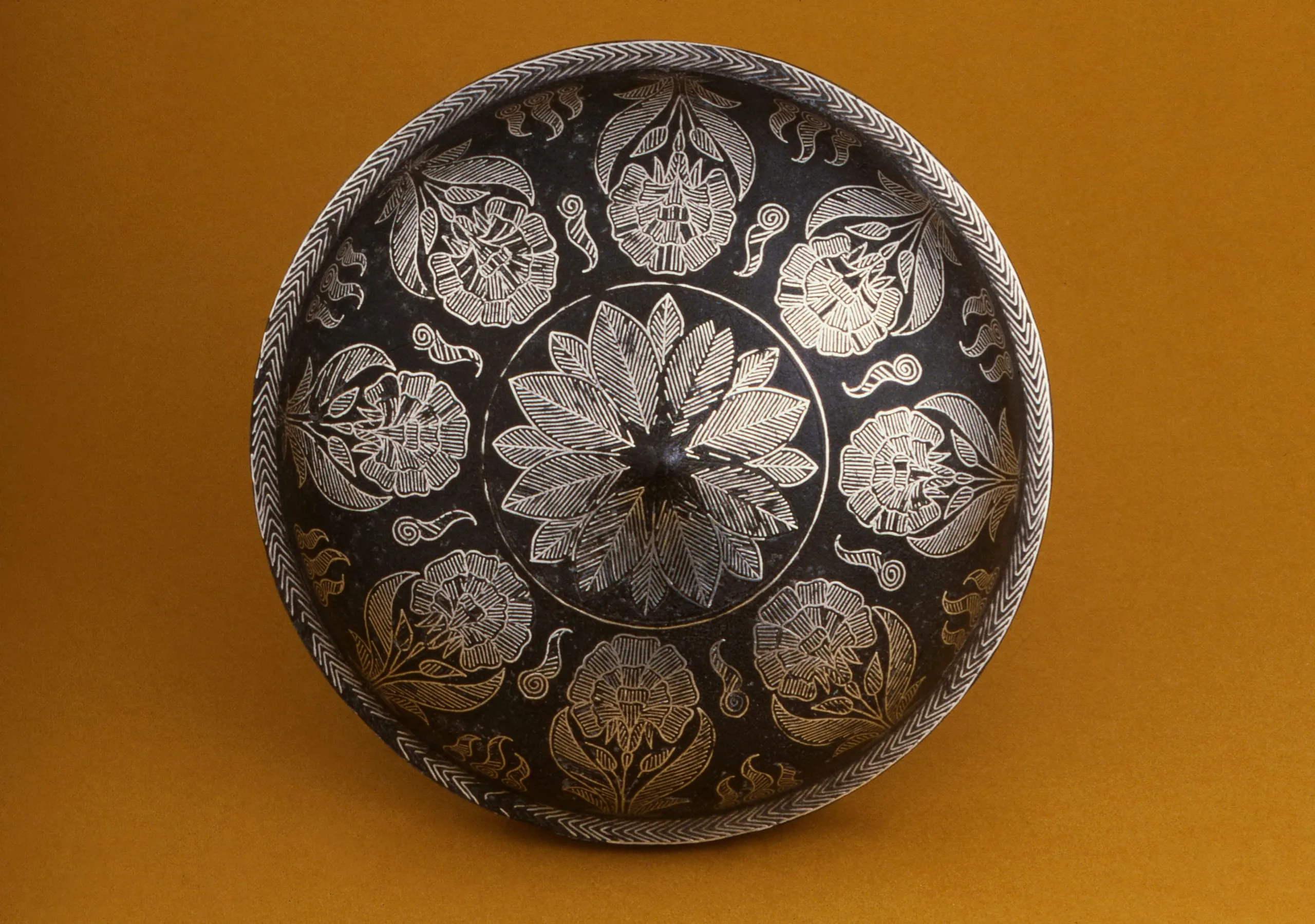
Dome-shaped dark metal vessel, nearly spherical, covered with densely engraved silver-toned floral and leaf designs, including a central eight-pointed rosette surrounded by large peony-like blooms
Artist or Maker
Unknown
Title
Betel Box (pandan)
Place Made
India, Telangana, Hyderabad or Karnataka, Bidar
Date Made
circa 1750-1800
Medium
Bidri ware (tarkashi technique)
Dimensions
4 x 5 3/4 in. (10.16 x 14.61 cm)
Credit Line
Gift of Margot and Hans Ries
Accession Number
M.81.278.4a-b
Classification
Furnishings
Collecting Area
South and Southeast Asian Art
Curatorial Notes

The bidri betel box is circular with concave sides and a pointed convex dome. There are no interior compartments. The ornamentation of the box consists solely of silver wire inlay (tarkashi technique), out of which are represented Mughal-descended floral sprays, scrolling tendrils and blossoms, small amoeba-like cloud swirls inherited from Chinese pictorial conventions through Iranian painting, and an overlapping leaf design on the peak of the dome.

From the 16th century onward, myriad diverse accoutrements made of bidri ware and other precious materials have been fashioned for use in the popular social custom and ritual of sharing pan, a ceremonial amenity and digestif made of cut betel nut, mineral lime powder or paste, sundry spices, and sometimes tobacco and even gold or silver foil all wrapped in a betel leaf (Piper betle). Ornate round, polygonal, lobed, or foliate containers (pandan) were used to offer guests the prepared pan quids. By the late 19th century, elaborate betel sets had evolved with interior compartments for storing the betel leaves and spices of the delicacy, the implements used to prepare it, and serving trays. These accessories were often made in sets with matching decoration.
Selected Bibliography
  • Sanfrani, Shehbaz H., ed. Golconda and Hyderabad. Bombay: Marg Publications, 1992.