Image
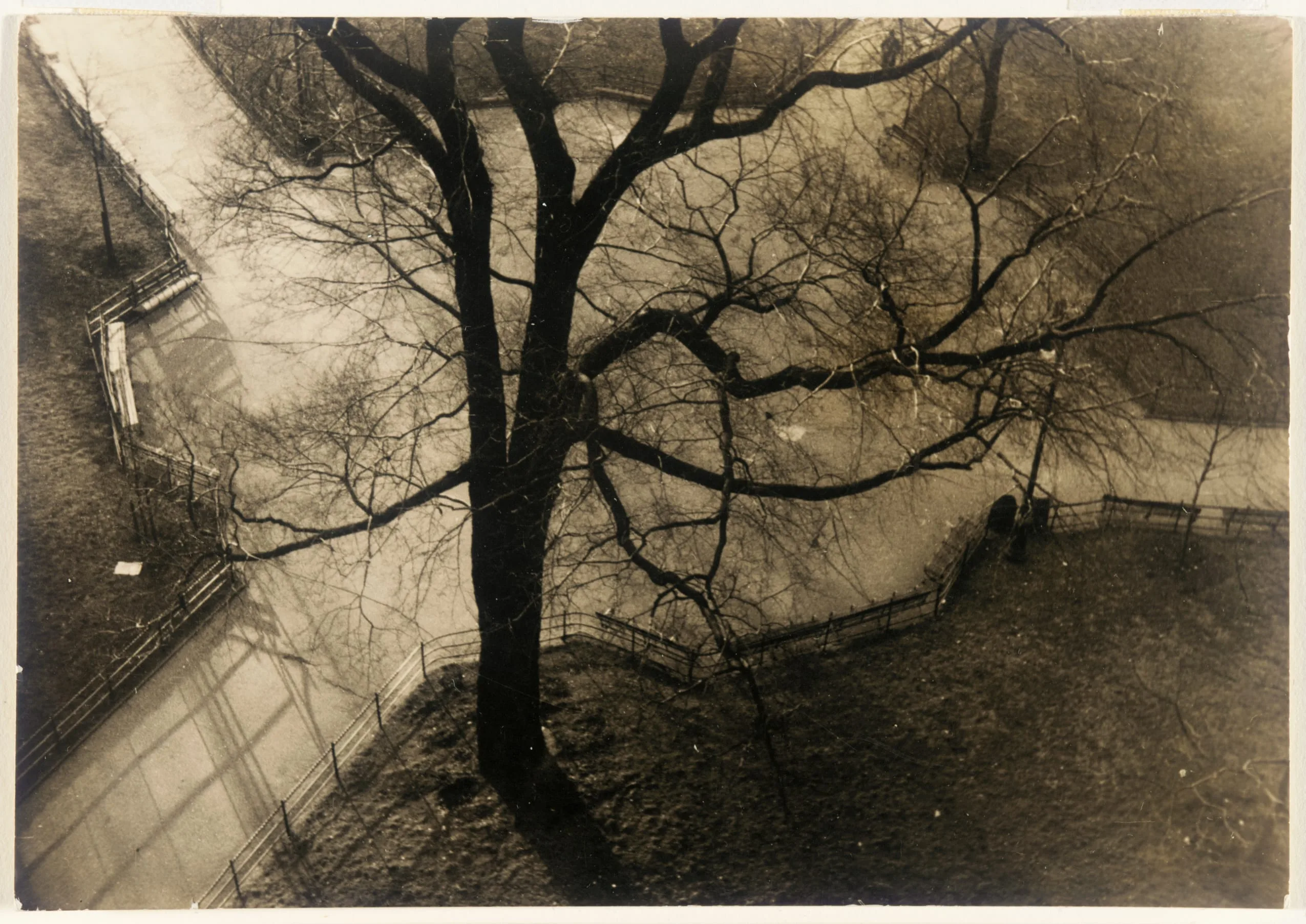
Marjorie Content's carefully framed composition and its contrasting tones abstract this scene of pedestrian walkways. The light pathway acts as a central shape that allows the viewer's eye to move through the tree's silhouette. The bird's-eye view emphasizes the graphic qualities of the visual elements. Contact-printed from a 5 x 7 inch negative, this sharply detailed print offers an intimate view, as if the artist is sharing a secret.
Technique
Marjorie Content used a hand-held camera and contact-printed the film negative onto gelatin silver paper, which bound the silver emulsion to the paper with a gelatin binder. This was the most popular printing material for commercial and amateur photographers until the popularization of color photography in the late 1960s. (For more on gelatin silver paper, see Untitled [Group].)
Context
Post—World War II artists took their cues from a rapidly changing world, using advances in technology to create their compositions. Rather than literally documenting scenes, they focused on visual elements and their relation to each other. Photographers created dramatic compositions that emphasized patterns, rhythms, and lines, or utilized tight cropping or bird's-eye views.
Marjorie Content was a member of the New York circle that included Alfred Stieglitz, Georgia O'Keeffe, Marsden Hartley, Kay Boyle, Maxwell Anderson, and other artists and writers. During the 1920s, she focused on cityscapes, flowers, still lifes, and portraits, approaching her subjects with an unpretentiousness that combined delicacy and purity of form to produce modest contact prints in small sizes. Her work has been described as poetic, exact, and elegiac. Influenced by the artistic tendencies of her New York friends, Content's straight photographic approach transformed ordinary subjects into visually wondrous images.