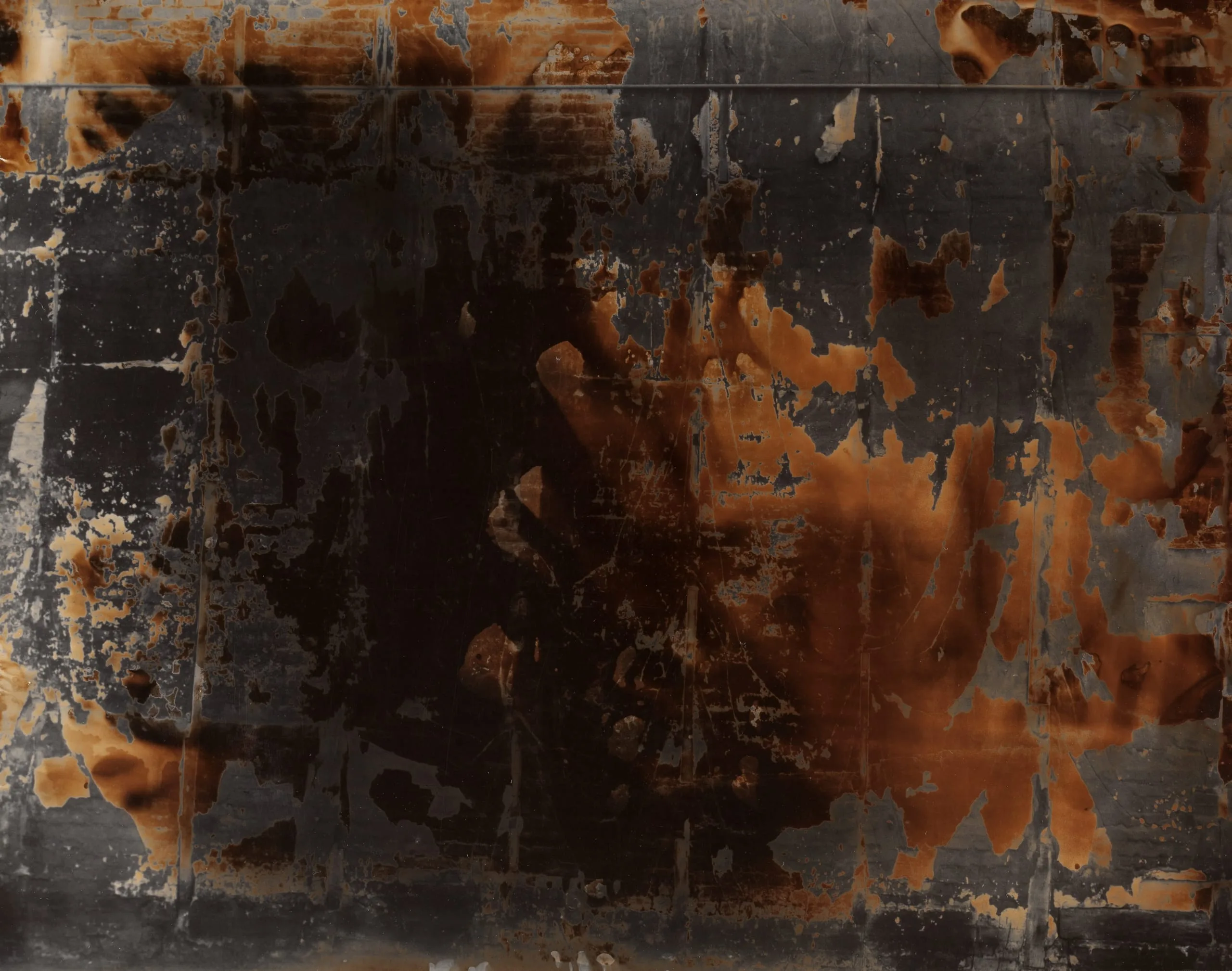
Edmund Teske’s photographic innovations, including the use of multiple negatives, solarization, and toning, allowed him to explore nonobjective imagery through chance. Philosophically this approach was rooted in the branch of Hinduism he studied in Los Angeles called Vedanta, which considers time as relational only to other moments in the universe. In terms of Teske’s art, this idea led him to experiment with breaking down the fixed status of a singular negative and instead create composite and overlapping images.
Wall is among his early duotone solarizations, a technique he accidentally happened upon in the late 1940s but began to perfect in 1958. After exposing the image on a high-contrast fiber-based paper and developing it normally, he immersed it in diluted solutions of stop bath and fixer. Pulling it out of the chemistry and onto a sheet of Plexiglas, he then blasted it with light before fixing it a second time and washing it. The influx of light creates spontaneous color effects in the form of copper color streaks and reversal of tones, giving the image an otherworldly ethereality. Teske often revitalized old negatives by printing them in this fashion. In 1959, he was approached by Edward Steichen, curator of photographs at the Museum of Modern Art, who acquired eleven of his works. It was Steichen who named Teske’s technique that we see in Wall “duotone solarization.”
Born in 1911 near Chicago’s South Side, Teske’s early forays into photography included family portraits with his mother’s box camera and learning darkroom techniques from his elementary school teacher. He also began piano and saxophone lessons while studying music theory, forever linking photography and music. He later described the joy of learning photography to be “like sitting down at the piano and getting lost in the musical composition” (Cox 2004: 2). Over the next ten years, Teske became a protégé to concert pianist Ida Lustgarten and installed his first solo photography exhibition at Chicago’s Blackstone Theatre. He held a series of commercial photography jobs that included working in the studio of A. George Miller and commissions from Frank Lloyd Wright documenting the architect’s buildings throughout Illinois and Wisconsin. He also worked for the U.S. Army Corps of Engineers, the Federal Arts Project, and the New Bauhaus.
Teske moved to Los Angeles in 1943 and, through Wright, met Aline Barnsdall, who invited him to live in Studio Residence B adjacent to Hollyhock House. By 1949, he was entrenched in the city’s bohemian culture, teaching and making work that he regularly exhibited locally and internationally.
Rebecca Morse, Curator, Wallis Annenberg Photography Department
2024
Bibliography
Cox 2004. Julian Cox. Spirit into Matter: The Photographs of Edmund Teske. Los Angeles: The J. Paul Getty Museum, 2004.