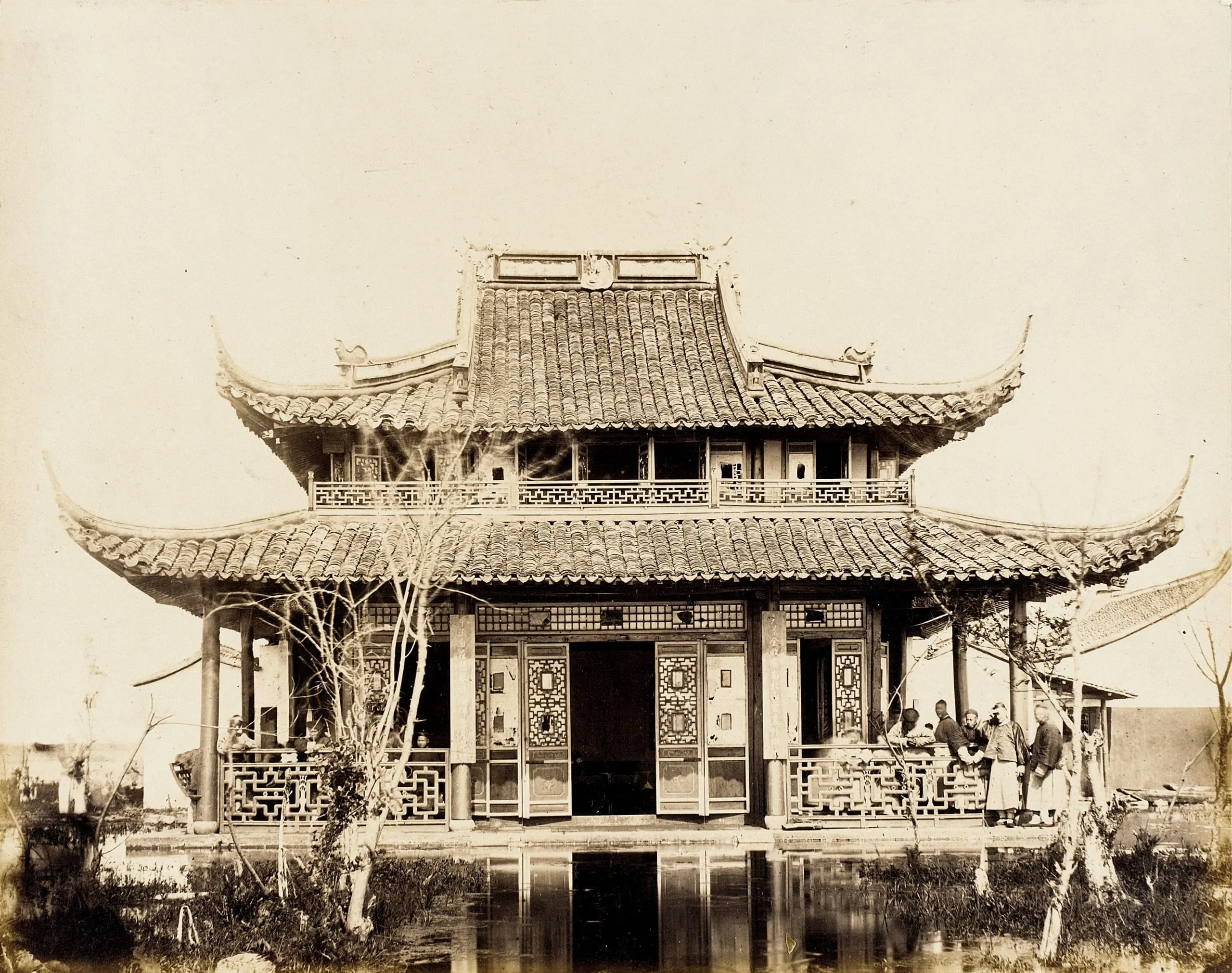
The Chinese structure symmetrically fills the frame. Although the building resembles a temple, the words on the banners to the left and right of the entrance are not religious in nature, and it is supposed that it is a tea room. The people captured on the edges of the photograph are incidental to the purpose of this photograph, which was to depict in exacting detail the distinctive architecture of China.
Technique
Felice Beato used the cumbersome collodion on glass (wet-plate) process, traveling with a heavy, large-format camera, coating glass plates with chemicals, exposing them while they were still wet, developing the plates quickly in a portable darkroom before they dried, and contact-printing his negatives onto albumen paper. With the image suspended on the surface of the paper in the layer of egg white (albumen), the photographs have a startling clarity from both the glass negative and the albumen paper. The brown tone is a result of being printed in sunlight. The blurring of the figures reveals the long exposure time. (For more on the collodion on glass process, see the Alinari Brothers' Campanile, Pisa. For more on albumen prints, see Alfred Capel-Cure's St. Ouen, Rouen.)
Context
Felice Beato is considered one of the first photojournalists. He traveled through Asia, the Mediterranean, and the Middle East to photograph people, architecture, landscapes, and events for European and American audiences. A British subject from the Greek island of Corfu, Beato recorded Britain's colonialist conflicts and the human consequences of the British expansionist wars. His photographs were the first to show dead bodies of British enemy forces.
Beato had been a photographer since 1850 when he formed a partnership with British photographer James Robertson and completed assignments with him in the Crimea and Northern India, where he documented the Indian Rebellion of 1857. In 1860, Beato left the partnership and went to China to photograph the Anglo-French military campaign in the Second Opium War. After arriving in Hong Kong in March, he traveled with the army for months, before their campaign against the Chinese emperor's Summer Palace, Qingyi Yuan (Garden of Clear Ripples) in the fall. The Summer Palace was one of the emperor's private estates, with palace pavilions, temples, gardens, and a large artificial lake. Beato photographed buildings that were later looted and burned to the ground by Anglo-French forces in retaliation for the deaths of twenty members of an Anglo-French diplomatic party. Before leaving China, Beato photographed Lord Elgin with Prince Kung as they signed the Convention of Peking, a group of treaties.
Beato returned to England in 1861 and sold four hundred of his photographs of India and China to a London photographer who duplicated and resold them. Beato's photographs were expensive, offered in a series for £37,8 ($416) when the average annual per capita income was £32 ($352).


![Artists Represent Themselves: Frida Orupabo on “Untitled (sources unknown except Shadman Shahid [bottom left])”](/_next/image?url=https%3A%2F%2Funframed.lacma.org%2Fsites%2Fdefault%2Ffiles%2Fstyles%2Farticle_full%2Fpublic%2Ffield%2Fimage%2FM2020_265_1_1-4-20221012-Access.jpg%3Fitok%3DemgBGR8Z&w=828&q=75)


