Image
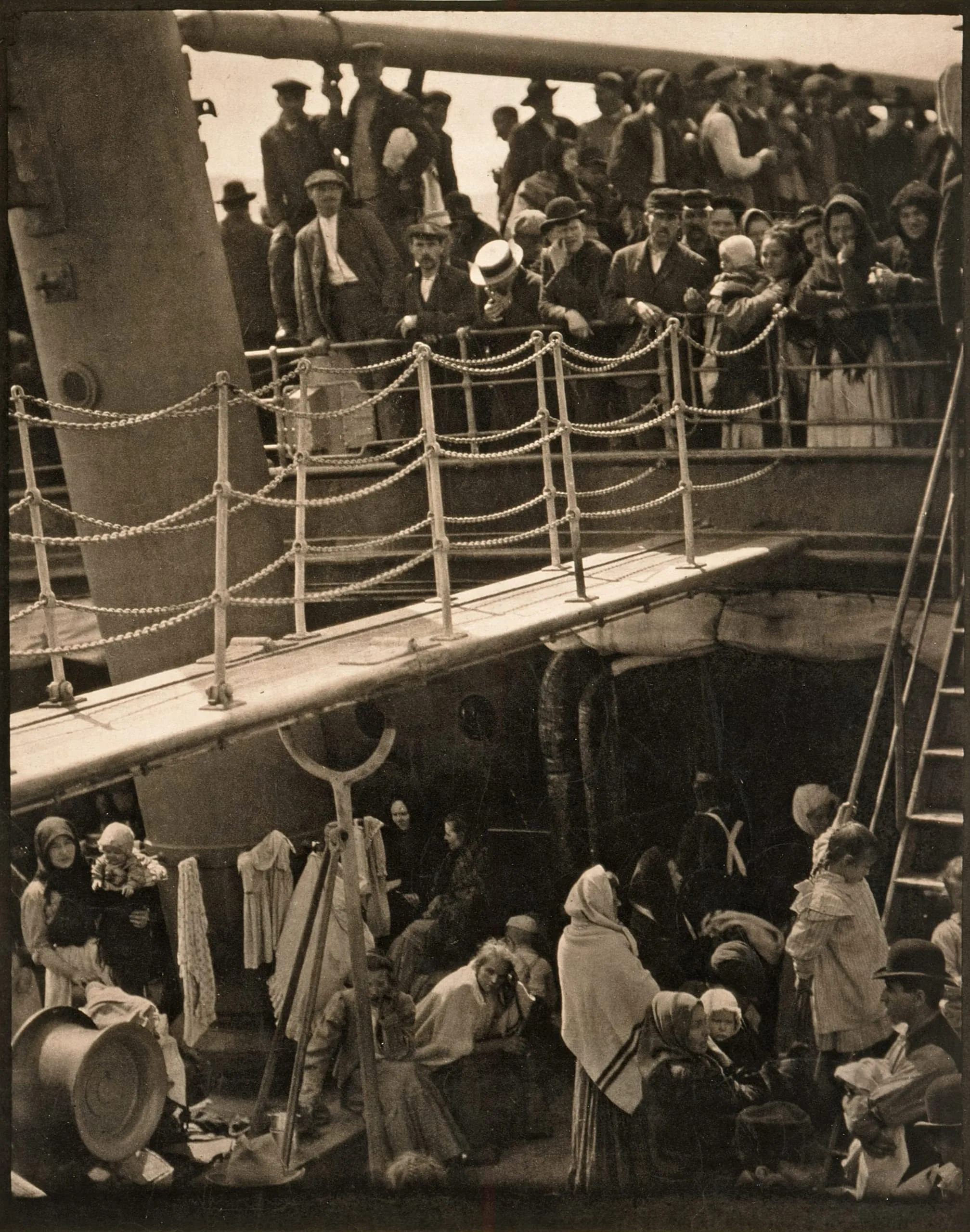
The Steerage is one of Alfred Stieglitz's signature works and one that he has described as his first "Modernist"5 photograph. He wrote that he was captivated by both the shapes and lines that he saw, as well as the feeling the scene evoked in him:
The scene fascinated me: A round straw hat; the funnel leaning left, the stairway leaning right; the white drawbridge, its railings made of chain; white suspenders crossed on the back of a man below; circular iron machinery; a mast that cut into the sky, completing a triangle. I stood spellbound for a while. I saw shapes related to one another—a picture of shapes, and underlying it, a new vision that held me: simple people; the feeling of ship, ocean, sky; a sense of release that I was away from the mob called the "rich." Rembrandt came into my mind and I wondered would he have felt as I did.
Technique
Photogravure was invented in the 1830s and refined in the 1870s. An intaglio printmaking process in which the photographic image is etched into a copper plate, photogravure is both archival and permanent. Created by transferring ink from the etched copperplate to dampened paper run through an etching press, the photogravure has a uniquely wide tonal range because the practitioner can vary the depth of etching between shadows and highlights. The range achieved by this plate—whose varying quantities and depths of ink wells are blended into smooth tones during printing—is greater than the halftone processes used in magazines and newspapers, in which variable sizes of tiny dots are used to convey tone. Photogravure became a high-quality enterprise at the end of the nineteenth century, and Alfred Stieglitz was an exemplary practitioner.
Context
Alfred Stieglitz was one of the central figures in art in early-twentieth-century America, playing key roles as a photographer, gallerist, and writer. His stylistic trajectory from pictorialism to "straight photography" illustrates the point at which photography began to be celebrated for its own characteristics rather than for those qualities that conformed to the conventions of other accepted artistic mediums.
In 1902, Stieglitz formed an invitation-only group called the Photo-Secession, whose members included Edward Steichen, Gertrude Käsebier, Clarence H. White, and Alvin Langdon Coburn, who believed in the medium's artistic value for individual expression. He founded the group's publication, Camera Work,. which he would edit through 1917. He also organized exhibitions in Gallery 291, a space that later became known simply as "291" for its Fifth Avenue address, showing work by a range of European and American artists including Auguste Rodin, Pablo Picasso, Henri Matisse, Francis Picabia, Marsden Hartley, Max Weber, and, later, Georgia O'Keeffe.