- Title
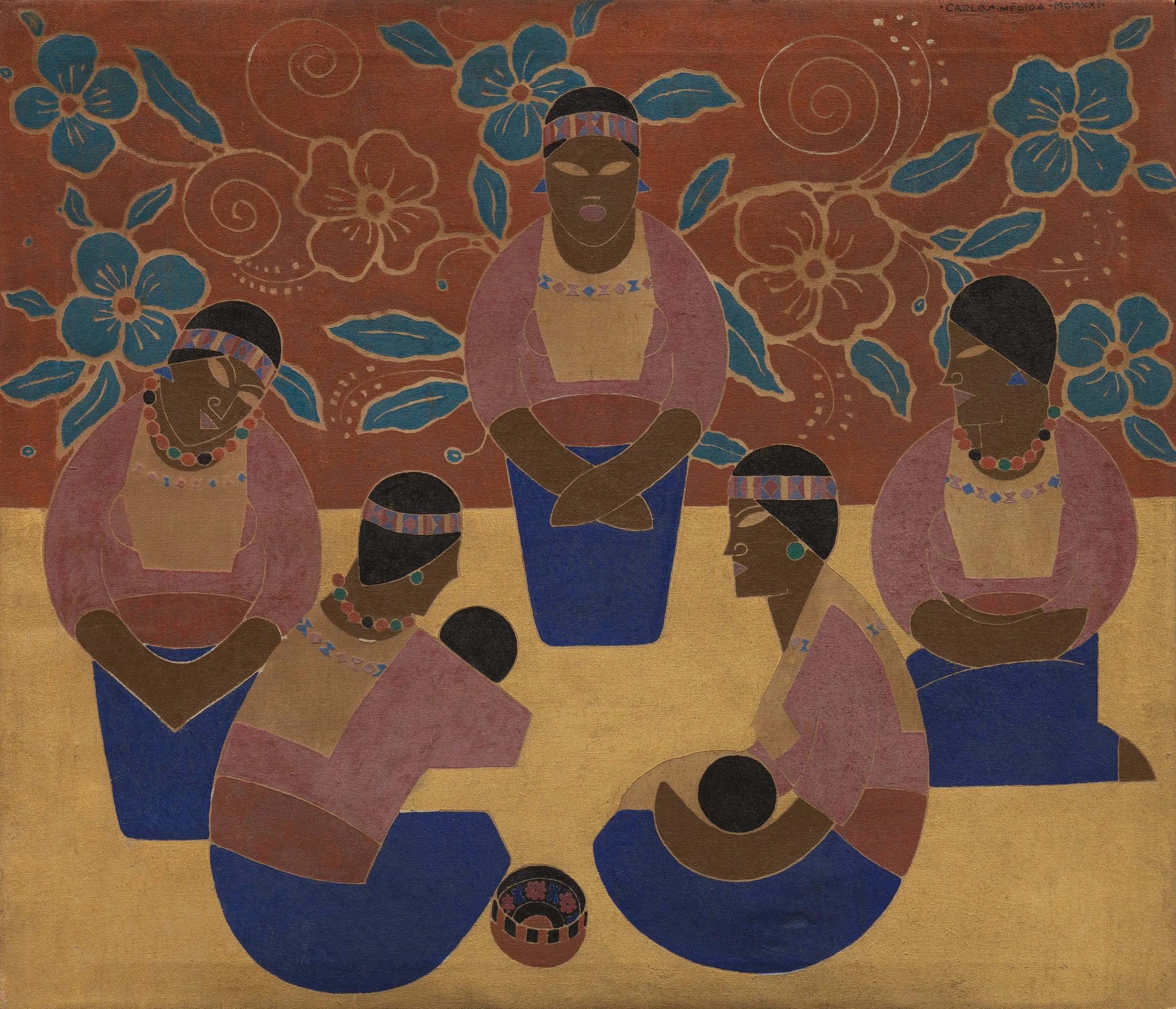
- Panajachel (Structural Study for a Mural) [Panajachel (Estudio estructural para mural)]
- Date Made
- 1921
- Medium
- Oil on canvas
- Dimensions
- Unframed: 31 × 34 1/8 in. (78.74 × 86.68 cm), framed: 34 3/4 × 39 × 1 1/2 in. (88.27 × 99.06 × 3.81 cm)
- Accession Number
- AC1997.LWN.323
- Curatorial Notes
Panajachel (titled after a town on the shore of Lake Atitlán in Guatemala) features a group of seated Maya-K’iche’ women with traditional dress, accessories, and pottery. The floral motif behind the women echoes that on the painted bowl in the foreground, further highlighting Indigenous craft. For Carlos Mérida, who was of Mayan descent and spent several years immersed in the Parisian avant-garde, Mexican and Guatemalan popular arts served as a distinctively local source to abstraction.
Mérida arrived in Mexico from his native Guatemala at a pivotal moment when the country’s decade of armed revolution was coming to an end and a new cultural and artistic movement was beginning to flourish. Within a year, he had his first solo exhibition at the Escuela Nacional de Bellas Artes (National School of Fine Arts) in Mexico City. With this exhibition and works like Panajachel, Mérida aspired to showcase his abilities to Mexican authorities in the hopes of securing a commission in the burgeoning Mexican mural movement.
Rachel Kaplan
2024
- Selected Bibliography
- Los Angeles County Museum of Art. New York: Thames and Hudson, 2003.
- Copyright
- © Estate of Carlos Merida / Licensed by ARS, New York, NY