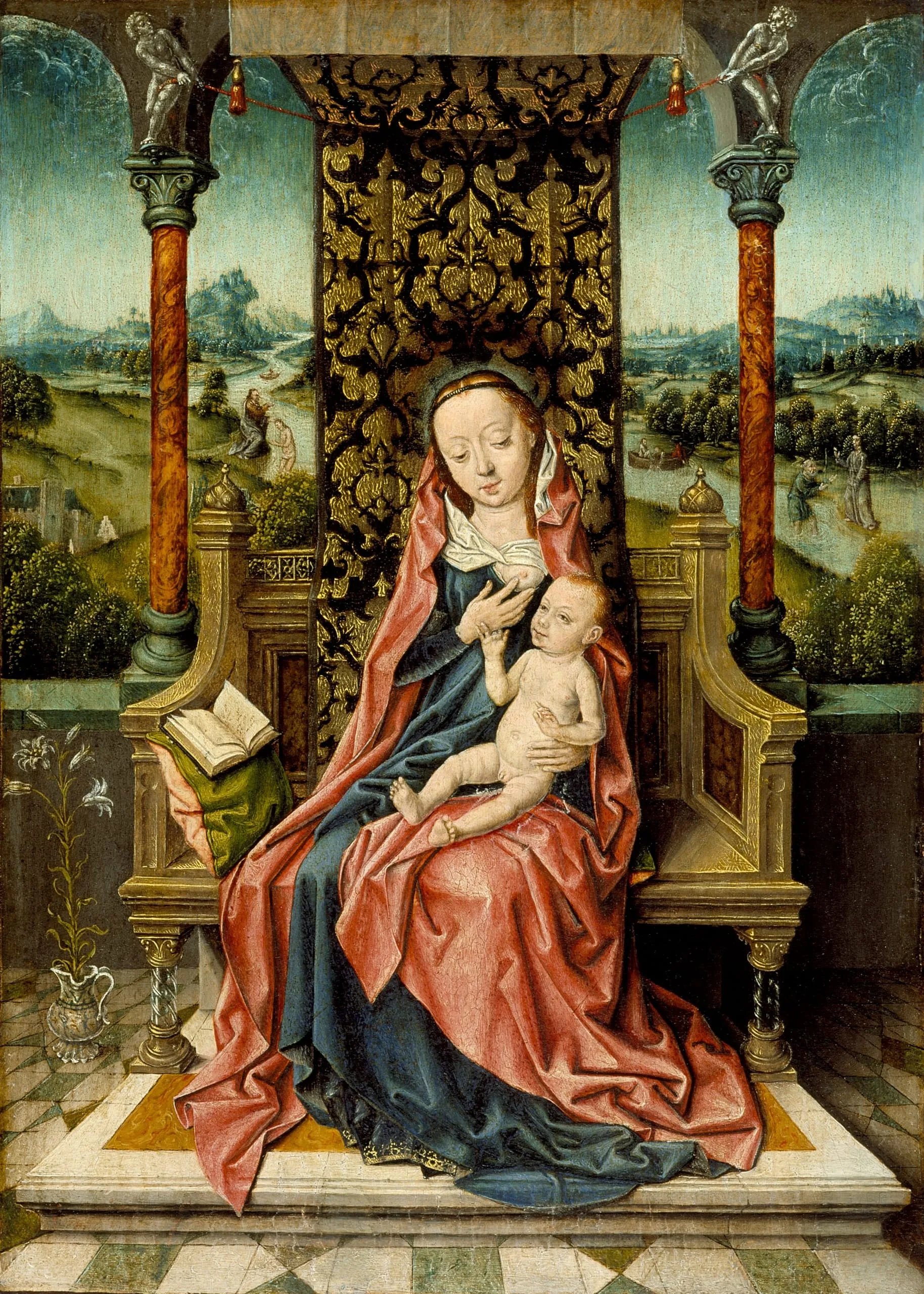
Small-scale images of holy figures, like this painting of the Virgin Mary and Christ Child, were popular aids for Christian personal devotion in western Europe. Its similarity to other works associated with Bouts and his artist family speaks to an active workshop practice using compositional models to meet the demands of the marketplace. The central figures are borrowed directly from a painting attributed to his father Dieric Bouts (Musée du Louvre, MI 734). In both, the enthroned Virgin wears a deep blue dress and red cloak and is seated next to an open book perched on a pillow. She gestures to her bare breast to reinforce her role as mother and emphasize Christ’s humanity. Yet the background of this devotional image is highly elaborate compared to its predecessor. Scenes from Christ’s life take place in the landscape, including his baptism, likely the Calling of the Fishermen, and a conversation with Saint Peter, episodes that also appear in other paintings by Aelbrecht Bouts’s workshop. While our contemporary society prizes the unique, during the medieval and Renaissance eras, copies signaled a successful composition, and multiplication increased the devotional potency of an object. It was common practice for studios to recycle and elaborate on designs.
Luxurious details add to the painting’s spiritual significance. Mary’s decorative stone throne is crafted with marble inlay and rock crystal legs. On the floor to her right is a blue-and-white ceramic vase holding a tall lily stem. Both the lily and the rock crystal allude to the Virgin’s purity. Framing the throne are two marble columns topped with stone capitals and animated sculptures supporting a Cloth of Honor, which visually reinforces the Virgin’s revered status. The textile hanging simulates a “cloth of gold,” an expensive brocade of cut silk velvet. Often rendered with a metallic “pomegranate” pattern (a loose term applied to a range of decorative flora designs), these fabrics were popularized in Northern Europe through merchants who imported textiles from various production centers, including Italy and Turkey.