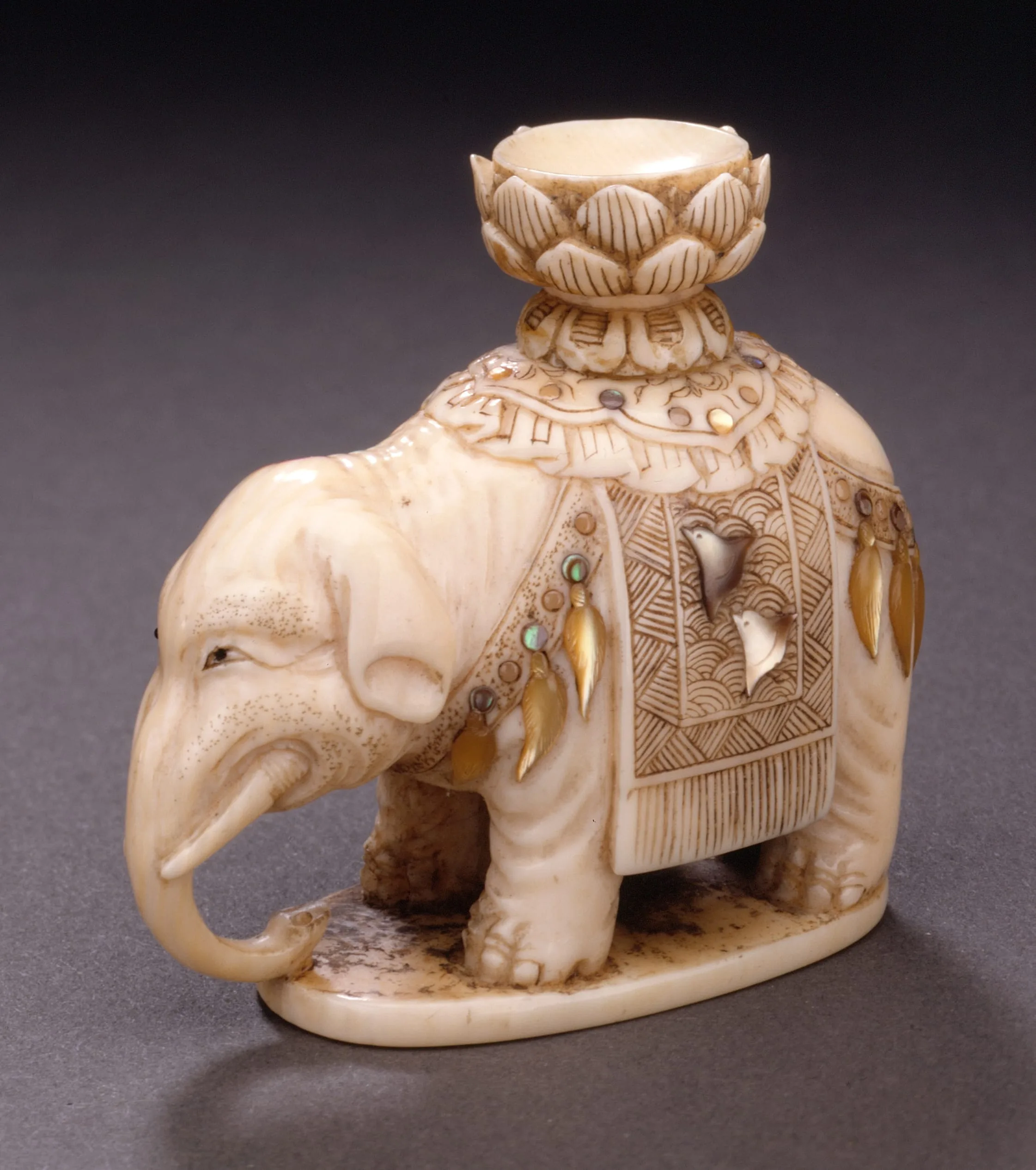
In netsuke, the depiction of elephants is predominantly related to their foreign origins and their reputation as “exotic” beasts. As there are no species of elephant native to Japan, their appearance there during the Edo period (1615−1868), brought by foreigners as gifts to the court, caused a sensation. In addition to being emblematic of the strange people and customs of the outside world, the elephant was a sacred creature intricately linked with traditional Buddhist beliefs, and appears most frequently in Buddhist art as the mount of the Bodhisattva Fugen. In traditional Buddhist art, the glorious world of enlightenment is expressed through the use of elaborate decoration. Hence, both Fugen and his elephant are portrayed in brightly colored, lavish dress and bejeweled accessories.
Notwithstanding the elephant’s religious significance, symbolism, and foreign references, however, it may have held quite a different attraction for some Japanese artisans. The caparisoned elephant, as seen here, was an ideal subject for exhibiting one’s artistic skills. Lacquerers, carvers, and artisans working with decorative techniques such as inlay created netsuke, inrō, and other works that were marvels of design, color, and detail. Here, the ornate embellishment reflects a style that originated with the late eighteenth-century artist Shibayama, who specialized in ivory works with innumerable small inlays in a variety of materials, including mother-of-pearl, coral, horn, glass, tortoiseshell, metals, and semiprecious stones.
Fugen is the protector of those who teach or practice Buddhism. From his place atop his white elephant, he encourages worshippers to practice the precepts of Buddhism and to conduct themselves accordingly. His elephant mount is symbolic of the power to overcome obstacles. A giant open lotus blossom on the elephant’s back serves as the pedestal upon which Fugen rests. In sculptural representations, the bodhisattva may be omitted and the pedestal transformed into a bowl for religious offerings, as here.
2024