LACMA

ShopMembershipMyLACMATickets
LACMA
Los Angeles County Museum of Art
5905 Wilshire Blvd.
Los Angeles, CA 90036
info@lacma.org
(323) 857-6000
Sign up to receive emails
Subscribe
© Museum Associates 2026
  • About LACMA
  • Jobs
  • Building LACMA
  • Host An Event
  • Unframed
  • Press
  • FAQs
  • Log in to MyLACMA
  • Privacy Policy
© Museum Associates 2026
Collections

Ryūkei I
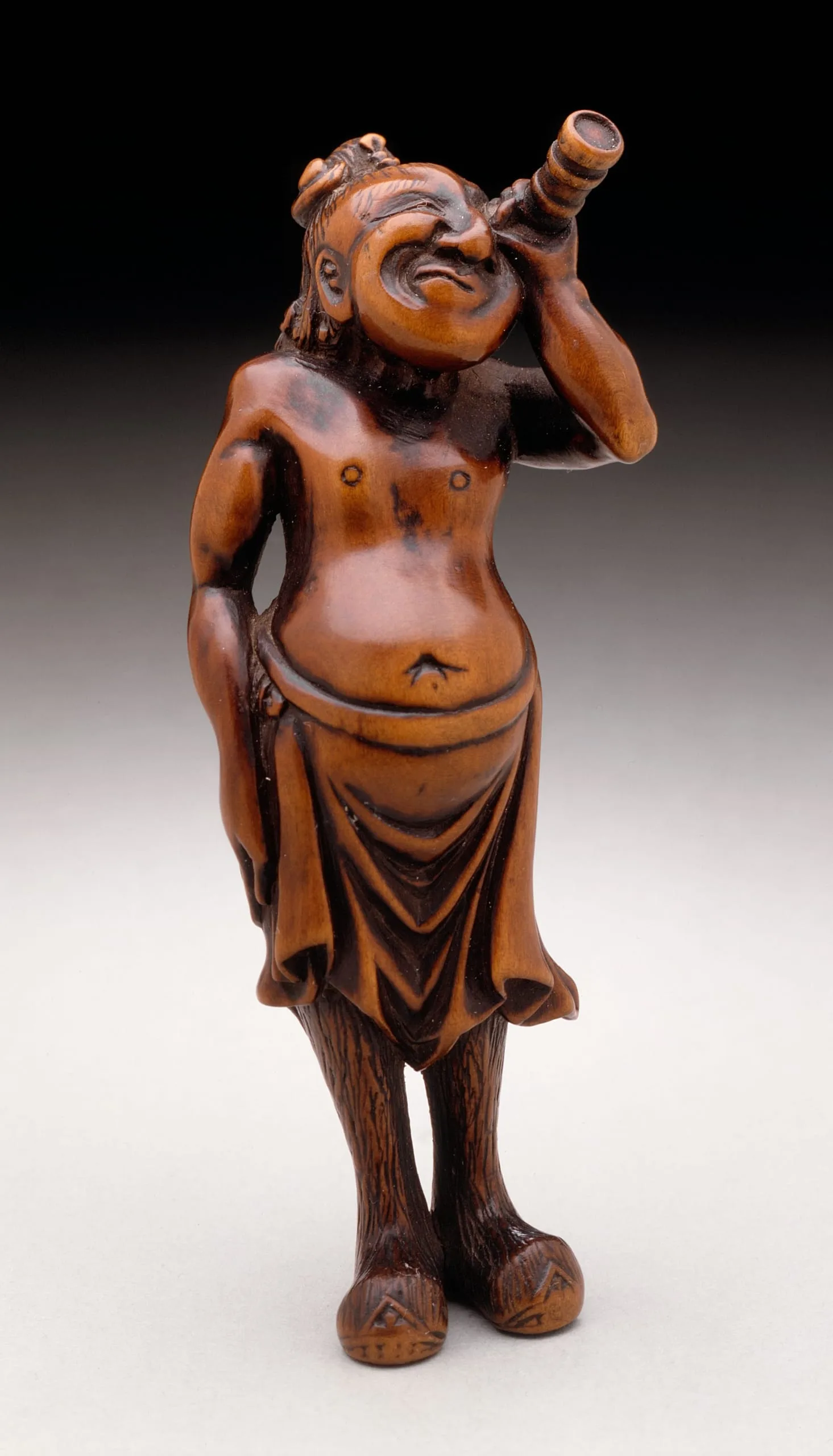
Pacific Islander Using Spyglasslate 18th-early 19th century

Not on view
Small carved wood netsuke of a rotund standing figure with bare torso, draped cloth at hips, head tilted back drinking from a tube, with exaggerated facial features

Ryūkei I, Pacific Islander Using Spyglass, late 18th-early 19th century, Los Angeles County Museum of Art, Raymond and Frances Bushell Collection, photo © Museum Associates/LACMA

Artist or Maker
Ryūkei I
Japan, active late 18th-early 19th century
Title
Pacific Islander Using Spyglass
Place Made
Japan
Date Made
late 18th-early 19th century
Period
Edo period (1603-1868)
Medium
Wood
Dimensions
2 15/16 x 1 1/16 x 13/16 in. (7.5 x 2.7 x 2.0 cm)
Credit Line
Raymond and Frances Bushell Collection
Accession Number
M.91.250.306
Classification
Costumes
Collecting Area
Japanese Art
Curatorial Notes

In the mid-seventeenth century, Japan’s ruling shogun cut off nearly all ties to the outside world, launching a period of self-isolation (sakoku) that would last more than 200 years. Contact was limited to highly regulated interaction with Chinese and Dutch traders. Crewmen, laborers, attendants, and servants were essential to the daily running of foreign trade companies, and Edo-period (1615−1868) Japanese paintings and prints of Dutch ships show that many of the shipmates and workers loading and unloading vessels were people from island cultures. The Dutch East India Company, headquartered in Batavia (present-day Jakarta), employed workers from Indonesia or nearby islands. Laborers or sailors also came from the numerous ports through which ships passed on route to Japan. Like the Dutch merchants, they were a curiosity to the Japanese and likewise appeared as subjects in netsuke.

In nearly all examples of “islander” netsuke, the figure is an amalgamation of attributes taken from different cultures. This figure wears a cloth skirt, the typical attire ascribed to islanders. However, here his legs are covered in what appear to be leggings or boots, and he wears closed shoes similar to those seen on Dutchmen netsuke. Another Western attribute is the spyglass, imported in increasing numbers in the latter part of the eighteenth century. Woodblock prints of Dutch merchant ships include South Asian crew peering through spyglasses.

2024
Selected Bibliography
  • Bushell, Raymond. An Exhibition of Netsuke from the Raymond Bushell Collection. Tokyo: Mikimoto World Jewelers, 1979.
  • Goodall, Hollis, Virginia G. Atchley, Neil K. Davey, Christine Drosse, Sebastian Izzard, Odile Madden, and Robert T. Singer. The Raymond and Frances Bushell Collection of Netsuke: A Legacy at the Los Angeles County Museum of Art. Chicago: Art Media Resources, Inc.; Los Angeles: Los Angeles County Museum of Art, 2003.
  • Bushell, Raymond. Netsuke: Japanese Sculpture in Miniature from the Collection of Raymond and Frances Bushell, Part IV. Los Angeles: Los Angeles County Museum of Art, 1987.