- Title
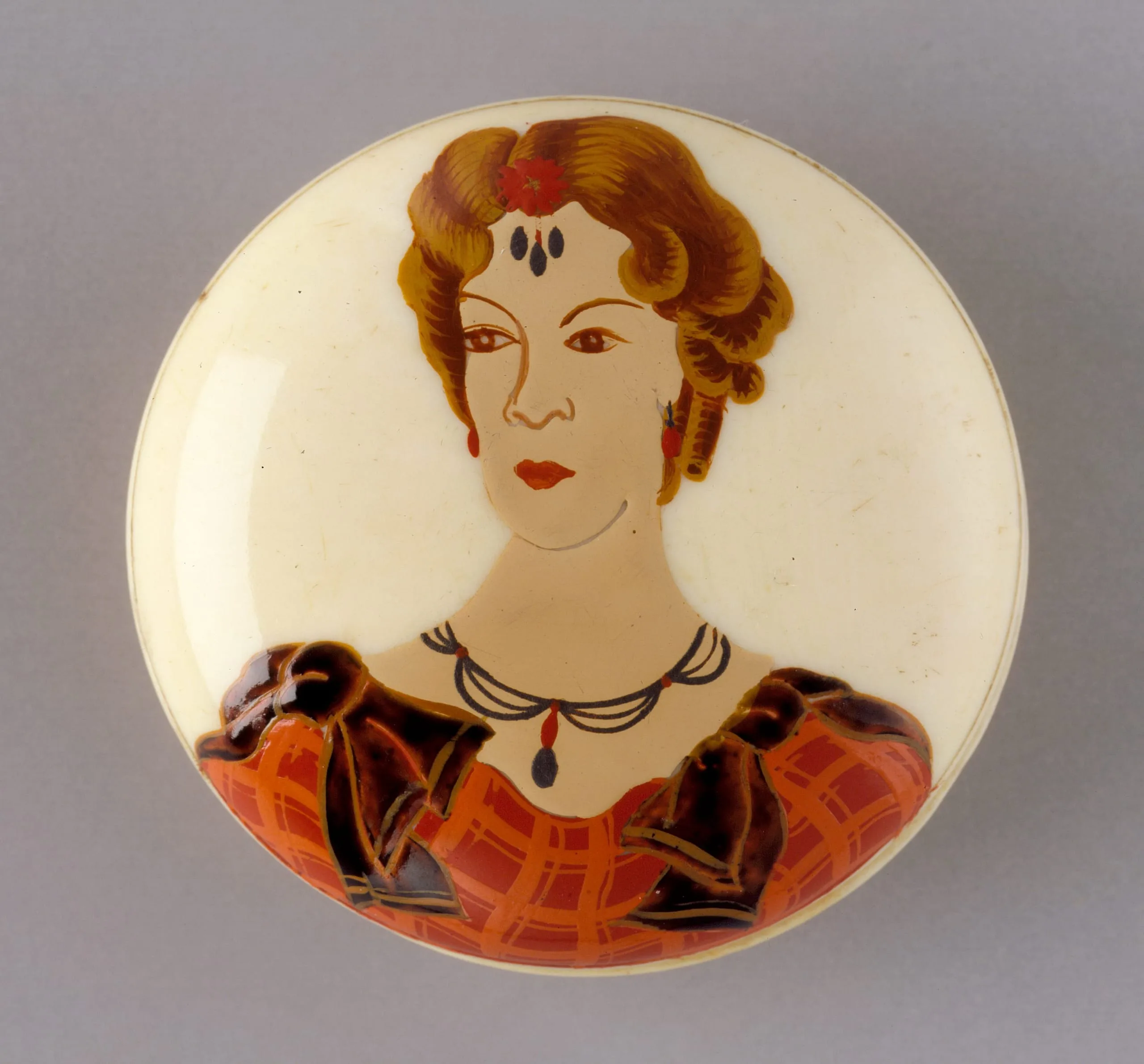
- European Lady
- Date Made
- late 19th-early 20th century
- Medium
- Ivory with colored lacquer; manjū type
- Dimensions
- 1 5/8 x 3/4 in. (4.2 x 1.8 cm)
- Accession Number
- M.87.263.33
- Curatorial Notes
For most of the Edo period (1615−1868), the Japanese shogunate restricted overseas trade, the only Westerners permitted such privileges being the Dutch. Confined to the small island of Deshima in Nagasaki harbor, Dutch traders were away from loved ones for long stretches of time (European women were banned). It was customary to have mementos of home, and officers of the Dutch East India Company stationed on Deshima likely brought with them pictures of their wives and families. Miniature portraits could be displayed in their quarters, carried in a pocket, or pinned to one’s garment. Eighteenth- and nineteenth-century European miniature portraits, often oval, were typically executed on ivory (see 51.38.4). This netsuke’s shape and depiction of a European woman suggest that it was inspired by an imported miniature. Portrayals of non-Japanese people in netsuke were executed almost exclusively in katabori (in-the-round) form, and manjū-type portraits of European women are rare. Though this netsuke is unusual in some respects, the subject’s red curly hair is very much in keeping with how the Japanese envisioned Westerners, in particular the Dutch.
2024
- Selected Bibliography
- Bushell, Raymond. Netsuke Familiar and Unfamiliar: New Principles for Collecting. New York: Weatherhill, 1975.
- Goodall, Hollis, Virginia G. Atchley, Neil K. Davey, Christine Drosse, Sebastian Izzard, Odile Madden, and Robert T. Singer. The Raymond and Frances Bushell Collection of Netsuke: A Legacy at the Los Angeles County Museum of Art. Chicago: Art Media Resources, Inc.; Los Angeles: Los Angeles County Museum of Art, 2003.
- Bushell, Raymond. Netsuke: Japanese Sculpture in Miniature from the Collection of Raymond and Frances Bushell, Part III. Los Angeles: Los Angeles County Museum of Art, 1986.