LACMA

ShopMembershipMyLACMATickets
LACMA
Los Angeles County Museum of Art
5905 Wilshire Blvd.
Los Angeles, CA 90036
info@lacma.org
(323) 857-6000
Sign up to receive emails
Subscribe
© Museum Associates 2025

Museum Hours

Monday

11 am–6 pm

Tuesday

11 am–6 pm

Wednesday

Closed

Thursday

11 am–6 pm

Friday

11 am–8 pm

Saturday

10 am–7 pm

Sunday

10 am–7 pm


  • About LACMA
  • Jobs
  • Building LACMA
  • Host An Event
  • Unframed
  • Press
  • FAQs
  • Log in to MyLACMA
  • Privacy Policy
© Museum Associates 2025
Collections

Tsukioka Yoshitoshi
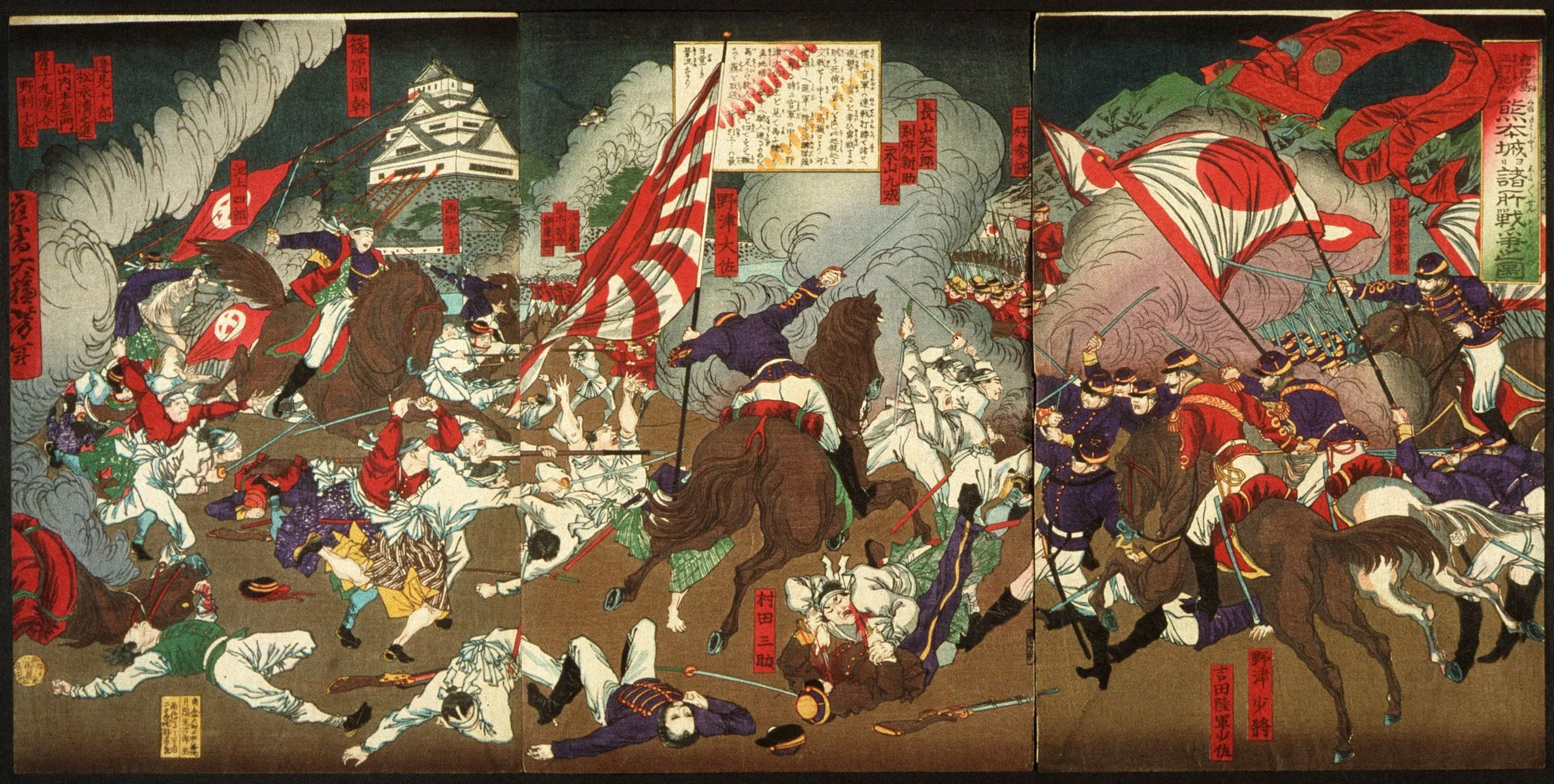
A Chronicle of the Subjugation of Kagoshima: Battle around Kumamoto Castle1877, March

Not on view
Japanese woodblock triptych print of a cavalry battle scene with soldiers in red and navy uniforms clashing on horseback, large flags, fallen figures, and a white castle visible through smoke in the upper left
Artist or Maker
Tsukioka Yoshitoshi
Title
A Chronicle of the Subjugation of Kagoshima: Battle around Kumamoto Castle
Place Made
Japan
Date Made
1877, March
Medium
Triptych; color woodblock print
Dimensions
14 x 28 in. (35.5 x 71.1 cm)
Credit Line
Herbert R. Cole Collection
Accession Number
M.84.31.321a-c
Classification
Prints
Collecting Area
Japanese Art
Curatorial Notes
With the passing of the Tokugawa shogunate and its restrictions on depicting current events, Yoshitoshi was free to illustrate the grisly realities of war. In two scenes of the Satsuma Rebellion in 1877, "Battle Around Kumamoto Castle" sets forth the final destruction of samurai rebels by the imperial army at Kumamoto, and "Headquarters at Sentoguchi, 1877" shows Saigō Takamori, the bearded leader of that doomed rebellion, with his generals at their headquarters in Satsuma. In the latter print, Kirino Toshiaki, one of Saigō's most important commanders, points forward with his sword, the ubiquitous symbol of samurai culture. The story of the Satsuma Rebellion remains a compelling tale of honor, loyalty, and revolution. Because of his dedication to tradition and the ways of the past, Saigō Takamori is nostalgically known as "the last samurai." During a battle after his defeat at Kumamoto, Saigō committed ritual suicide (seppuku) with the aid of a retainer.