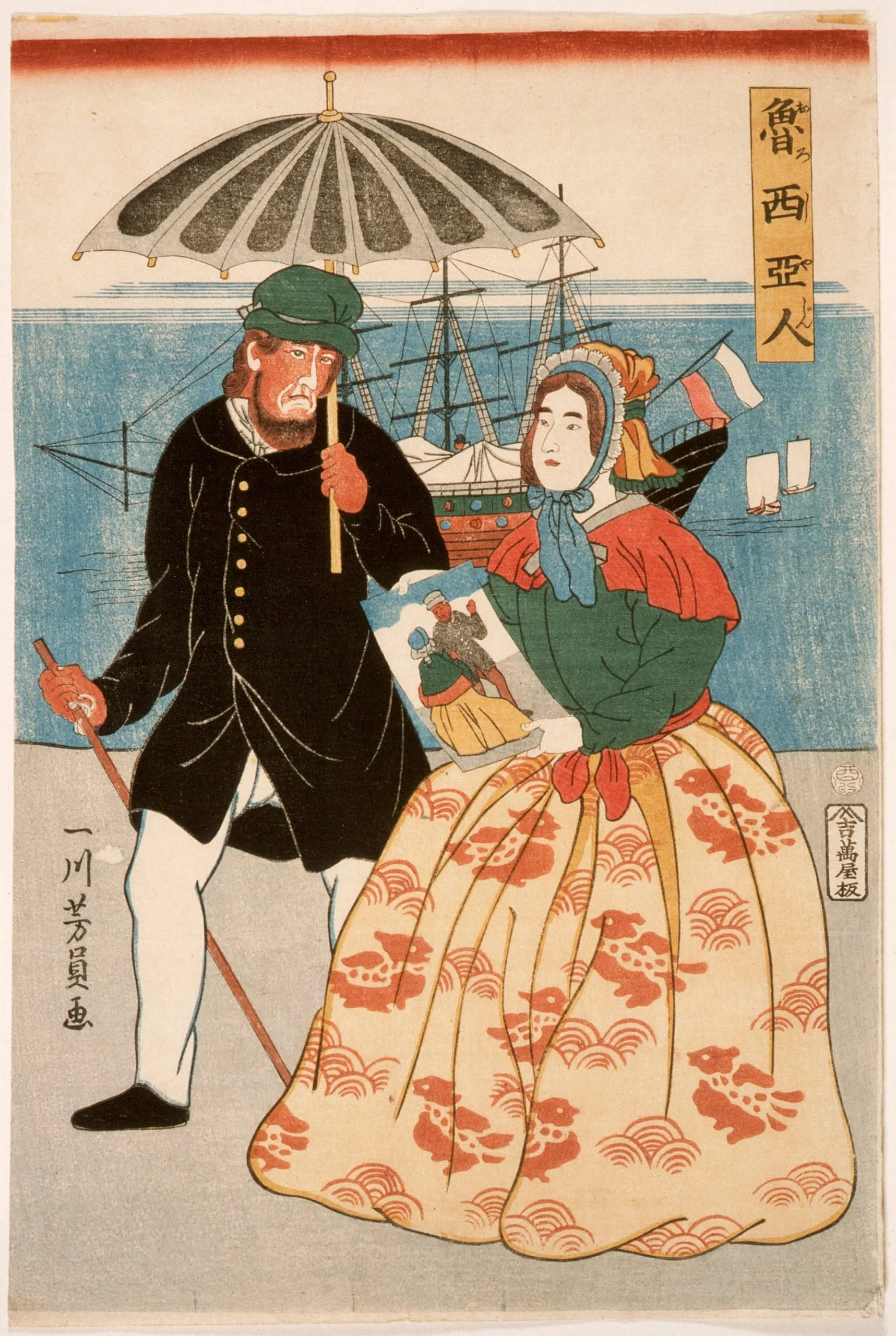
In the 1850s, after more than 200 years of self-imposed isolation, Japan signed trade agreements with the United States, Russia, England, France, and the Netherlands. By the end of the decade, foreigners were arriving in great numbers at Yokohama, the main port of entry. This influx of Westerners ushered in a short-lived vogue for woodblock prints called Yokohama-e (1859−64), pictures of foreigners and imported technologies increasingly visible in the city that served as souvenirs and didactic material. Individuals were depicted in groups, at banquets, engaged in work, with family, and as couples, as in this print. Artists typically consulted imported newspapers and magazines to verify modes of dress. Portraits of couples allowed printmakers to explore novel Western clothing features, such as this man’s coat with its many buttons, and the woman’s long, billowy dress and ribboned bonnet.
Yokohama-e typically included inscriptions that identified a foreigner’s nationality or the scene or activity depicted, as well as small cartouches labeling people, buildings, and ships. Here, the vertical cartouche at upper right identifies the couple as Russian (Oroshiajin). Behind them, a Russian flag flies from the mast of a ship in the harbor. The artist, Utagawa Yoshikazu, added a clever twist: the woman holds in her hand a souvenir Yokohama-e.
Yoshikazu spent his life in Edo, where he began his printmaking career under Utagawa Kuniyoshi. He produced print designs of legendary heroes (M.2006.136.294a-c), samurai, and historical battles (M.2006.136.296a-c), as well as bird-and-flower subjects, but is best known for his Yokohama-e.