- Title
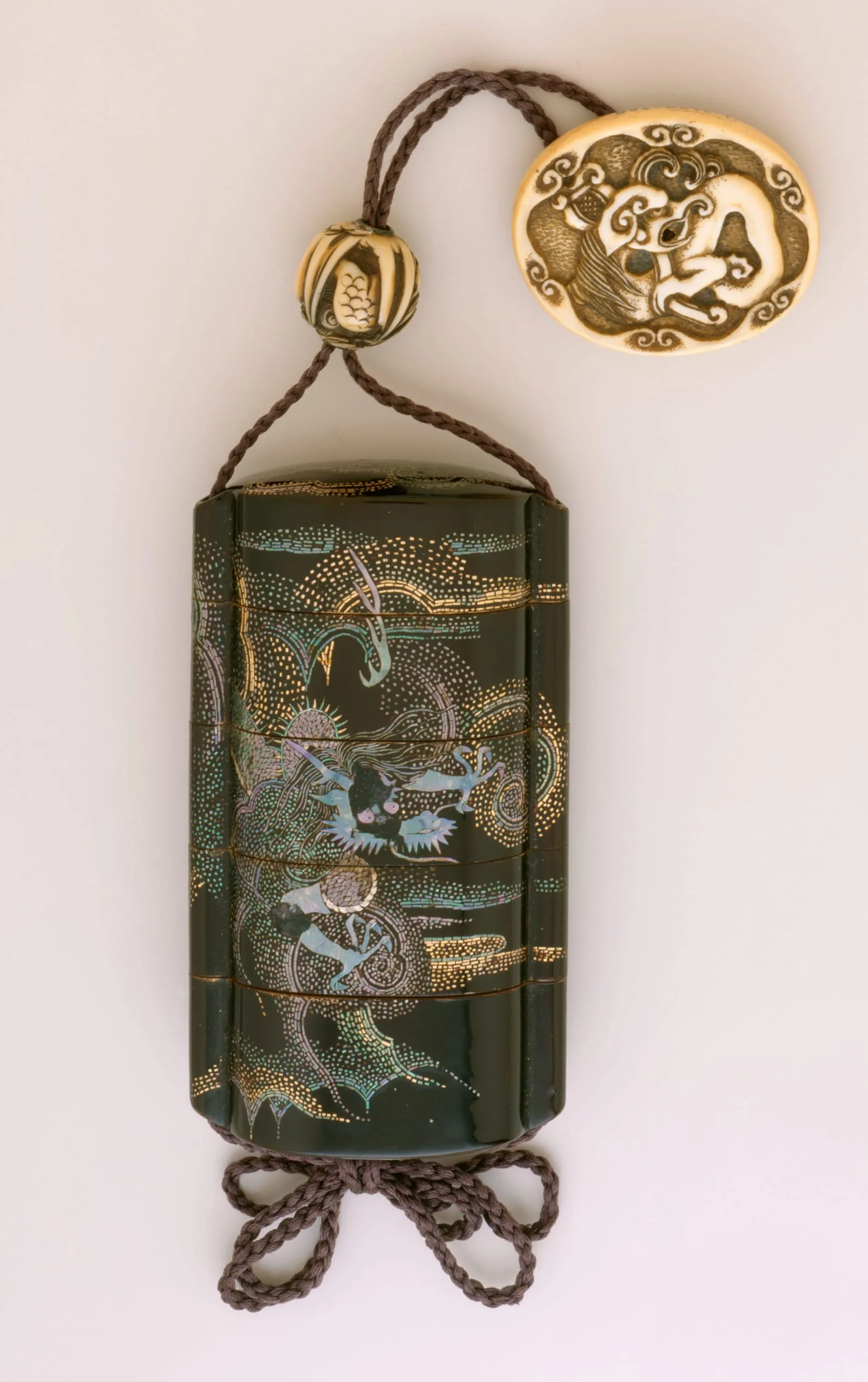
- Dragon amid Clouds (Inrō/Ojime/Netsuke Ensemble)
- Date Made
- mid-18th century
- Medium
- [inrō] lacquer with inlays of aogai (iridescent abalone shell) and gold; [ojime] ivory and metal; [netsuke] ivory
- Dimensions
- .a) inrō: 3 7/8 × 2 3/16 × 1 in. (9.9 × 5.5 × 2.6 cm)
.b) ojime: 3/4 × 11/16 × 11/16 in. (1.9 × 1.8 × 1.8 cm)
.c) netsuke: 1 1/2 × 1 13/16 × 5/16 in. (3.8 × 4.6 × 0.8 cm)
- Accession Number
- M.39.2.308a-c
- Curatorial Notes
The Ryūkyū Kingdom (1429−1879) had a long history of lacquer production, supplying works primarily for export or as gifts to Chinese and Japanese nobility and rulers. Most Ryūkyūan inrō were made for export to Japan, employing several lacquer techniques. High-quality shells were abundant in the waters surrounding the islands, where they were cut and polished for a variety of uses. The inlaying of shell designs on black lacquer became prominent in the seventeenth and eighteenth centuries. Ryūkyūan inrō makers rendered designs on a lacquer ground using a wide assortment of precut and shaped pieces of shell. Here, the clouds are composed of tiny square and variously sized rectangular pieces of gold and aogai (iridescent abalone shell). Other shaped pieces of shell make up the dragon’s body and tail, including long, narrow, pointed slivers placed along the body to create spikes. Larger pieces of shell were cut into the shape of the dragon’s legs, feet, and face. As is typical of inrō design, the image wraps around the form, with the dragon’s head on the front side and its tail and hind feet surrounded by more clouds on the reverse. The dragon motif is repeated on the ivory ojime and netsuke.
2024