- Title
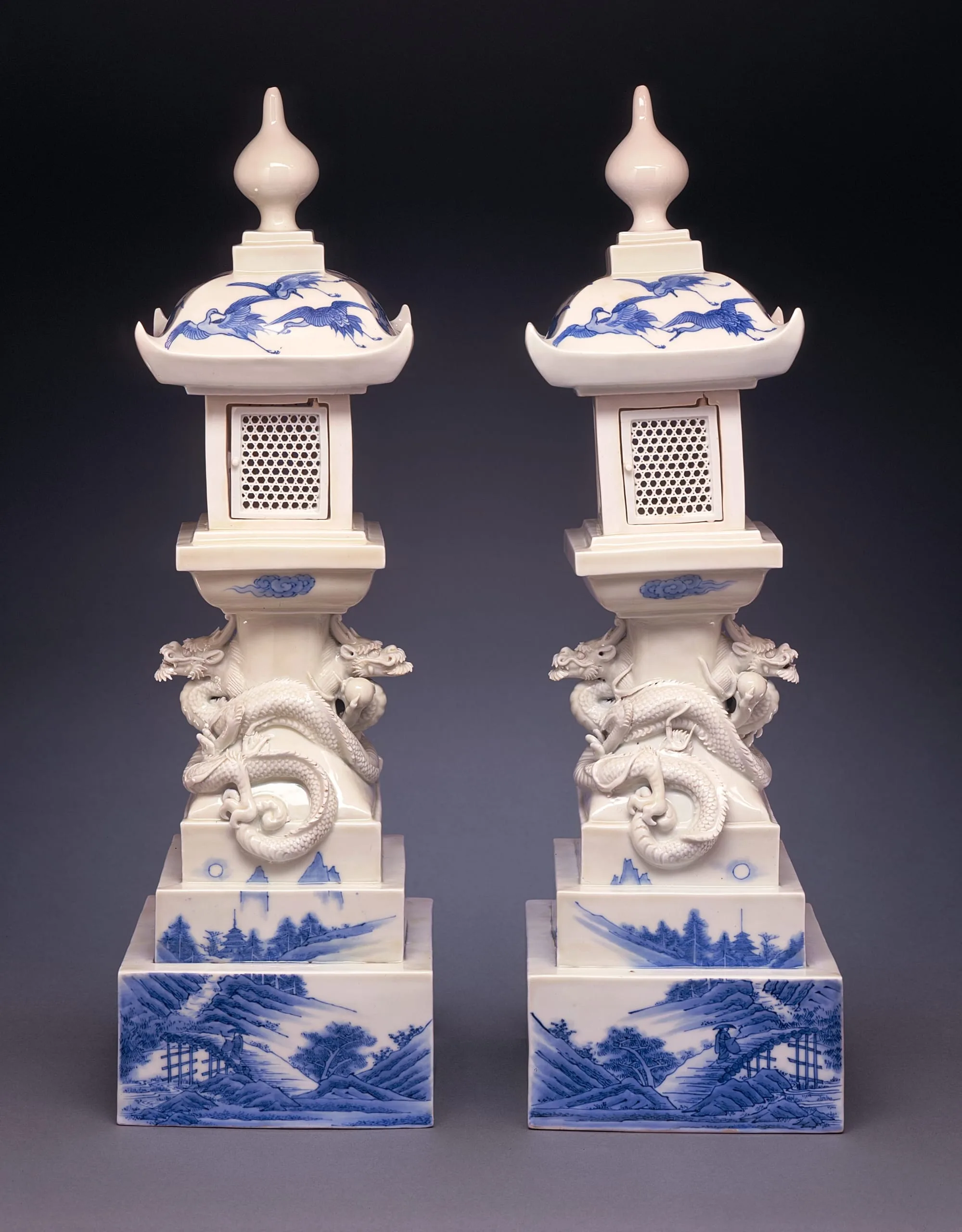
- Pair of Lanterns with Landscapes, Cranes, and Raised Dragons
- Date Made
- first half of 19th century
- Medium
- Hirado Mikawachi ware; porcelain with blue underglaze
- Dimensions
- Height: 19 3/8 in. (49.3 cm); Width: 5 7/8 in. (14.9 cm) base; Depth: 5 7/8 in. (14.9 cm) base, each
- Accession Number
- AC1998.115.32.1-.2
- Curatorial Notes
The porcelain kilns of Hirado were established in the first half of the seventeenth century and relocated to an area called Mikawachi in 1650. By the end of the century, the quality of Hirado Mikawachi wares had reached a remarkable level of achievement and were used by the local fief lord as official gifts to the shogun, emperor, and other dignitaries. The discovery of higher quality kaolin in 1712 resulted in works of even greater whiteness for which Hirado Mikawachi wares became known. The clay of Hirado was very strong and pliable, accommodating modeling and intricate carving, which enabled the execution of refined and detailed designs.
These lanterns or incense burners exhibit some of the finest aspects of Hirado Mikawachi ware. The reticulated doors and the dragons’ scales and facial features speak to the carving skill of the potters as well as the strength and workability of the clay. The landscapes painted on each of the four sides of the square bases are executed in gradations of blue.
In the nineteenth century, Hirado wares were increasingly produced for the export market. While functional objects were not made in pairs for domestic use, they found a ready market in the West. Pairs of large vases, urns, and lanterns of this type were ideally suited for display on a fireplace mantel or in a foyer, flanking the entrance to a large European home.
2025
- Selected Bibliography
- Singer, Robert; Hollis Goodall. Hirado Porcelain of Japan: From the Kurtzman Family Collection.
Los Angeles: Los Angeles County Museum of Art, 1997.