LACMA

ShopMembershipMyLACMATickets
LACMA
Los Angeles County Museum of Art
5905 Wilshire Blvd.
Los Angeles, CA 90036
info@lacma.org
(323) 857-6000
Sign up to receive emails
Subscribe
© Museum Associates 2026
  • About LACMA
  • Jobs
  • Building LACMA
  • Host An Event
  • Unframed
  • Press
  • FAQs
  • Log in to MyLACMA
  • Privacy Policy
© Museum Associates 2026
Collections

Unknown
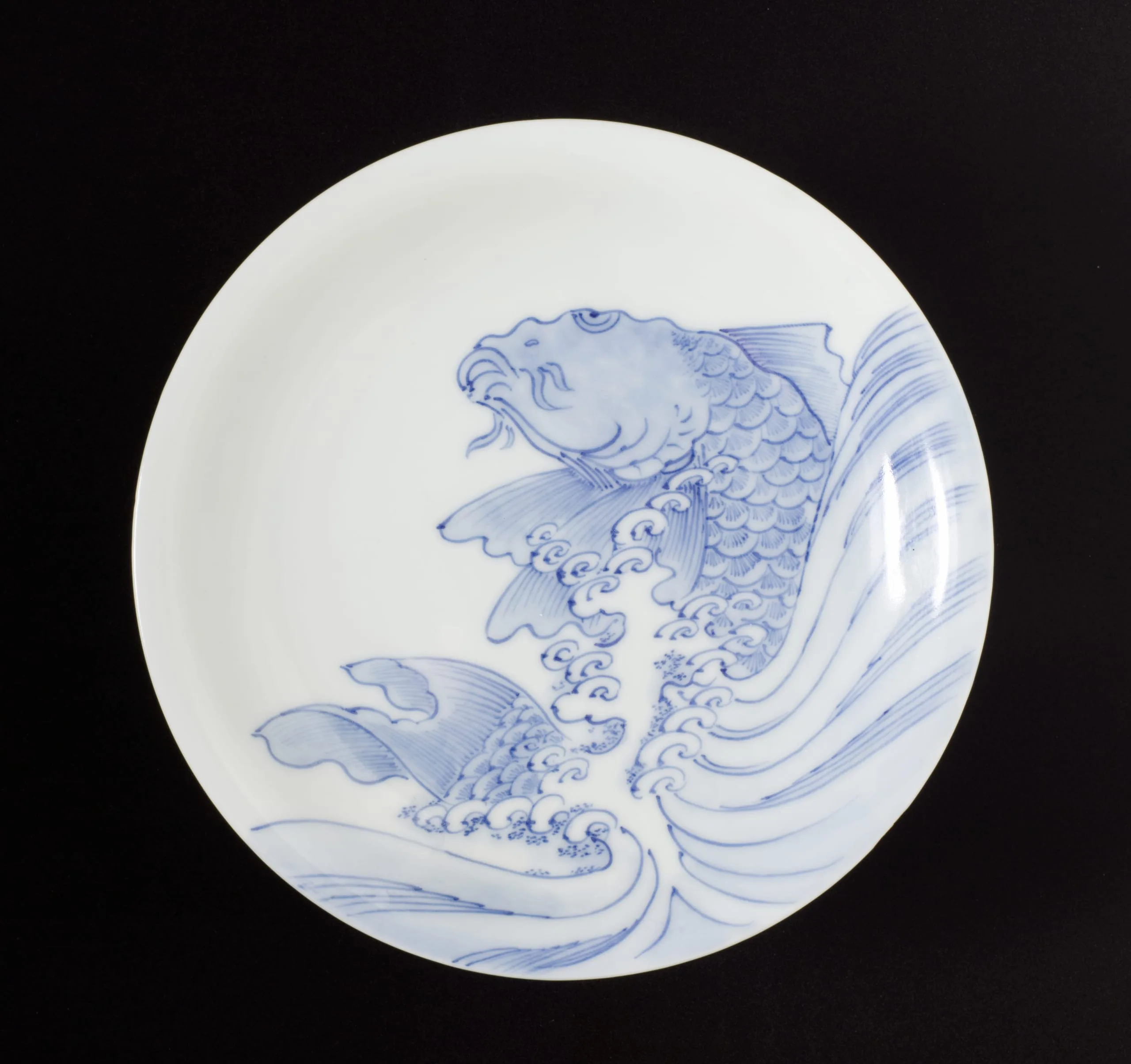
Bowl with Design of Leaping Carp Amid Wavesearly 20th century

Not on view
Blue and white ceramic plate with underglaze painting of a leaping carp with open mouth and scaled body, surrounded by stylized crashing waves

Unknown, Bowl with Design of Leaping Carp Amid Waves, early 20th century, Los Angeles County Museum of Art, Gift of Allan and Maxine Kurtzman, photo © Museum Associates/LACMA

Artist or Maker
Unknown
Title
Bowl with Design of Leaping Carp Amid Waves
Place Made
Japan
Date Made
early 20th century
Period
Meiji period (1868-1912) or Taishō period (1912-1926)
Medium
Hirado Mikawachi ware; porcelain with blue underglaze
Dimensions
1 × 6 3/8 × 6 3/8 in. (2.54 × 16.19 × 16.19 cm)
Credit Line
Gift of Allan and Maxine Kurtzman
Accession Number
AC1998.115.24
Classification
Ceramics
Collecting Area
Japanese Art
Curatorial Notes

The teachings of Confucianism, which originated in China, promoted social harmony, order, and prosperity, as well as high standards of individual morality, learning, and achievement. Introduced to Japan in roughly the sixth century, Confucian theories became very influential in Japanese government organization and policy during the Edo period (1615−1868). Adhering to Confucian ideals and emphasis on education, individuals were required to pass rigorous examinations before being chosen to serve as government officials. The great effort and accomplishment of those who secured a government position was likened to a carp successfully leaping the rapids.

According to Chinese legend, a carp transforms into a mighty dragon after climbing the rapids and overcoming the waterfalls of Dragon Gate, a narrow passage on the Yellow River. A symbol of determination and perseverance, over time the carp came to symbolize a general wish for good fortune. It has long been a popular motif in Japanese art, appearing in paintings, prints (M.80.219.62), and textiles (M.2009.33.1a-b), and adorning the surface of lacquer and ceramic (M.2008.264.43) objects such as this bowl.

2025