Ancient Egyptians valued faience so highly that they referred to it as tjehnet, meaning “brilliant or scintillating, like the light of the sun, moon, and stars.” They were amazed that such a lustrous, often colorful material could be produced from common ingredients - crushed quartz pebbles, natron, a small amount of lime, and ground copper as colorant. When fired, the quartz body developed its typical blue-green glassy surface that has sometimes paled with age.
Beginning around 3500 BCE, Egyptians shaped faience into small objects such as tubular beads, amulets depicting deities, and architectural tiles for royal tomb interiors. Figural pieces remained rare until the Middle Kingdom (2030–1640 BCE), when a brief tradition emerged: faience hippopotami were placed in private tombs, likely to ward off the mythical enemies of the deceased. The famous faience hippo known as “William,” now in the collection of the Metropolitan Museum of Art in New York, is a celebrated example from this era.
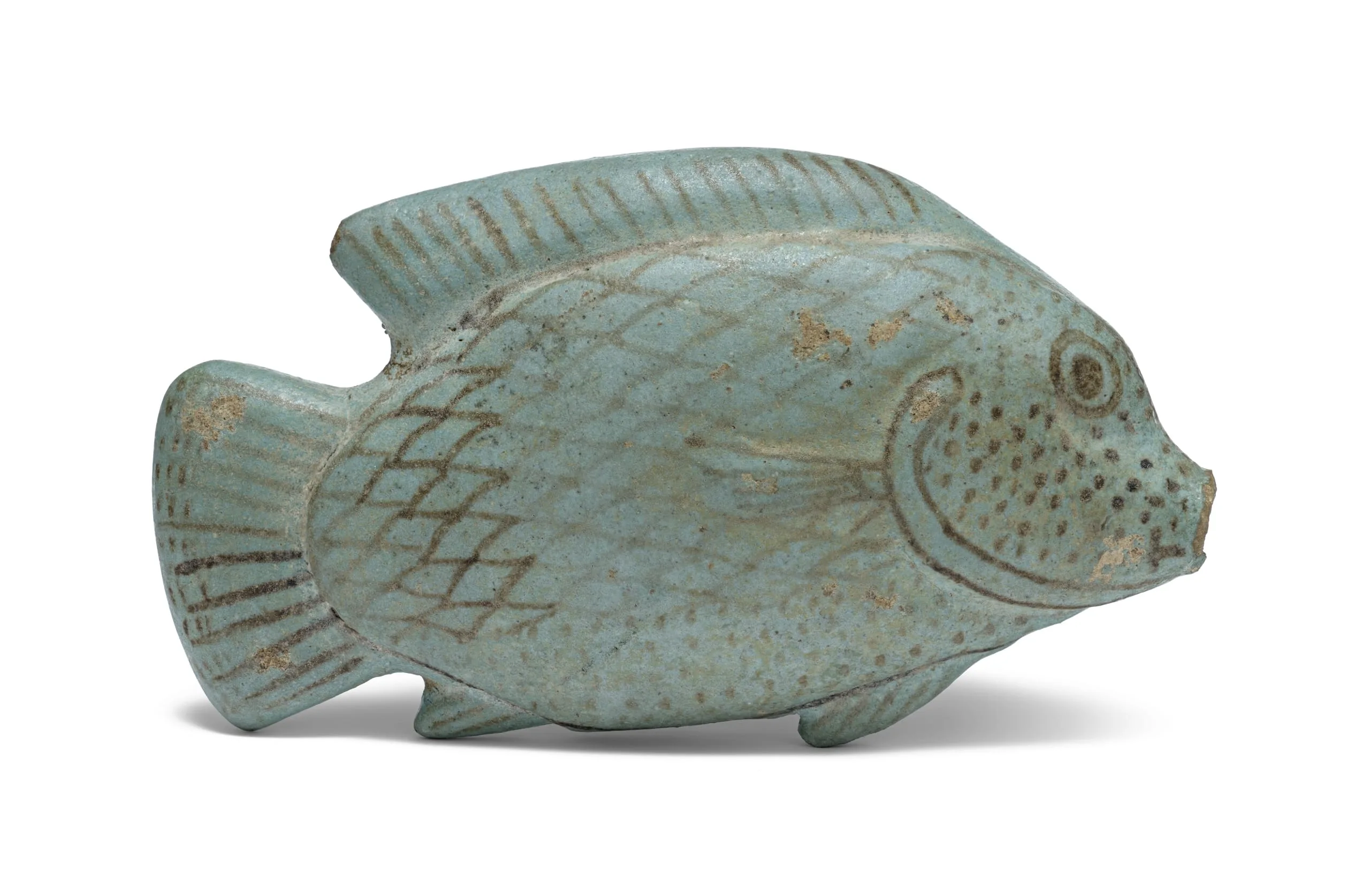
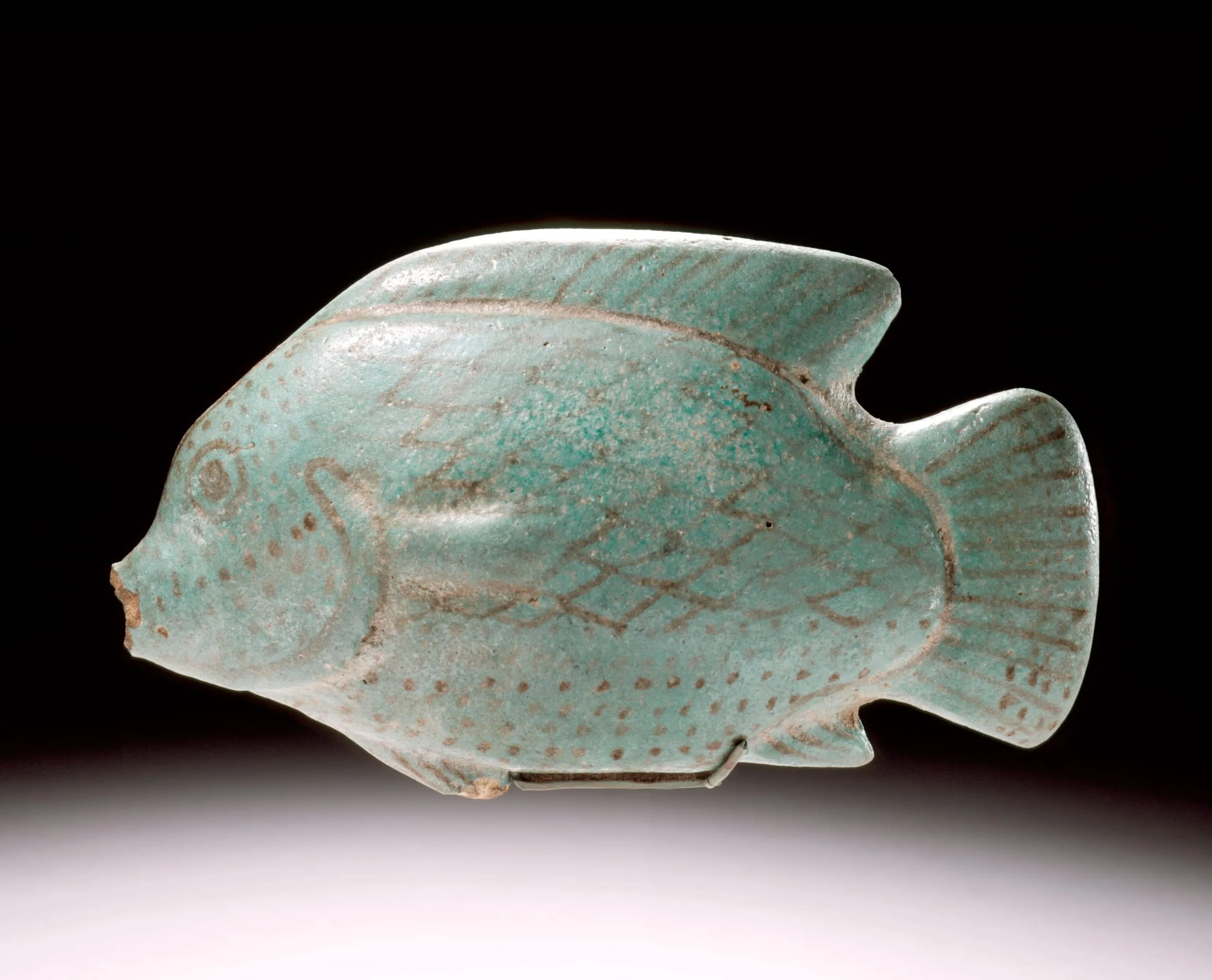
The New Kingdom, particularly the 18th Dynasty (1550-1295 BCE), was a period of foreign expansion, increasing wealth, and rapid development in the arts. Faience was used to produce new forms, elegant lotus chalices, shallow bowls with depictions of papyrus-filled pools, and cosmetic vessels in animal form (geese, monkeys, fish). This vessel depicts a Tilapia nilotica, a Nile perch, called bulti in Arabic, and an abundant food source for both ancient and modern Egyptians. Nile perch were considered a symbol of regeneration by ancient Egyptians, likely based on their trait of guarding their young within their mouths, which might have appeared to be a case of spontaneous regeneration. As such, this served as a powerful symbol of eternal life, and the image of the Nile perch was used in amuletic jewelry and as a decorative motif. This vessel may have served a dual purpose, both as a sophisticated cosmetic jar used in the New Kingdom daily life and as a meaningful emblem of rebirth, when placed into a tomb.