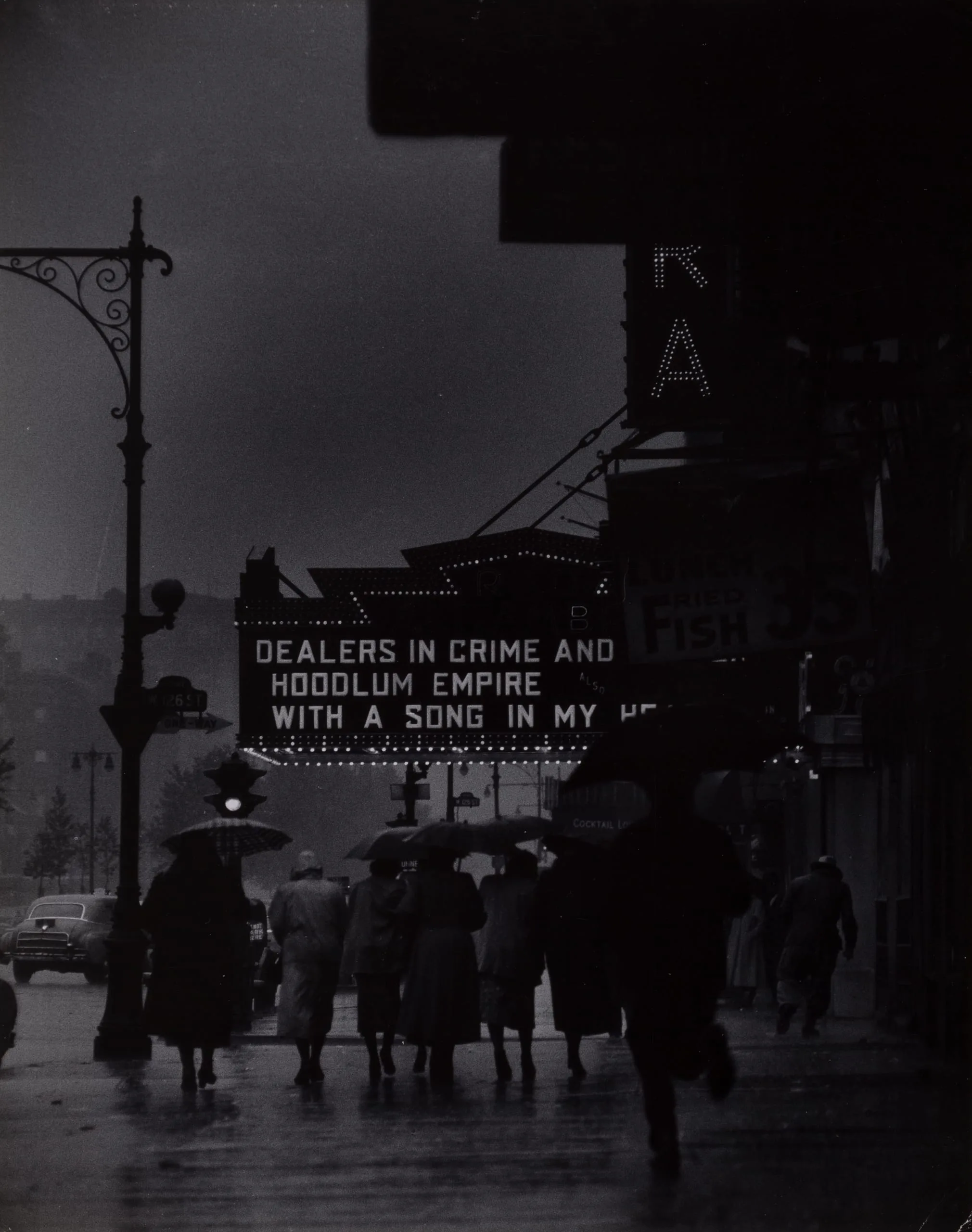
African American artist Gordon Parks made compelling still images, photo essays, and films between the early 1940s and the 1990s. While he used the camera to address poverty and discrimination in America, he was also a highly skilled portraitist, fashion photographer, filmmaker, writer, and musician. As a photographer, Parks behaved like a director—posing his sitters, staging personal items and furniture, and using mirrors to create visual adjacencies. He was also a keenly observant street photographer, capturing the world as it appeared around him. Harlem Neighborhood pictures the hustle of Harlem’s residents, at the end of a rainy day, in the shadow of the RKO Alhambra, an early twentieth-century vaudeville theater that became an important venue for jazz performers like Bessie Smith and Billie Holiday in the 1930s.
Parks’s first trip to the cultural epicenter of Black America was in 1933, when he came to New York City with his band. Made nearly twenty years later, Harlem Neighborhood was one of hundreds of photos he shot as a resident of Harlem while working on “A Man Becomes Invisible: Photographer re-creates the emotional crises of a powerful new novel” for Life magazine in 1952, in conjunction with the release of the novel Invisible Man by his friend and collaborator Ralph Ellison. Life hired Parks as a staff photographer in 1948—the first African American to hold the position—and his inaugural essay “Harlem Gang Leader” focused on one person. Harlem Neighborhood, made four years later, focuses not on one individual but on the feel of the iconic place.
Born in Fort Scott, Kansas, in 1912, the youngest of fifteen children, Parks was an artistic child who learned the piano at age six and composed music his entire life. In 1939, while working as a waiter on the Chicago−Seattle rail line, he disembarked in Chicago where he visited the Art Institute and watched a newsreel on the sinking of the USS Panay. He was so moved by these images that he bought a camera in Seattle and taught himself photography. In 1942, he received a Julius Rosenwald Fund fellowship of $1,800 to support his photographic work on Chicago’s South Side. That year, he moved to Washington, D.C., and began working for Roy Stryker and the Farm Security Administration to photograph the effects of economic policies on America. Parks concentrated on his Southwest D.C. neighborhood, where the tenements had no indoor plumbing and residents scavenged wood to cook and heat their homes, all a stone’s throw from the U.S. Capitol and the White House.
Rebecca Morse, Curator, Wallis Annenberg Photography Department
2024