- Title
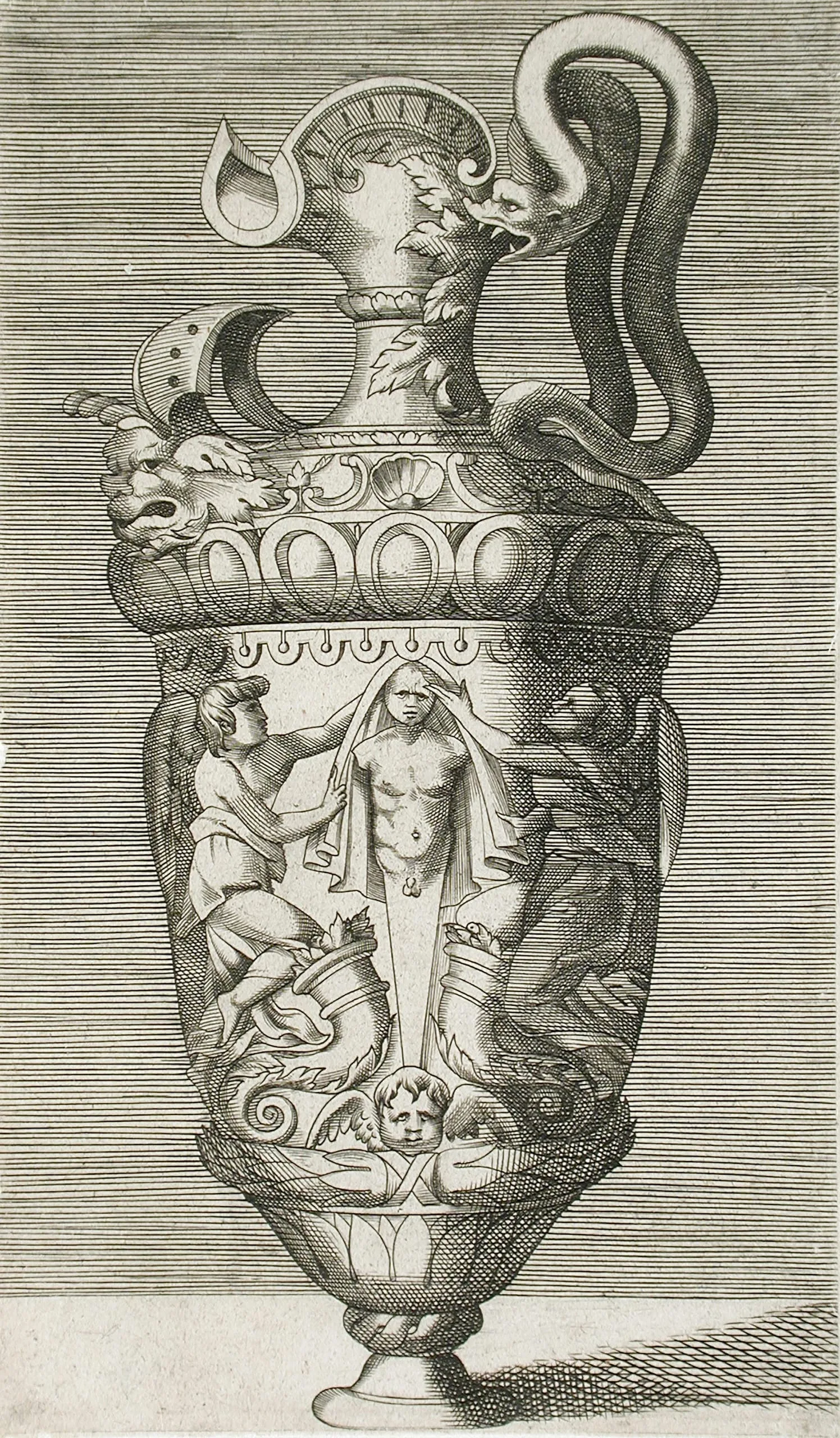
- Vase with Two Winged Figures Draping a Term
- Date Made
- circa 1540-1565
- Medium
- Engraving
- Dimensions
- Sheet: 7 5/8 × 4 1/2 in. (19.37 × 11.43 cm)
Image: 7 1/2 × 4 1/2 in. (19.05 × 11.43 cm)
- Accession Number
- AC1998.240.4
- Curatorial Notes
This ornate ewer features a double handle shaped like a snake, its open mouth affixed to the pitcher’s neck through a burst of acanthus leaves. Its body is decorated at top with an undulating pattern of shells and scrolls and a grotesque mask at the base of the spout, and at bottom with a scene of winged figures flanking a herm, a sculpture showing a male head and torso with a columnar body. In the ancient world, herms were associated with good luck and venerated through anointing or draping with a garland or cloth, as the two figures do here.
This print is part of a series of twelve imagined vases designed by Rosso Fiorentino (1494−1540) and Polidoro da Caravaggio (c. 1499−c. 1543), two artists influenced by Raphael’s interests in ancient ornament known as grotteschi, which adorned the walls of antique villas being unearthed in early sixteenth-century Rome. Polidoro trained in Raphael’s workshop and may have relied upon the master’s designs when envisioning these elaborate vessels.
Claire Spadafora Baes
2024