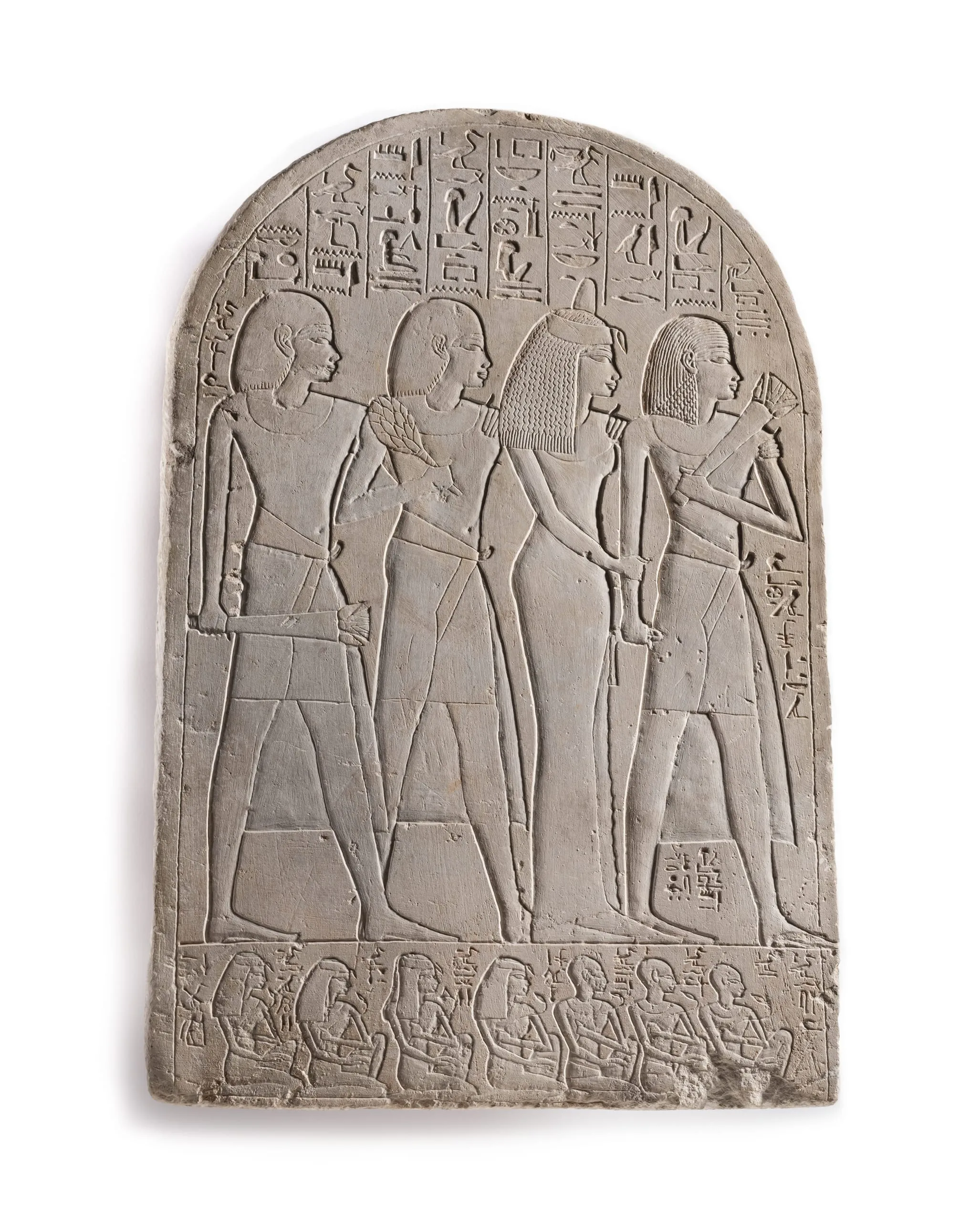
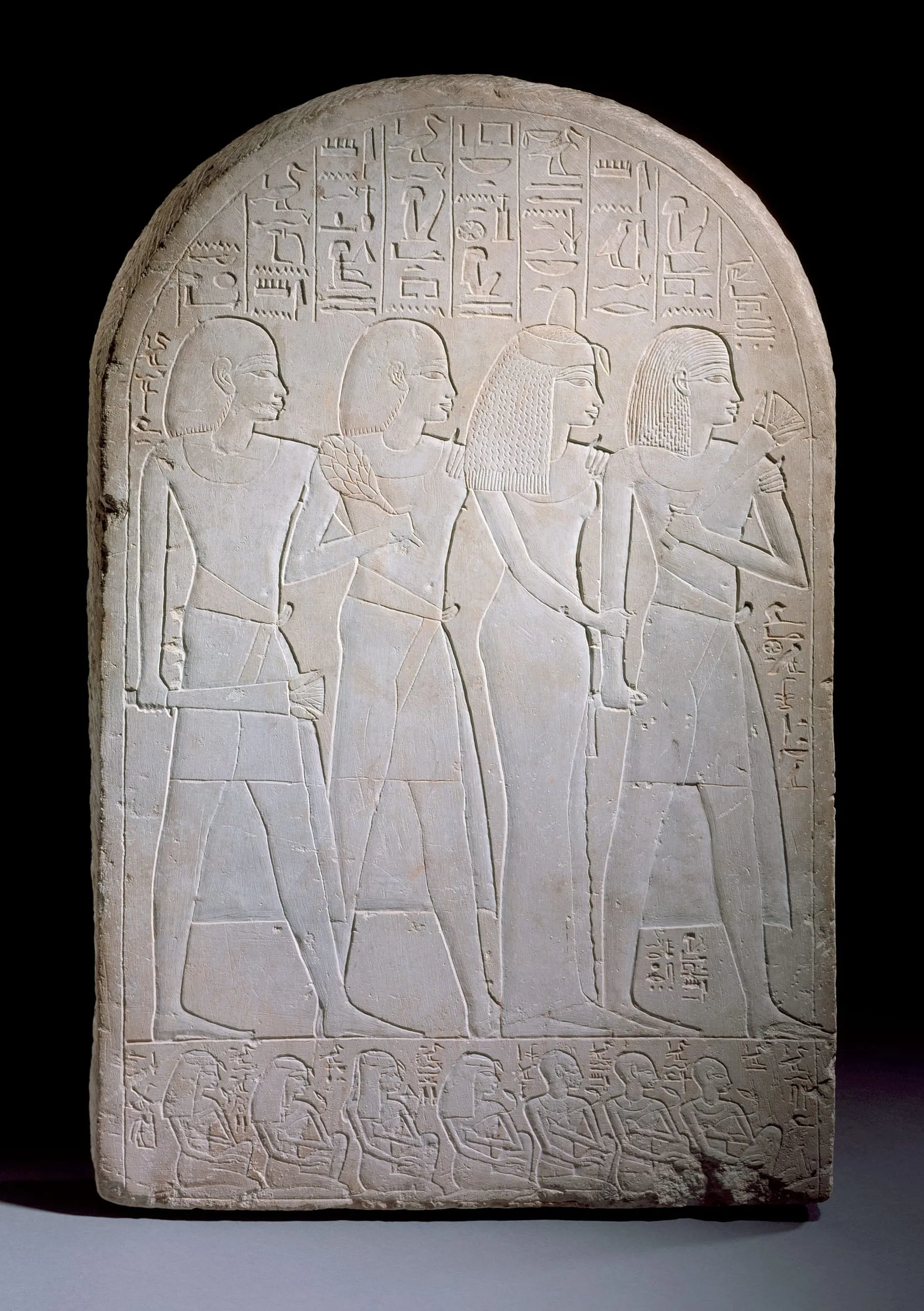
This stela, a flat stone slab with a commemorative purpose, was created for Iuef-er-bak, who is depicted on the far right and identified by the hieroglyphs above his head as “guardian of the storehouse of the Temple of Amun.” He is accompanied by his wife Nebet-iunet and two sons; the men carry floral funerary offerings. The stela was carved in sunk relief in varying levels of depth. The carving is exceptional for its attention to detail and graceful contours, especially the facial features of the main figures. The group is united by gestures of familial affection; left arms are wrapped around the shoulders of adjacent figures, and Nebet-iunet holds the right arm of her husband. Eyes and shoulders are shown frontally, heads and lower bodies in profile, which Egyptian artists believed was the best way to provide a comprehensive view of the human body. They also used scale to indicate relative degrees of importance; here, in the lower register, seven additional family members, noticeably smaller than the figures above, participate in a funerary banquet. Originally, the entire surface of the stela was painted; now only traces of pigment remain in the wigs, the hieroglyphs, and the banquet scene.
The stela was carved during the reign of Amenhotep III (1391−1352 BCE), a stable and prosperous period considered a high point of ancient Egyptian artistic production. It was likely made for the necropolis of Western Thebes, where it would have been placed in the deceased’s tomb. According to Egyptian belief, the afterlife was a physical existence that required sustenance, which the living provided through offerings. Most stelae of this type include a direct request for such offerings within the text, or depict a tomb owner and his family receiving them from a specific deity. This stela is unusual because the text and depictions are purely biographical; however, they may imply a request for perpetual offerings to be brought to the tomb by family members or funerary priests.
Provenance: Collection of Edward Roger Pratt (b. Norfolk, England 1756–d. 1838 England) acquired in Egypt 1833–4; By decent. Sold [Sotheby’s New York] to; LACMA.