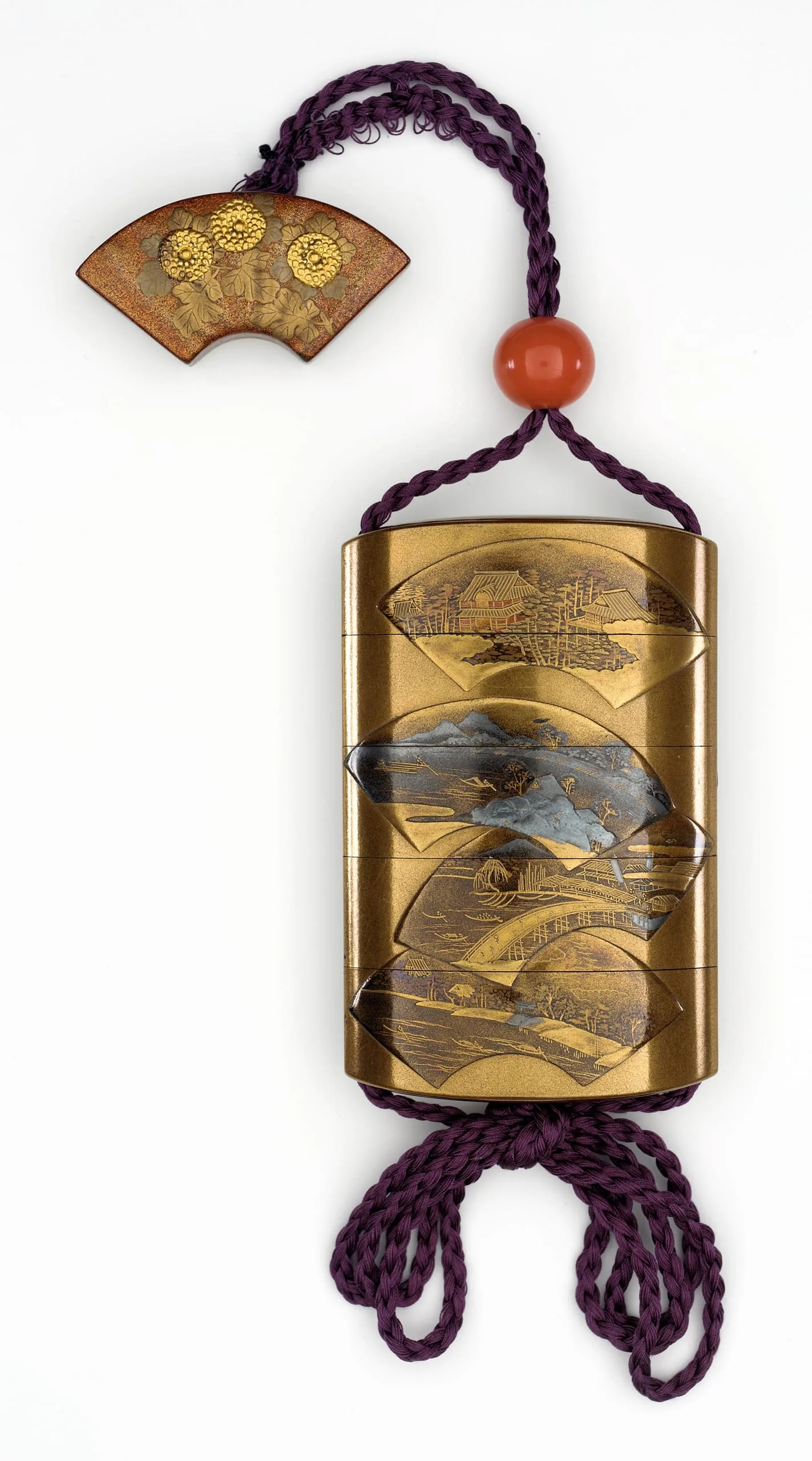
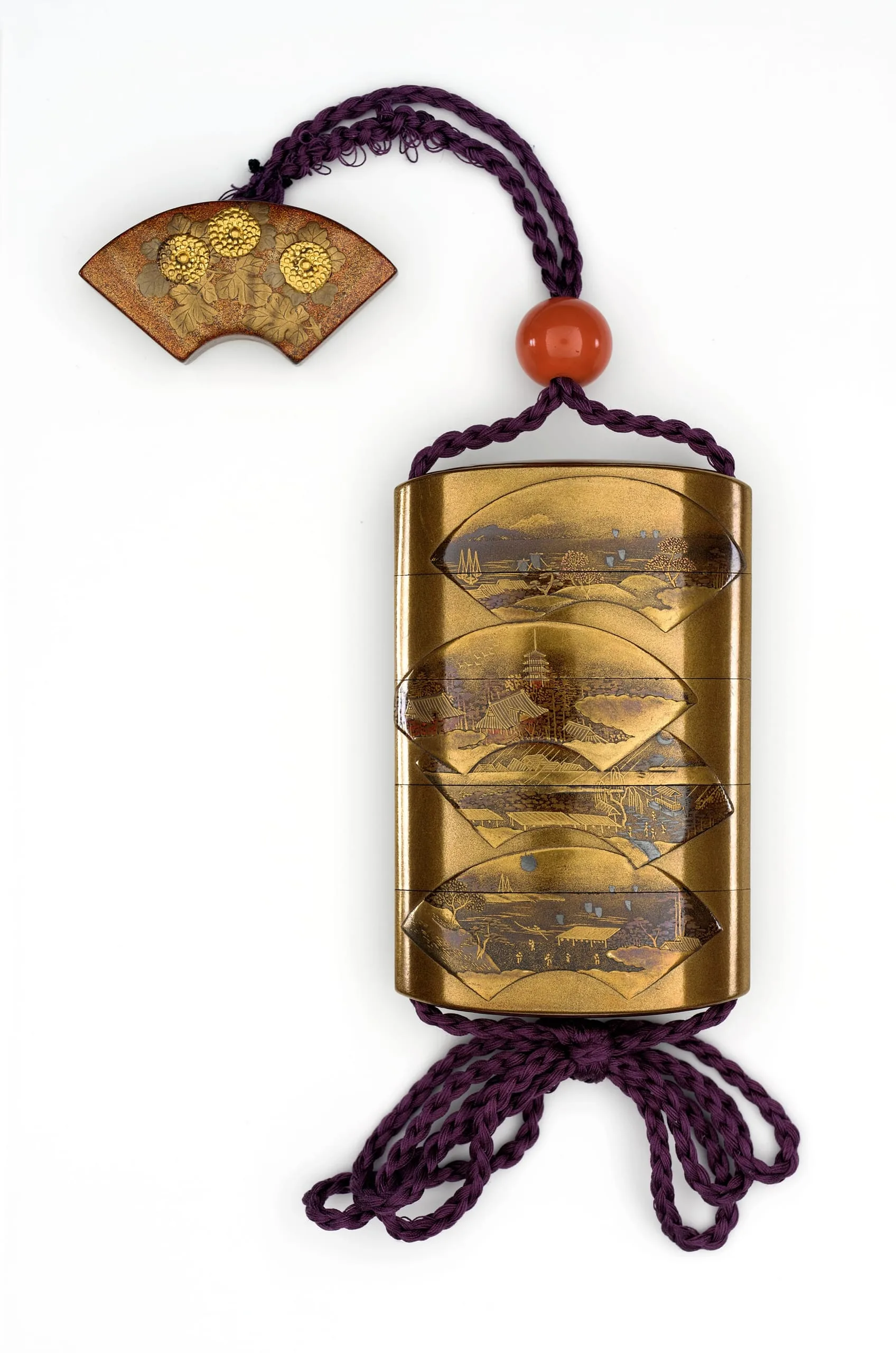
The fan-shaped cartouches on this inrō are filled with the Eight Famous Views of the Eastern Capital (Edo) (Tōto hakkei), a play on popular views of Lake Biwa. This practice of substituting or replacing a familiar design with something new is known as mitate, which can be translated as “see and compare” or “see as.” Combining unexpected visual elements created layers of meaning and added to the enjoyment of discovering a hidden metaphor. Mitate can be traced back to eighth-century literary sources, and since that time has been used in poetry, the tea ceremony, and the arts.
As with other famous view series, the locations pictured on this inrō would have been recognizable to the wearer or anyone viewing it. On the side with buildings in the top fan, the scenes from top to bottom are: early summer breeze at Ueno, dusk or evening snow at Matsuchiyama, sunset at Ryōgoku, and returning geese at Sumida. On the other side, the scenes from top to bottom are: returning ships at Godenyama, evening bell at Asakusa, night rain at Yoshiwara, and autumn moon at Takanawa. The same design is found on other inrō and may derive from a Japanese album in the collection of the National Museum of Ethnology in Leiden, the Netherlands. The album contains sixty design drawings dating from the seventeenth to the mid-nineteenth century, one of which closely resembles LACMA’s inrō.
By the Edo period (1615−1868), the theme of Eight Famous Views was one with which the Japanese were very familiar. The most celebrated of these scenes were the Eight Famous Views of Lake Biwa (Ōmi hakkei). The selection of eight views was inspired by Chinese ink paintings that had made their way to Japan, specifically those showing scenic locations around Lake Dongting in Hunan Province and known in Japan as the Eight Famous Views of the Xiao and Xiang Rivers (Shōsō hakkei). The views of Lake Biwa became a popular motif in paintings, sliding-door panels, prints, ceramics, and lacquers (see M.2003.60a-h).
2024