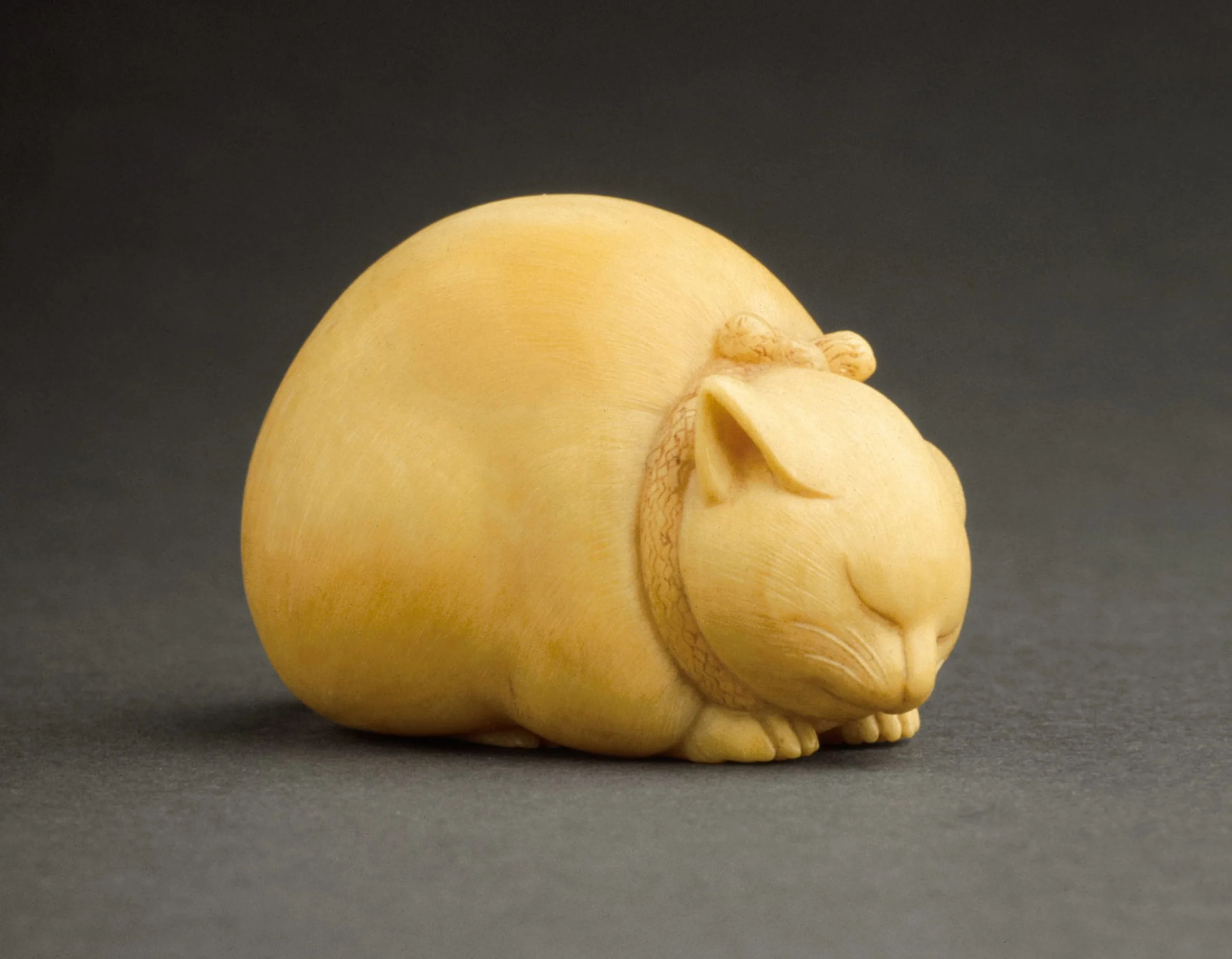
Domestic cats were first imported to Japan from China with Buddhism in the sixth century and, recognized for their expert hunting skills, were initially kept by temples to protect sacred religious texts from the ravages of rodents. Along with these new arrivals came tales of their magical powers as demons and shapeshifters; over time, however, the old stories gave way to new ones of loyal, protective, and talismanic felines. These affectionate and playful animals were soon to be found as pampered pets of the court and in Japanese homes. They likewise gained acceptance as subjects in art. The most familiar literary association is from the eleventh-century classic Tale of Genji (Genji monogatari), in which Prince Genji’s wife plays with her cat, but they appear with the greatest frequency in Japan’s pictorial arts, namely paintings and woodblock prints, typically in genre scenes tugging at the hem of a garment, chasing a length of string, or raising havoc amid the activities of humans (see M.2006.137.75).
In netsuke, cats usually appear alone, grooming themselves, devouring their latest prey, or contentedly resting, as in this figurine. Such depictions of cats exhibiting intrinsic behaviors flourished in the nineteenth century, when artists were influenced by the trend toward empirical observation. Hence, in later netsuke, we find an increasing number of more anatomically accurate cats in natural poses. Here, the skilled carver Kaigyokusai Masatsugu used the finest quality ivory known as tōkata, a dense but pliable material with a uniform white color. He rendered the cat’s whiskers and fur in very fine linework and eschewed the use of colorants in favor of the ivory’s natural color and sheen. The underside of the cat is likewise realistically rendered. Though today nearly undetectable, red pigment once colored the collar.
2024