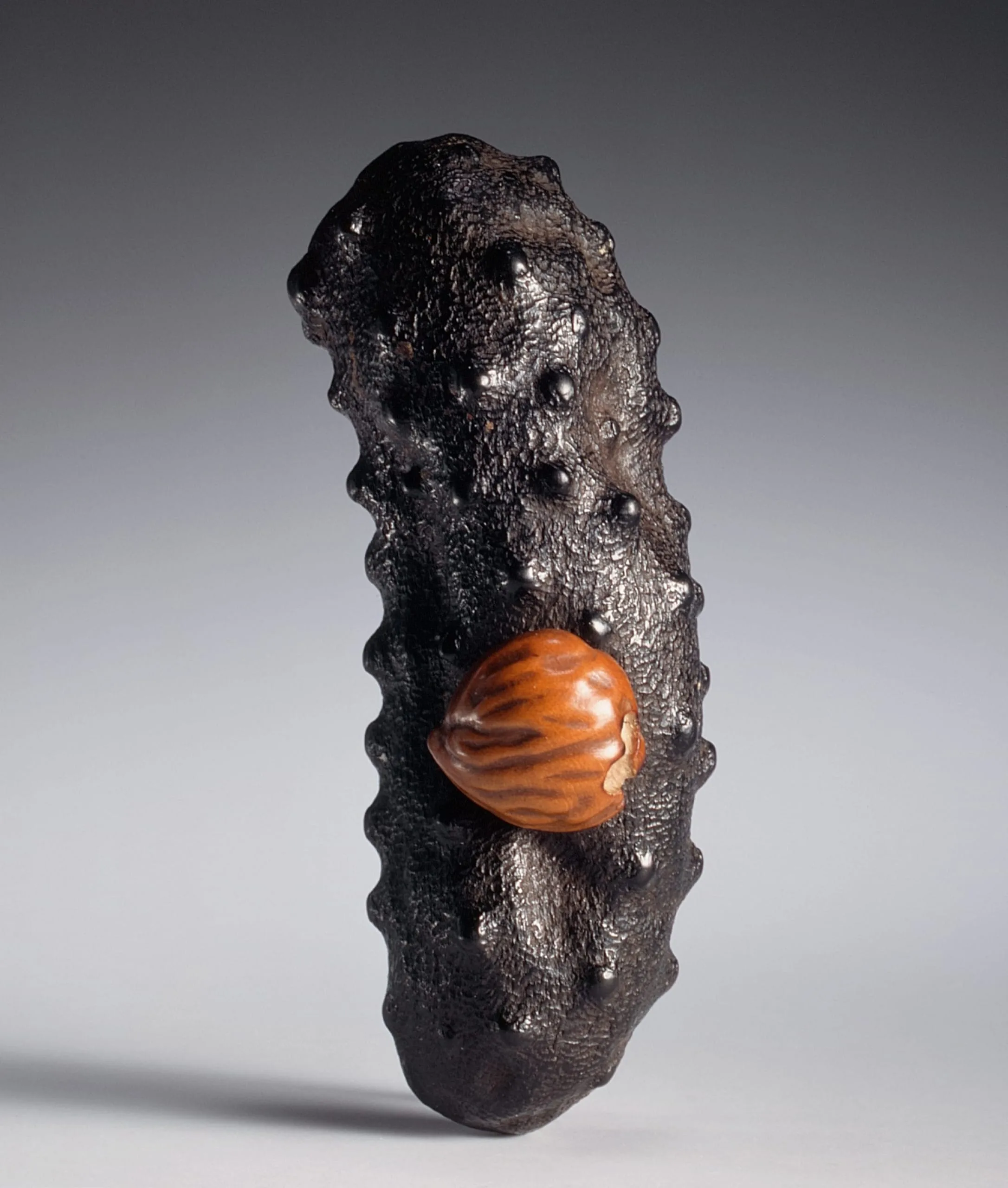
At the age of seventeen, Ōhara Mitsuhiro began a ten-year apprenticeship with an ivory merchant, during which time he kept a journal for notes on his training, creative ideas, and netsuke he had carved. He titled the notebook Takarabukuro (“treasure bag”). This netsuke is recorded as a “Roasted Sea Slug, Dried Chestnut, and Taro—for an Ojime . . . These things of the sea, mountain, and field are for celebrating the New Year. The roasted sea slug is carved in ebony, the dried chestnut in boxwood, and the taro in ivory” (the taro-shaped ojime is now lost). The tiny sculpture exemplifies Mitsuhiro’s practice: everyday subjects paired in compositions that allowed him to explore different color and carving treatments, combining different materials that best accommodated the desired color or surface effect. Ebony wood was typically used to render black or very dark subjects such as iron kettles, bats, or in this case a dried sea cucumber.
Like many artists and craftsmen of the time, Mitsuhiro was influenced by the growing emphasis on naturalism in the arts, and descriptions of many netsuke in the Takarabukuro stress the realism that he sought in his carving. For animals he might employ countless fine lines to delineate hair or fur. Stains were used to give the appearance of patina or make a carving look antique. Here, the exterior of the boxwood chestnut was stained and polished to give it a color and sheen that contrast with its coarse, lighter interior. Mitsuhiro also employed a carving technique called ishime, in which tiny depressions are cut into the material’s surface, simulating rough stone. He used it, however, to mimic a variety of surfaces, including metal, ceramic, stone, and the skin of various fruits or food, as seen on this sea cucumber.
2024